
Hidden Yields darling Aflac (AFL) just announced its raise for 2027: another 5%, for the second year in a row. And riddle me this—the company’s dividend bill dropped year over year.
Through the third quarter of this year, the insurer paid shareholders $929 million in dividends. Over the same nine months a year ago, it paid $939 million. The insurer’s payout bill dropped $10 million, but its dividend-per-share is higher. How? Because of the buybacks, Aflac owes dividends to 6% fewer shares.
It’s an important shareholder-return nuance! Most investors don’t appreciate it, but this buyback-dividend hike combo has helped power the 18% annualized returns we’ve enjoyed from a 5%-per-year dividend raiser since we added Aflac to our HY portfolio in August 2025.
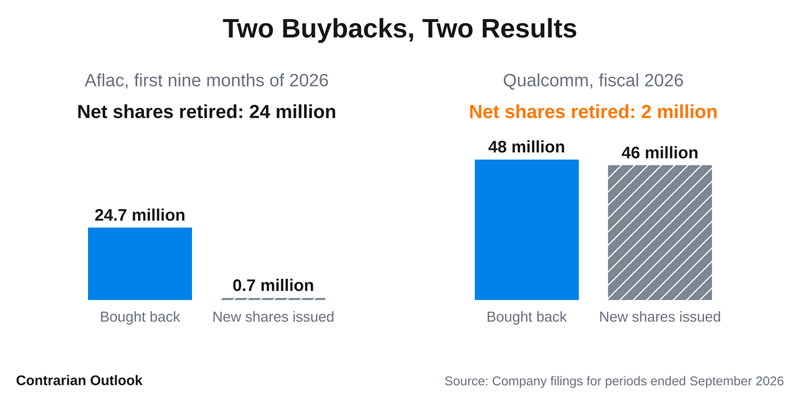
Management repurchased 24.7 million shares over the last nine months. Remember, in a buyback, a company spends its own cash to purchase its own shares and then “retire” them.
Most dividend growth investors see only the raise. We careful contrarians consider the hike plus the share count. When a company boosts its dividend, it in effect receives a bill from shareholders for more money. But when it buys back shares, it reduces that bill. Say a company has 100 shares outstanding and pays a $1/share annual dividend. That’s $100 a year. The company buys back 10 shares, leaving 90. Its dividend “bill” is only $90 a year. The buyback frees up $10 in cash each year.
Let’s look at Aflac over a 10-year period. In 2015, the company paid $682 million in dividends. By 2025, it paid $1.24 billion, so its total dividend bill grew 82%.
But how about the dividend per share that we received as shareholders? It nearly tripled, from 79 cents per share (adjusted for a 2018 stock split) to $2.32, a whopping 194%!
Aflac’s secret sauce is its declining share count, off 38% from 866 million to 535 million over the same period. Without these buybacks, the same dividend bill would have lifted Aflac’s payout only about 82% per share. But by spreading the payouts across fewer shares, Aflac grew its dividend a phenomenal 194% per share.
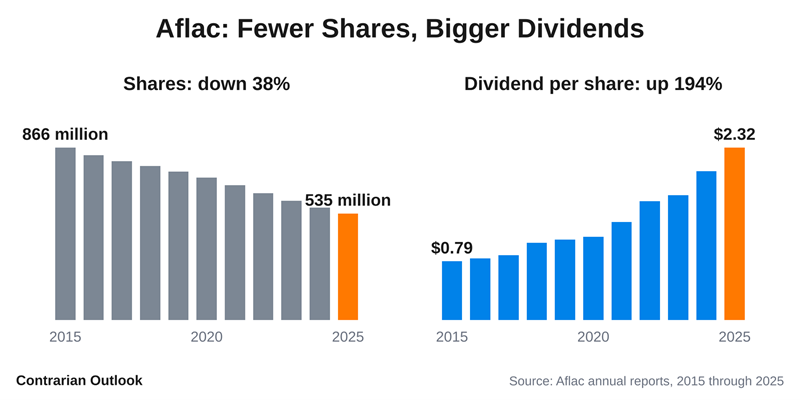
You can think of it this way: Management has a budget that it sets every year for dividend costs. It then divides that budget on a per-share basis, so the share count is the number of shareholder mouths to feed.
Here’s why we care about dividend-per-share growth. Over time, a stock’s price follows its payout per share. This is the Dividend Magnet, and it’s the reason why Aflac’s stock rose 268% from 2015 to 2025. We covet companies that raise their dividend and buy back shares, right?
We also need to be careful. Let’s consider the curious case of Qualcomm (QCOM), which, on paper, sounds similar to Aflac. In March, the company raised its dividend by 3.4% and announced a new $20 billion buyback. In its fiscal year that just ended, Qualcomm spent $7.8 billion on share repurchases, double what it paid out in dividends. So far, so good, right?
Qualcomm started the year with 1,074 million shares and finished the year with 1,072 million. Wait, what? It bought back 48 million shares, but its share count fell by just 2 million. Where did the other 46 million go? Qualcomm issued 46 million new shares during the year: 29 million to pay for new acquisitions and most of the rest to employees as compensation.
Qualcomm appeared to give to shareholders with one hand, but the company took it back with the other! (In fairness, Qualcomm’s buybacks the year before did shrink its share count by 3.5%.)
What does this mean? When we see a buyback, we need to run two checks:
- We count the shares outstanding, not the dollar amount. Every annual report (Form 10-K) shows the share count at the end of this year and the previous year. If the count didn’t fall, the buyback didn’t raise our ownership stake. Then we ask, where did these shares go?
- We need to check the price that management paid for these shares. A buyback at a high price burns our money. We want companies that buy back shares when they are cheap, just as we value-based investors strive to do.
One caveat: The total of dividends plus buybacks should fit inside the free cash flow that the company generates over a stretch of years. (For an insurer like Aflac, we look at capital strength instead.)
The duo of a dividend hike and share buybacks can work well, but let’s make sure we apply these two checks first.
My Dividend Magnet Plan and the Five Stocks I Like Right Now
Aflac is a great example of the type of research I do in Hidden Yields, pairing rising dividends with meaningful buybacks that shrink the share count, freeing up more cash for divvie hikes ahead! The result has been 23% total returns from Aflac since we bought it in August 2025, an outstanding 18% annualized.
If you’re interested in my Dividend Magnet plus buyback approach, I’ve laid it out for you in a new special report, along with five top drawer dividend growers. Today, click here for my latest research, and I’ll send you the names of these fab five stocks right away.