
One of my favorite closed-end funds (CEFs) has put up a superb total return so far this year. Heck, it’s even outrun the S&P 500!
That’s pretty unusual—especially for a fund kicking out an 8.9% yield.
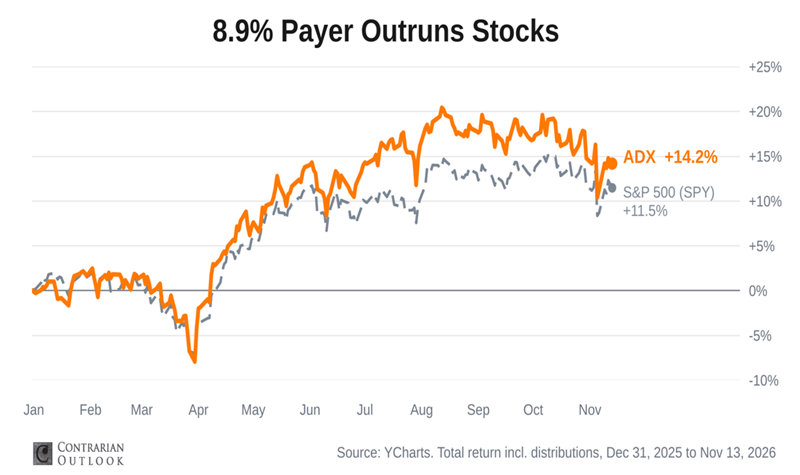
The Adams Diversified Equity Fund (ADX) is interesting for reasons beyond this chart because it’s one of the oldest CEFs on the market. It launched in 1929, but traces its history back to the 19th century.
It’s survived (many!) wars, as well as the Great Depression, the 2008/2009 financial crisis, COVID-19 and the 2022 crash, all while giving investors strong total returns.
Over the last decade, ADX has returned 18% annualized on a market-price basis. That’s well ahead of the S&P 500 and far ahead of the fund’s 8.9% dividend yield. This suggests ADX should have no problem maintaining its dividend. It also puts the prospect of payout hikes on the table.
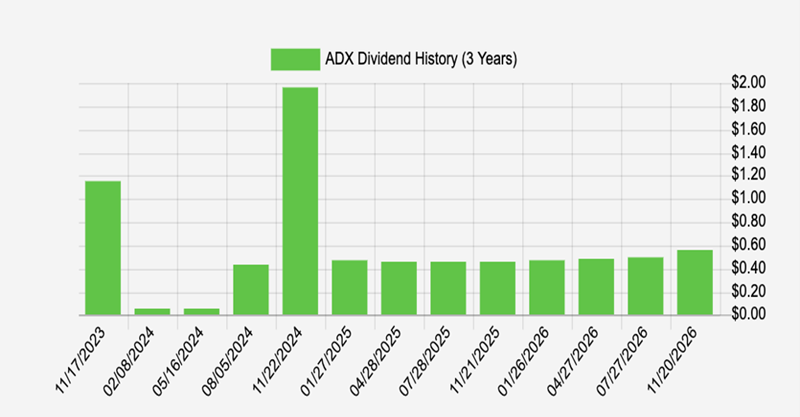
Source: Income Calendar
As you can see above, the dividend has been climbing recently. Further increases wouldn’t be surprising, since ADX has been slowly raising its payout since it flipped to a “managed-distribution” policy in May 2024.
Under the new plan, management committed to give at least 8% of the fund’s average net asset value (NAV, or the value of its underlying portfolio) out as quarterly dividends.
That made ADX’s income stream more reliable, which has been a gift to us CEF Insider members, who hold ADX for high income and strong total returns. It’s delivered: Since we added the fund to our portfolio back in 2017, it’s returned around 328% for us.
That track record is, of course, based on the fund’s holdings, which are top-quality blue chips. Its biggest positions include NVIDIA (NVDA), Apple (AAPL), Microsoft (MSFT), and Alphabet (GOOGL) among its top positions.
Of course, NVIDIA is getting hit hard lately due to Jensen Huang’s ousting after his affair, but as long-term investors, we look past that noise—and like that ADX is an opportunity to buy it when the noise makes it far oversold.
And ADX isn’t just a tech fund: It also holds the likes of JPMorgan Chase & Co. (JPM), Eli Lilly & Co. (LLY) and McDonald’s (MCD).
Before ADX made its policy change, the fund paid an almost negligible regular payout and held most of its portfolio gains until a big end-of-year payment. But now, ADX is taking advantage of its big gains to raise its dividend.
Investors are noticing.
Before management changed the dividend policy, ADX’s discount to NAV was rangebound between 12% and 14%. But then the discount slowly began to shrink as investors came to see this big yield as sustainable, and potentially rising.
Even so, it took a long time to bid up ADX’s market price close to its NAV—well after the dividend policy was changed in 2024.
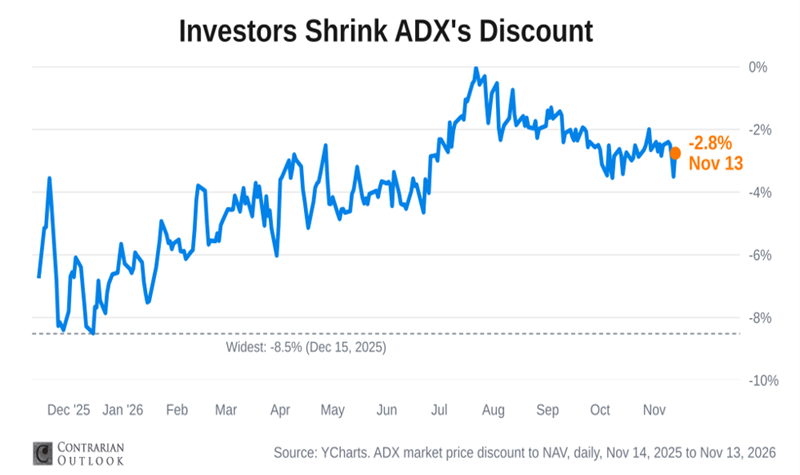
Although ADX’s bigger payouts should have been a signal that demand for this fund would likely keep rising, investors didn’t really price in this fact until earlier this year.
This isn’t surprising. While stock investors react quickly to every bit of news, CEF investors are more hesitant, pricing in changes much more slowly.
This can be an opportunity: Invest in a fund like ADX when its discount gets wide, sell when it shrinks, and take profits. Do this with a fund with a strong fundamental change, like ADX went through with its payout, and the opportunity grows more attractive.
Of course, some might say it’s too late to do this with ADX, and that’s fair. This doesn’t mean we should sell, however, especially as the fund still trades at a discount and has a strong portfolio and an excellent management team.
But it does mean we’re more likely to see ADX’s total return grow more slowly for a spell. If we want to profit from a steep discount, we need to look elsewhere. And there are a lot of places to look.
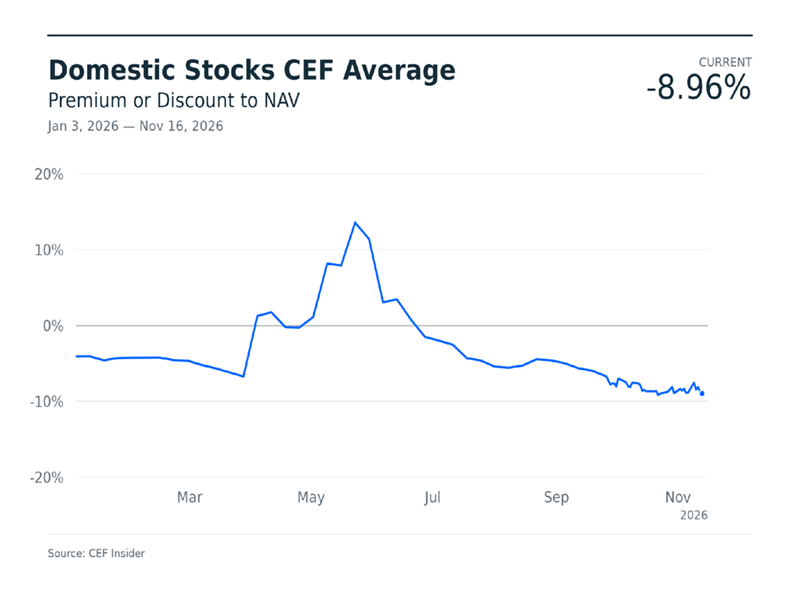
One thing we do at CEF Insider is track discounts across CEFs. Patterns emerge over time precisely because CEF investors are so slow to react.
This year, we’ve seen discounts widen over the last few months, following a brief spike where they flipped to a premium. That premium was, however, less pronounced than it looks in the chart above. That’s because it was mostly driven by one fund, the Fundrise Innovation Fund (VCX), which at one point traded at a premium of over 1,900% (!)
Without VCX, the average domestic-stock CEF averaged a 5.5% discount back in May. So even when we exclude extremes like the one caused by VCX, we see that domestic-stock CEFs have seen widening discounts since the summer, to around 9% now.
That has been happening largely due to a flat market: Stocks have been largely moving sideways over the last few months, and CEF investors have gotten antsy, with more looking to move assets away from equities and into other areas, like corporate bonds.
The recent volatility has accelerated that discounting, making for more oversold funds for us to scoop up.
ADX Rode Big Tech. These 4 Funds Ride AI’s Next Wave (for 10% Dividends)
ADX shows how patience can pay off in CEFs: We often get a “lag” to buy before slowpoke CEF investors catch on to a fund’s strengths.
But with ADX’s discount now under 3%, the bargains have moved elsewhere (for now!).
I’m finding some of the most compelling ones in what I call AI’s four “pivot points”: the drugmakers, factories, power producers and lenders putting AI to work far beyond Silicon Valley.
I’ve zeroed in on a CEF to tap each one. Together, these 4 funds yield 10% on average. On a hypothetical $500,000 portfolio, that works out to about $4,167 a month in dividend income.