
We love CEFs for a simple reason: Their big dividends are the best route to financial independence.
I say that from experience: Years ago, CEFs’ high income streams allowed me to leave a full-time job I disliked, travel, and live wherever I wished to. Later on, I launched my CEF Insider service to help other investors unlock these funds’ vast income potential.
Today we’re going to look at a high-quality (and high-yielding) equity-focused CEF to see how it delivers its outsized income stream (a 10.5% yield as I write this). Then we’re going to stack it up against another CEF you might think is a strong buy, but unfortunately this fund’s size and celebrity manager mask some significant flaws.
CEFs “Translate” Portfolio Gains Into High Dividends
The way CEFs deliver their strong income streams is straightforward and unique at the same time: These funds invest in a particular asset class—be it stocks, bonds, real estate investment trusts (REITs) or other holdings—and aim to return as much of their returns as possible to shareholders in the form of dividends.
Some CEFs also employ leverage to amplify those gains, while others use option strategies.
As a result of these moves, the average CEF yields 8.7% as I write this, while our CEF Insider portfolio yields slightly more: 9.1%. With yields like those, an investor needs to save a lot less to generate, say, $100,000 in yearly income than they would if they invested in a typical S&P 500 index fund (current yield around 1%):
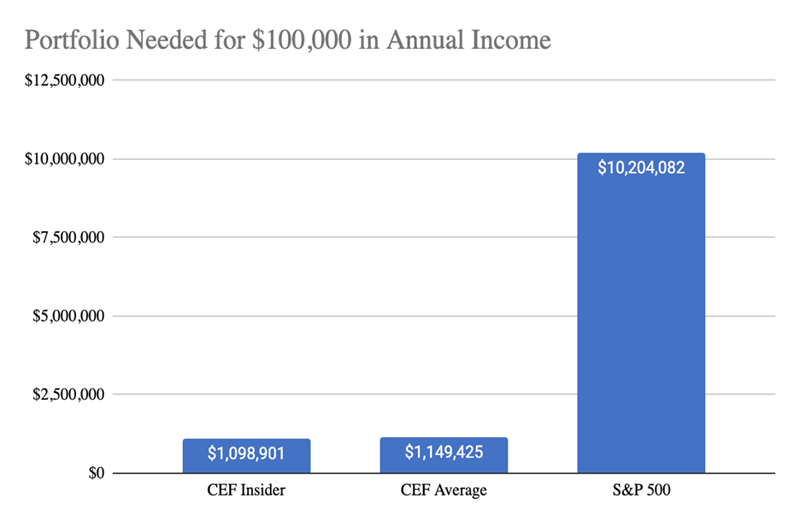
Source: CEF Insider
Bear in mind, too, that the market’s 1% yield has been falling as stocks have gained, since yields and prices move in opposite directions. So you’d think a CEF that invests in well-known S&P 500 stocks and “translates” their gains into dividends would be worth a lot to an investor looking for passive income with a reasonable level of risk.
You’d be right. Which brings me to the first fund we’ll discuss today.
USA: A 10%-Paying CEF That Does Everything Right
The Liberty All-Star Equity Fund (USA) pays that 10.4% yield I mentioned earlier. It’s also returned 11.7% annualized over the last decade. Note that this return is based on the fund’s market price, not its per-share NAV, or the value of its underlying portfolio (an important distinction for CEFs, as we’ll see in a moment).
In other words, USA is basically handing out its return based on market price in the form of dividends. That’s a sweet setup for an income-focused investor who wants to own S&P 500 stocks and doesn’t want to worry about timing their sales to get the cash they need.
Consider, too, that USA’s dividend payouts (in orange below) are up 25% in that time.
High, and Growing, Dividends From This “Gain Translator”
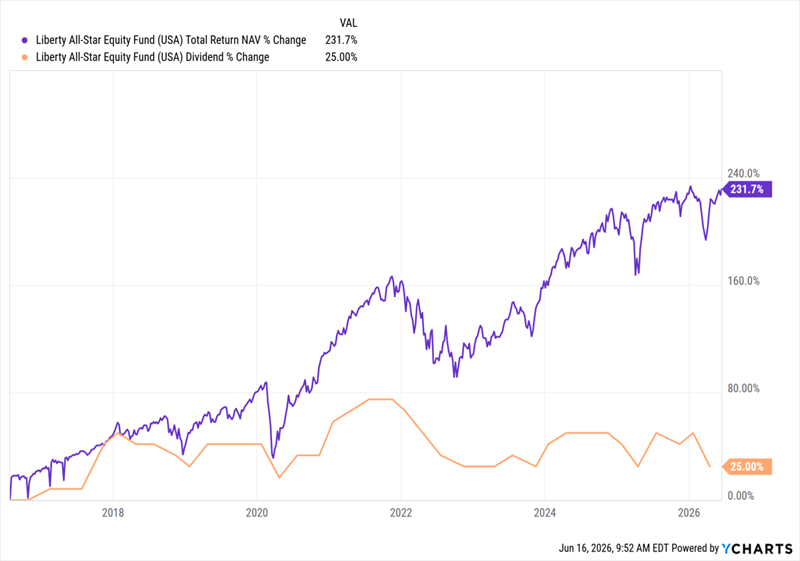
Those gains are thanks in no small part to the strong performance of the fund’s NAV (the purple line). The payout floats up and down because USA ties its dividend to its NAV performance, aiming to pay out 10% of NAV a year, in four quarterly installments of 2.5% each.
NAV is important for another reason, too, as a CEF’s NAV and market price can move independently of each other, causing the market price to trade at discounts or premiums to NAV. As I write this, USA trades at a 12.5% discount to NAV, well below its five-year average discount of 0.9%.
That’s far oversold for a proven fund like this, especially since USA also uses almost no leverage—around 5% of the portfolio as of this writing.
This is a CEF performing at its best, and there are many funds that deliver this kind of performance and strong income. But not all CEFs are winners. One fund recently launched by a popular investor is a good example of a CEF we want to avoid.
Size, Celebrity Manager Mask PSUS’s Flaws
That CEF is called Pershing Square USA (PSUS), and it’s run by billionaire investor Bill Ackman. We did a breakdown of PSUS in a May 14 article on Contrarian Outlook.
If you’ve been investing for a while, you’ve probably heard of Ackman. He’s a value-investing maverick and billionaire whose public fights against corporate management teams have grabbed headlines worldwide.
He dramatically took on Herbalife (HLF) via a huge short position in 2012. He ended up on the losing end of that one, but his aggressive moves did turn Chipotle Mexican Grill (CMG) around. Similar tactics with Valeant Pharmaceuticals (VRX) and Canadian Pacific Kansas City (CP) had mixed results.
In April, Ackman launched PSUS, his venture into CEFs. Despite Ackman’s fame, it hasn’t gone well.
A Steep Decline in a Strong Market
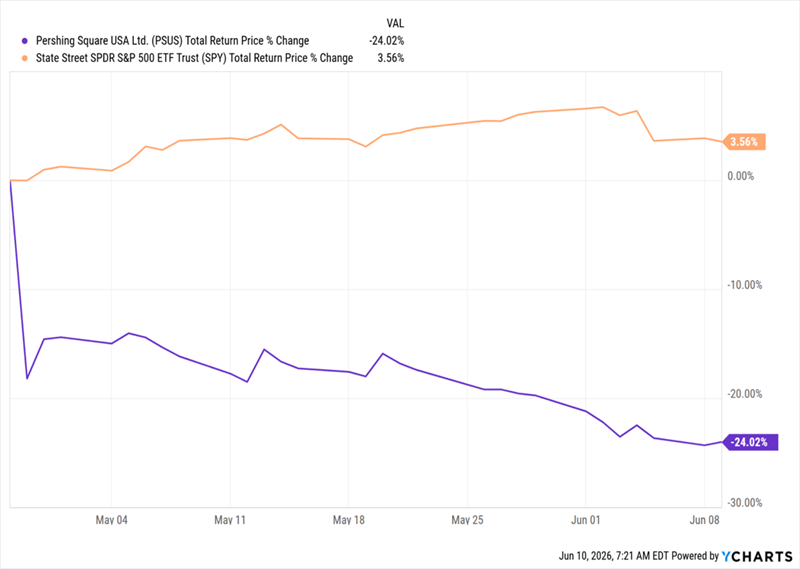
As you can see above, PSUS’s return based on market price (in purple) has dramatically underperformed the S&P 500 (in orange) since the end of April, when Ackman launched PSUS. Worse, the fund’s return is down 24% since its launch.
The lack of a dividend—something we demand in CEFs—surely doesn’t help, either.
If you just know Bill Ackman as a successful hedge-fund manager, PSUS’s poor start doesn’t make sense. But it does make sense for those who’ve followed CEFs for a while.
Ackman raised $5 billion for this fund, which briefly made PSUS the fifth-largest CEF in the world. (The biggest, just as an aside, is the Sprott Physical Gold [PHYS], with $15.5 billion in assets under management).
PSUS’s size is actually part of the fund’s problem.
Five-billion dollars is a large sum by any measure. But it’s a fraction of what Ackman originally wanted: When he first discussed launching this fund in 2024, he said he was going to bring in $25 billion. When it finally launched two years later, the amount was much less than that. And even its current size has proven to be too big.
Source: Pershing Square USA
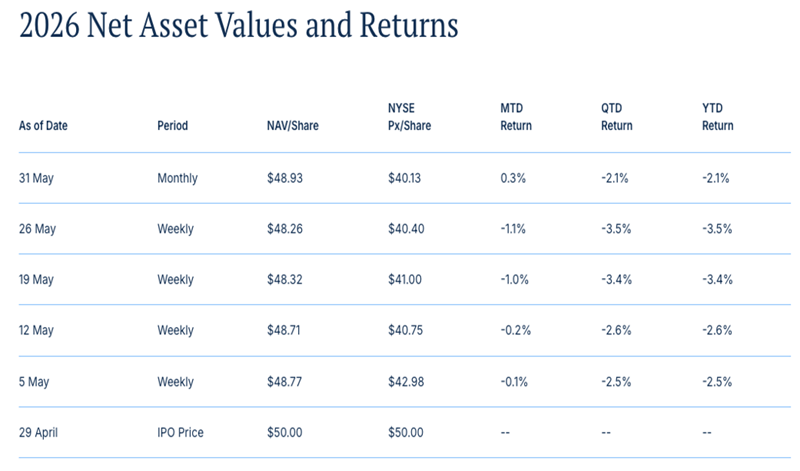
PSUS’s total NAV return since its launch has been around negative 2.5%, as of this writing, which is significantly worse than the S&P 500’s 3.6% gain over that period.
Investors are no doubt unhappy, and there are a lot of investors in this fund now due to its size and higher profile. With that in mind, the significant drop in PSUS’s market price makes sense: Demand for PSUS is falling much faster than its underlying NAV, resulting in an outsized 22.7% discount as I write this.
PSUS is still a top-10 CEF in terms of its market capitalization, so it’s no small fund. But this trend also means it’s a top-10 CEF in another way: It’s now the ninth-most-heavily discounted CEF on the market.
And PSUS could still move up to number one by that metric, unless Ackman makes some moves to close that gap. Until that happens, and the fund’s discount starts to meaningfully close, we’ll avoid PSUS at CEF Insider.
How to Build a $2,425-a-Month Income Stream (With Just 5 Funds)
The other thing we love about CEFs? Plenty of them pay consistent, reliable dividends every single month.
We’re not sacrificing high yields to get those regular monthly payouts. The top 5 monthly dividend CEFs I recommend now, for example, yield 9.7% on average.
That’s $9,700 in dividends on every $100K invested, or $808 every month.
On, say, a $300K nest egg, we’re talking about $29,100 in yearly income, or $2,425 a month.
Plus there’s plenty of price upside on the table, thanks to these funds’ outsized discounts to NAV.
The time to buy these 5 CEFs is now, while these deals are still on the table. Click here and I’ll introduce you to this 5-fund monthly dividend portfolio and give you a free Special Report that gives you their names, tickers and everything else you need to know to buy.