
There’s a big disconnect between the headlines and vanilla investors’ mood these days.
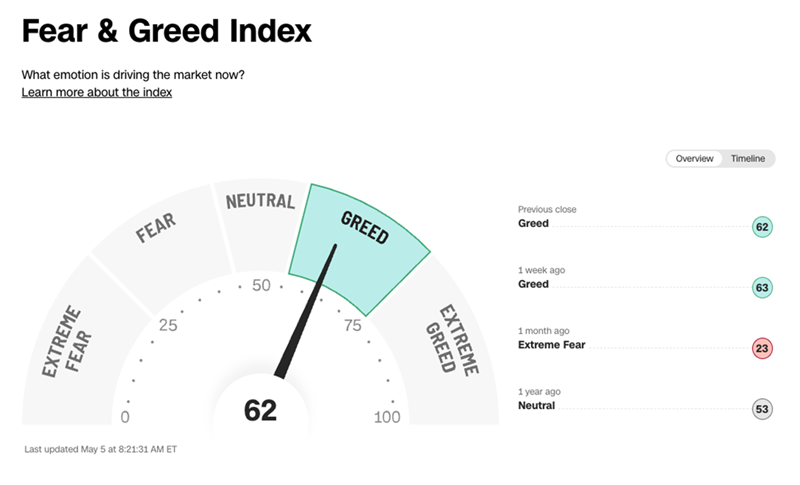
The headlines? Dark. Investors? Greedy.
Source: CNN
The CNN Fear & Greed Index has its flaws, but on the whole is a decent indicator of where investors’ heads are. As we can see here, despite the Iran conflict, they’re giddy.
At times like these, it pays for us contrarians to be cautious.
For us closed-end fund (CEF) investors, however, this isn’t a big concern. The funds in our CEF Insider portfolio (21 in all, with an average current yield of 7.9%) are run by pros we can count on to navigate overly exuberant times like this.
But even so, when greed runs high, it’s easier to let FOMO lure us off our income path. The result could be a situation where we trade too much (or worse, on emotion). Some people could take that to an extreme and even take a stab at day trading.
Let’s talk a bit more about that. While it is a little outside our beat here at CEF Insider, a look at day trading is a useful exercise in what not to do when it comes to investing, and why we continue to recommend a longer-term, dividend focused strategy instead.
As we’ll see, getting caught up in day trading is at best many hours of work (the opposite of what we want: to be retired!) and at worst a one-way ticket to losses.
Yes, You Can Beat the Market Day Trading
Let’s start with what should really be the goal of any day trader: to beat the market. A lot of ink has been spilled about how active managers—and I’d include individual investors here—simply can’t do so. This is nonsense. Plenty of portfolio managers and individual investors do beat the market—and they do so regularly.
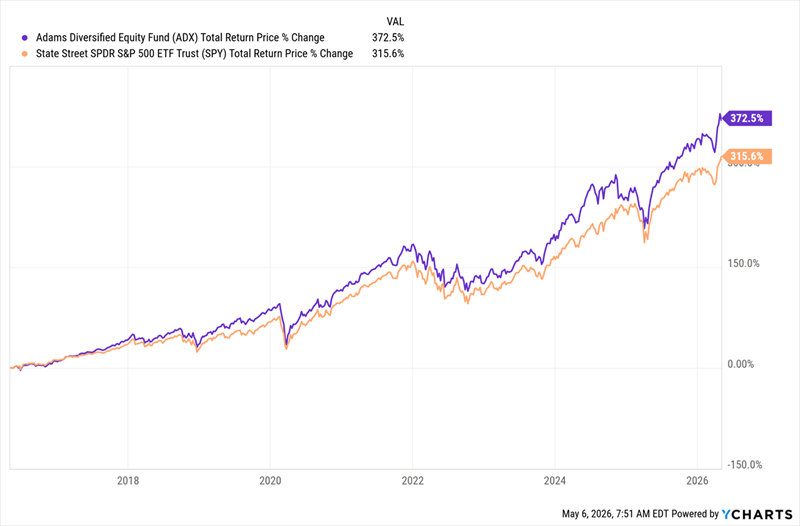
Actively managed CEFs are a good illustration of this, as plenty sport histories of beating their benchmarks. Consider an equity CEF called the Adams Diversified Equity Fund (ADX), a CEF Insider pick we’ll talk more about below.
Over the last decade, ADX (in purple below), which holds many of the blue chips you’d find in an S&P 500 index fund, has returned 373%, well ahead of the index’s 316%.
ADX Has Beaten the Market in the Last Decade …
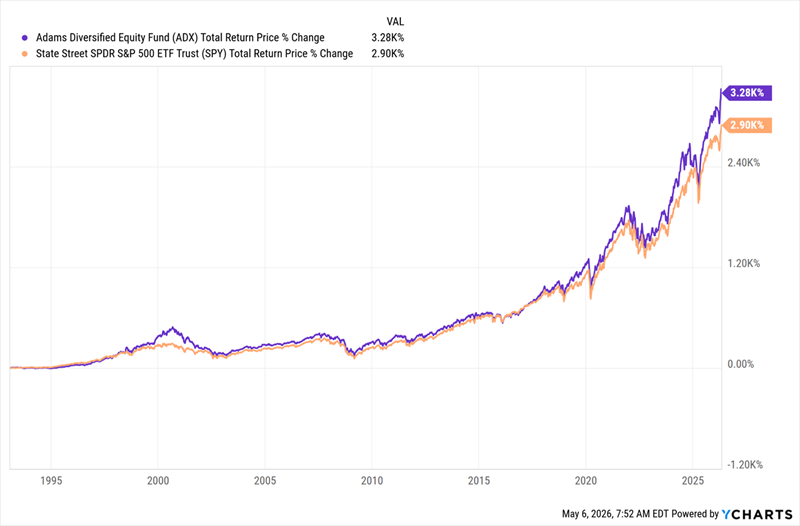
And if we zoom out, we see that this 8% payer has been doing this for much longer than a decade.
… And in the Longer Run, Too
Market outperformance gets even easier when you look beyond stocks, to assets like real estate investment trusts (REITs), corporate bonds and municipal bonds.
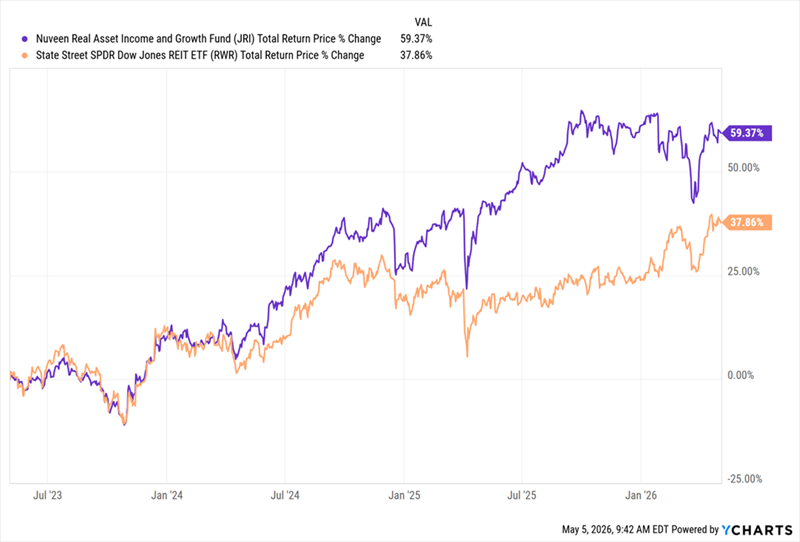
CEFs offer another example here, with another CEF Insider holding, the 12.4%-yielding Nuveen Real Asset Income and Growth Fund (JRI), posting a total return far larger than its REIT benchmark over the last three years, as REITs regained their footing following the 2022 interest-rate spike:
12.4%-Paying REIT CEF Beats Its Index
But let’s keep the focus on day trading. What I’m trying to show above is that it is possible for a “human” manager to beat their index. So it’s possible for day trader, too.
Where to Start—and How It Usually Ends
A good place to start is the field you know best. Let’s consider a hypothetical investor who is a retired HVAC engineer. Could that expertise help them identify strong HVAC firms better than a Harvard-educated investment banker could?
Of course. Which is why investment banks hire firms to help them gain the expertise of people skilled in one field. Our investor, as a day trader, might be able to cut out the middleman—the banks collecting all that expertise—and beat the market.
Even so, the math says day trading is still unlikely to work out in the end.
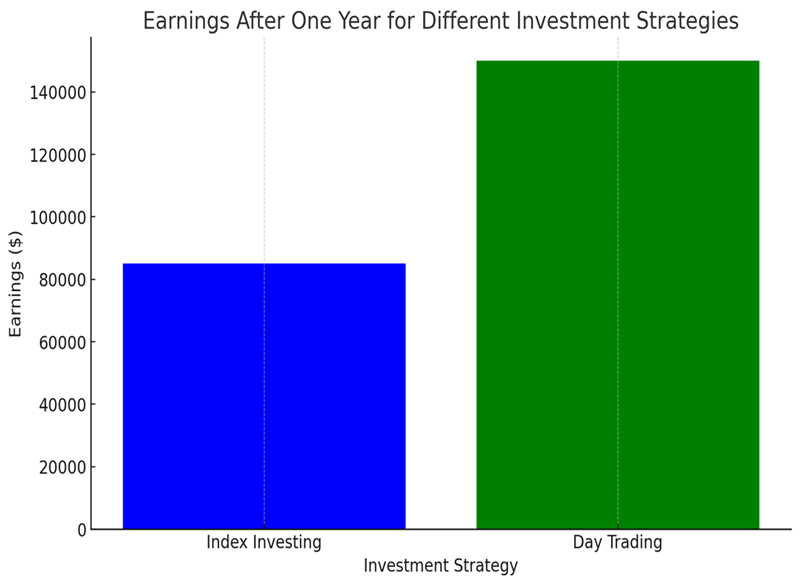
Let’s say another investor has a million dollars and invests in an index fund with an average annualized return of 8.5%—more or less the stock market’s long-term return.
For our day-trading scenario, let’s be (very) generous and say a 15% average annualized return is on the table here.
Source: CEF Insider
Bearing these assumptions in mind, the difference in favor of day trading is $65,000—a lot of cash, I’ll admit.
But let’s translate that into time. US stock markets are open 6.5 hours a day, five days a week, with few days off. That translates to 1,631.5 hours a year of work, meaning you’ve earned a bit less than $40 an hour.
If that’s more than you earn now and you’re 100% confident you won’t make a mistake you can’t recover from—great. But even under these circumstances, we need to be clear that we haven’t found financial independence here. We’ve just found a new full-time job as an asset manager.
Of course, any day trader will tell you that they don’t just work during market hours, so that $40 per hour will be less. We can fix this by earning a bigger return: The day trader who is confident they will earn 150% annually, on average (an extreme figure, to be sure), would make $867 an hour for their labor on a million-dollar investment.
Impressive, I suppose, although many in finance earn more doing things that are much less stressful. But clearly, no matter how good we are at it or how much money we can make, day trading is a job, and the risk is much greater when it’s with our own money.
The Passive-Income Alternative
With dividend yields averaging over 7%, CEFs are a far better approach for just about all investors because they “translate” long-term capital gains from stocks and other assets into an income stream.
That 7% is actually an understatement: It’s dragged down by a lot of municipal-bond CEFs that yield less, but since their income is tax-free for most Americans, tend to be the equivalent of around 8% for median US earners (and more for higher earners).
Equity CEFs, for their part, average an 8% yield over the long term. That’s key because it means we can get the 8.5% annualized profits of the stock market almost entirely in the form of dividends. The aforementioned 8%-yielding ADX is a good example of this, delivering nearly the market’s return in payouts.
Over the last 15 years, ADX has paid out a total of $21.25 per share in dividends. Investors who bought then and have collected payouts since have earned a 12.3% yield on their initial investment.
Also, ADX shares are now 108% higher than they were 15 years ago, as I write this. So on top of that 12.3% yield, they’re sitting on gains that have more than doubled their investment.
Finally, what we like the most is the lower risk involved. One major mistake with day trading can wipe out a trader’s life savings; ADX has been a profitable company since 1854 and a profitable CEF since 1929. While hundreds of day traders are ruined every year, ADX has held fast through ups and downs over more than a century.
Which is why we at CEF Insider continue to see buying quality CEFs, holding for the long term and collecting their high dividends as a much better way to go.
4 Cheap CEFs Yielding 10% as AI Reshapes the Economy
Many investors still see day traders as heroes. We saw this in the GameStop fiasco, and the meme-stock trend that still persists today.
They don’t see the hours and hours of work needed—or the high failure rates.
It reminds me of the misconceptions around AI.
As I write this, the story around AI is still one of fear: worry around job losses and hits to entire sectors of the economy.
But the crowd is missing the real point here: The fact that AI is driving 4 other economic shifts that are just getting started. I call them “Pivot Points.” They’re nowhere near mainstream investors’ radar—yet.
I’ve handpicked 4 CEFs to get us in on each of these 4 pivot points and put them in their own “mini-portfolio.” Together, I call these funds the “4 Pivot Point” 10% Dividend Portfolio.
These 4 funds are cheap now, and they kick out a 10% average yield. That’s an ideal setup for us: We get paid 10% in cash over the coming year (and beyond) while we wait for investors to take note of these 4 pivot points—and drive our upside.
When they do come around, I expect them to do so fast. The time to buy is now. Click here and I’ll break down each of these 4 critical pivot points for you, and give you full details on the 4 high-yielding CEFs you need to cash in on each one.