
ASA Gold & Precious Metals Limited (ASA) is a standout among closed-end funds (CEFs), but not for the reasons we’d like!
For one, this gold-focused CEF pays almost no dividend itself (its yield is a meager 0.14% as I write this). That’s unusual for a CEF, as investors mainly buy these funds for their high yields. As I write this, the portfolio of my CEF Insider service yields a stout 8.9% on average.
As the fund’s name says, its main function is to give investors access to physical gold (64.2% of the portfolio). Silver makes up another 5%, and shares of gold-mining companies account for most of the rest. You can pretty quickly see that this breakdown is not an income investor’s dream, with precious metals offering little in payouts.
But be that as it may, most potential ASA buyers likely don’t care much about that: The fund’s main appeal has always been its gold exposure, which was why ASA was, by far, the best performing CEF of 2025. As you can see below, the fund (shown in purple) massively outperformed the benchmark State Street SDPR S&P 500 ETF Trust (SPY).
ASA Rode Gold to a Huge Return in ’25
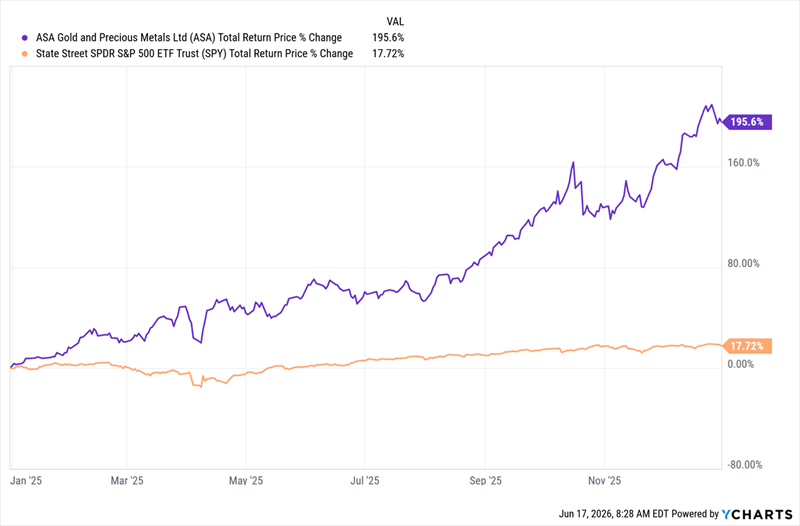
This happens with gold every once in a while: In 2009, 2019 and again in 2025, the metal soared due to concerns about inflation, geopolitical events and a host of other worries.
This was all great for ASA investors last year. This year? Not so much.
As you can see in purple below, the SPDR Gold Shares (GLD) ETF, a reasonable proxy for gold prices, is flat on the year, well behind SPY’s 10% return.
Gold Lags Stocks in ’26
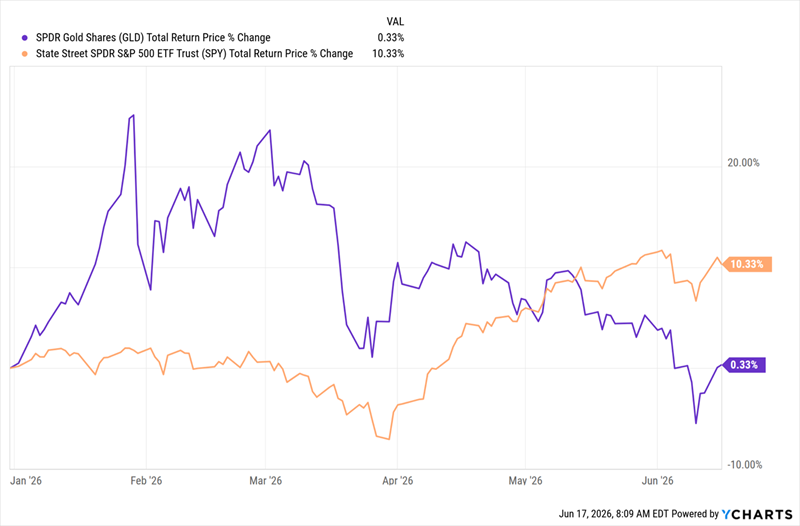
That flat performance comes in a year that’s featured plenty of uncertainty, especially around inflation. With the Iran conflict breaking out and the Strait of Hormuz closed, oil prices shot higher, pushing the consumer price index up. That’s the kind of setup that normally pushes gold higher. Instead, it’s flat.
ASA, for its part, has posted a total return of around 3% as I write this.
What’s happened here? Simply put, the insecurity and instability of today was priced in yesterday, as is quite common for gold. The result is that gold’s ability to go higher is strained now, and probably will be for a while yet.
With all that in mind, it’s fair to believe that ASA’s decline is just beginning, and the fund is probably best to avoid for the longer term. And there are other problems “under the hood” here, as well.
Beyond Sluggish Gold
While ASA is likely to struggle due to the fact that gold looks hamstrung here, the fund also looks like a value trap at its current level. By that I mean that it looks like a bargain on the surface, but is, in my view, “cheap for a reason.”
Let’s walk through why I say that, starting with ASA’s discount to net asset value (NAV, or the value of its underlying portfolio). As I write this, it stands at 13.9%. So it looks like we’re getting in at about 86 cents for every dollar of assets here.
But we need to look deeper. For one, that discount is right around the fund’s five-year average discount, so there’s nothing particularly different about the current level. But there is one thing that might still make the fund look attractive: The fact that ASA’s discount looks like it bottomed out in late April and is now starting to narrow (in the usual two-steps-forward, one-step-back fashion).
Did ASA’s Discount Really Bottom in April?
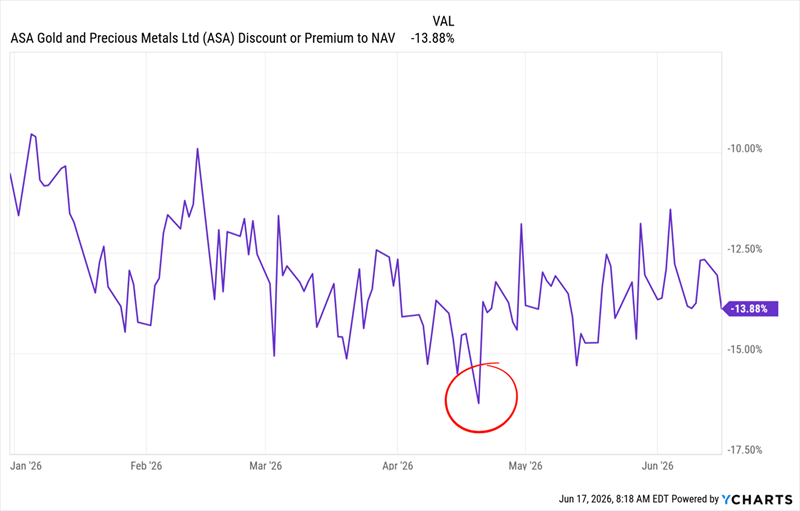
Most of the time, this is a strong setup: Even if a CEF’s underlying asset is unlikely to perk up, a fund can still see strong gains if investors realize they’ve gone too far and start to bid up the market price due to an overly large discount to NAV.
That looks like what’s happening here. But some behind-the-scenes tensions make me suspect this narrowing trend may not last.
To be specific, the fund’s COO, Axel Merk, announced his resignation on June 11. In his resignation letter, which he publicly released, Merk expressed concerns around governance, including that certain officers were excluded from board meetings, and that transition plans for certain key figures in the fund’s management team who are departing have not been provided to him.
ASA has disputed Merk’s letter in a release of its own.
This situation suggests the fund’s discount could widen from here (weighing down ASA’s market price as it does). The fact that we haven’t seen that in a significant way yet is because CEF investors tend to be slower to respond to changes (in the market or within funds themselves) than investors in regular stocks are.
However this situation plays out, I see it as best avoided, at least for now. And fortunately, there are plenty of other CEFs out there for us to choose from, covering a broad range of assets yielding much more than ASA, as well.
This Powerful Monthly Dividend Plan Pays You 60 Times a Year, Yields 9.7%
Another thing most people don’t realize? In addition to paying far (far!) bigger dividends than ASA, many CEFs pay dividends monthly.
And I’ve made it easier than ever for you to zero in on the very best of these high-paying monthly dividend funds: I’ve put my top 5 picks among monthly paying CEFs in a new portfolio I call my “60-Paycheck Dividend Plan.”
As the name says, these 5 funds each send you one dividend check a month, for 5 payouts monthly, and 60 dividend “paychecks” over the course of a full year.
And it gets better, because these 5 funds throw off big dividends, too—to the tune of a 9.7% yield on average.
That’s nearly 10% of your upfront investment back in your pocket every year, in 60 yearly installments. Use them to pay your bills—or reinvest them to grow your monthly income stream even more. It’s up to you!