
Income investors are attracted to low-beta stocks like moths to a flame. Low beta has a reputation for being low drama, but is it really?
Technically, beta measures how closely a stock moves with the market. Intuitively, we’re looking for low-beta stocks because we think that they’ll do better during a market pullback.
Here’s a low-beta dog—and one of today’s picks: NNN REIT (NNN). Its beta over the last year is near zero, but the stock has returned just 5.4% over the last 12 months, versus 14.4% for the S&P 500. And from its July high to mid-October, NNN fell 14%.
This stock is low beta the wrong way. It hasn’t been moving with the market, that’s for sure. It’s been going down while the market has been grinding higher!
But if adding a little portfolio security will help you keep your cool, there’s nothing wrong with tapping an age-old safety strategy … at least as long as we get paid.
Low-beta dividend stocks—in this case paying 5.9% to 12.1%—can be a blessing and a curse. Usually, the qualities that keep a company treading water when the market sinks are the same qualities that keep that company treading water when the market rockets higher.
In other words: We’ll never get ahead by putting all of our money down on low beta.
But Owning Some Low Beta Can Smooth Out Our Returns
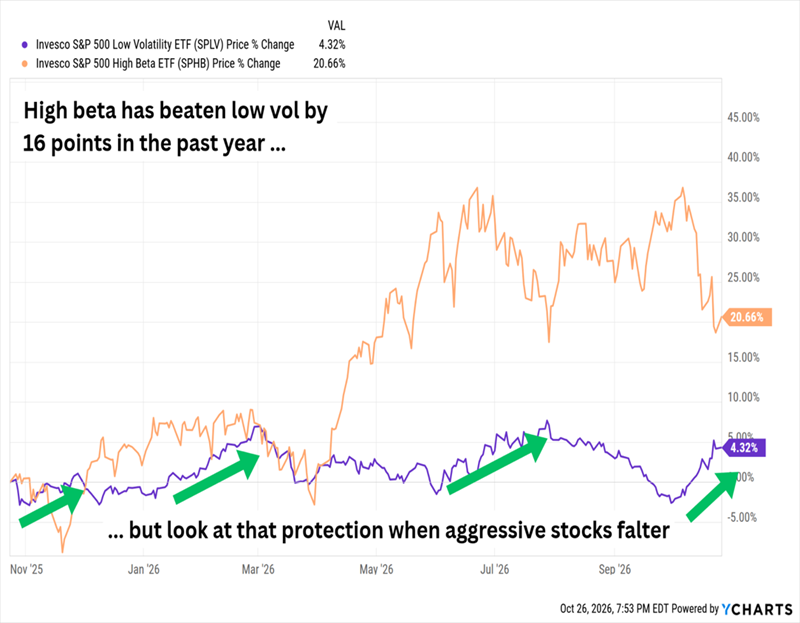
If nothing else, it’s a savvy psychological tactic. If part of our portfolio hangs tough when Wall Street loses its cool, that can keep us from making our own panicked decisions.
But if we are going to hide some of our money in a bunker, we should try to collect some income while we’re at it. And fortunately for us, there are literally hundreds of stocks that are low on drama but high on income.
I’ve narrowed down the field to a manageable seven companies that are worth a closer look for their poise … and their 5.9%-12.1% payouts.
I’ll start with NNN REIT (NNN, 5.9% dividend yield), a massive single-tenant real estate investment trust (REIT) that boasts 40.4 million square feet across 3,774 properties in 50 states, which are leased out to more than 400 tenants with an average lease term of just more than a decade.
Virtually all of NNN’s portfolio is made up of retail or service businesses—indeed, the company used to be known as “National Retail Properties.” Its top tenants include the likes of 7-Eleven, Dave & Buster’s (PLAY), Camping World (CWH) and AMC Theatres (AMC). It’s diversified, with no single tenant accounting for more than 5% of annualized base rent. And the NNN ticker is a nod to its triple-net leases, which back out taxes, insurance and maintenance—the REIT simply collects the rent, which is a formula for much more predictable income and cash flow.
That has been a perfect recipe for longstanding dividend growth. Like peer Realty Income (O), NNN REIT’s homepage is just as much about promoting its distribution (and its 37 years of uninterrupted improvement) as it is promoting the business.
But I’m highlighting NNN first to illustrate why we shouldn’t just accept a low beta at face value.
NNN’s beta of almost zero over the past year hasn’t meant boring movement. It has meant that NNN has marched to the beat of its own drum.
And Recently, That Beat Has Killed the Party
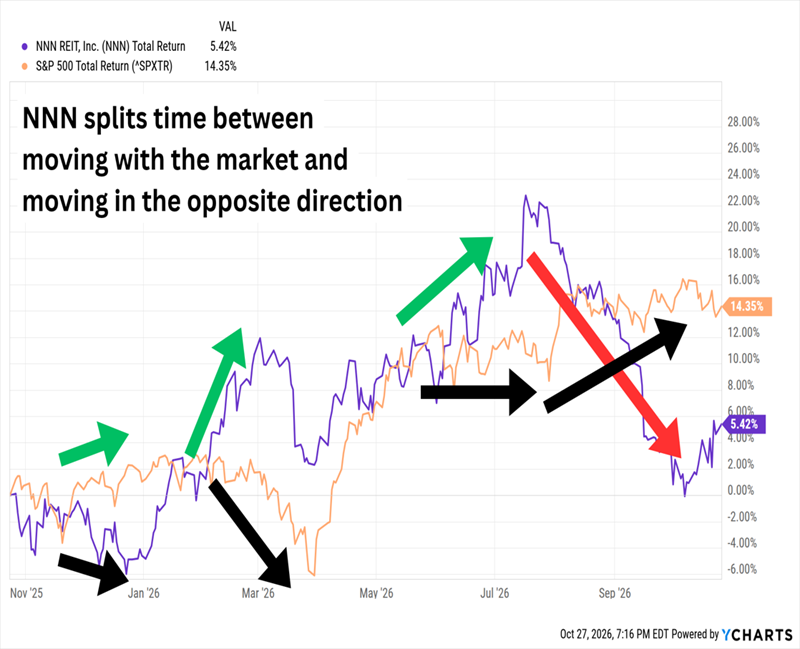
It’s more accurate to say that NNN just isn’t correlated with the market. It has been plenty volatile—and at least for the moment, it looks pretty exposed to further interest-rate tantrums.
CTO Realty Growth (CTO, 7.8% dividend yield), another retail REIT, has been a little more “honest” to its one- and five-year betas (0.3 and 0.6, respectively). While it hasn’t always moved in the same direction, it often does—just in a less exaggerated manner.
It’s not what you expect given the business. About half of its annualized base rent comes from “power center” outdoor malls anchored by large retailers; another third comes from “lifestyle” properties anchored by restaurants, banks and traditional retailers; the rest comes from grocery-anchored retail, mixed-use, single-tenant and office properties. And CTO also generates income from a roughly 13% ownership interest in Alpine Income Property Trust (PINE), which it also manages.
Despite its highly cyclical nature, CTO has historically provided some ballast in rocky markets, including significant outperformance during downturns in 2022, 2025 and this year.
That’s the Kind of Defense We Want Out of a Low-Vol Stock
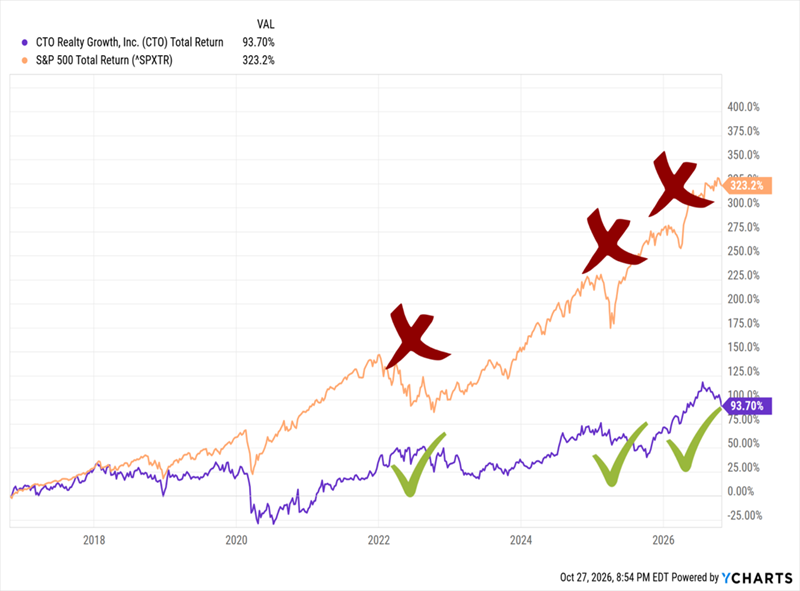
Like the rest of the REIT sector, CTO Realty Growth hasn’t given us much in the way of returns compared to the broader market. But it has been showing signs of operational improvement. Most recently, CTO reported a slight Q3 miss just this week, but adjusted funds from operations (AFFO, a critical profitability metric) were still up 10% year-over-year. And it’s currently trading at less than 9 times estimates for full-year AFFO.
Verizon Communications (VZ, 6.4% dividend yield) is another oddball beta case from the past year, but historically, it has delivered the kind of lazy movement that we would expect (and that the numbers suggest).
VZ sports a negative 0.5 beta over the past year. It has gone rogue, making a series of counter-market moves, including a massive spike following earnings in January, and a dive in June after the Dow Jones Industrial Average announced it would boot the telco for Google parent Alphabet (GOOGL).
But long-term, VZ has scrapped with the likes of AT&T (T) and T-Mobile (TMUS) to claw a little more share of the completely saturated U.S. mobile market. The result has been sleepy performance and a five-year beta of just 0.25—much more reflective of the defensive nature of Verizon’s utility-esque business.
Historically Defensive, But Even Less Upside than CTO
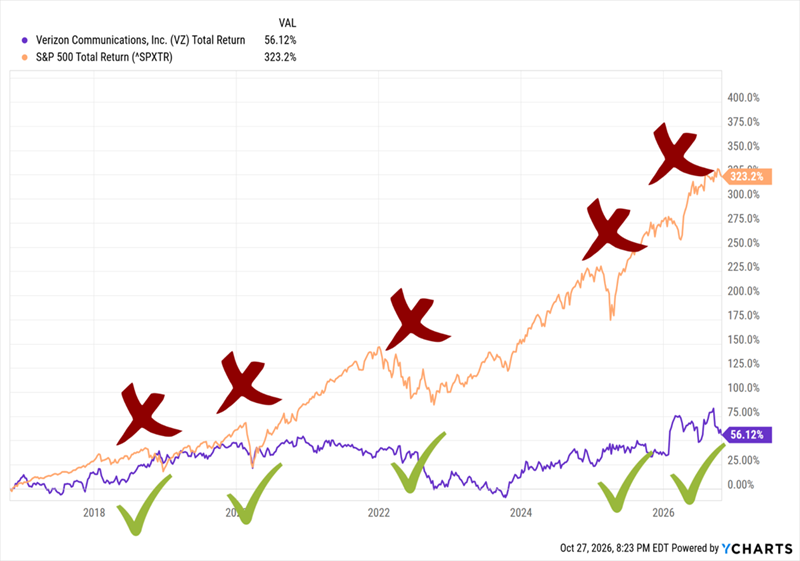
While Verizon will no longer be among the Dogs of the Dow come 2027, its 6%-plus yield is still a gold standard among mega-cap blue chips. And beyond protection, VZ has shown some spark of late; the company recently announced big upgrades in its outlook for postpaid net addition estimates, mobile/broadband service top-line growth and free cash flow growth.
Several long-term low-vol energy master limited partnerships (MLPs) have also delivered negative betas over the past year—not much of a surprise given that spikes in energy prices have weighed on the rest of the markets several times this year.
MPLX LP (MPLX, 7.4% distribution yield) is an oil-and-gas MLP that holds midstream assets such as pipelines, refineries and natural gas liquids (NGL) gathering systems for Marathon Petroleum (MPC).
MPLX has kept its pedal on the distribution since coming public in 2012. It was delivering raises on a quarterly basis up until 2020, when it switched to annual hikes—and even then, most of those hikes have come in at around 10% to 12% a year.
The Dividend Magnet Has Given Us Distribution Growth … And Growth Growth
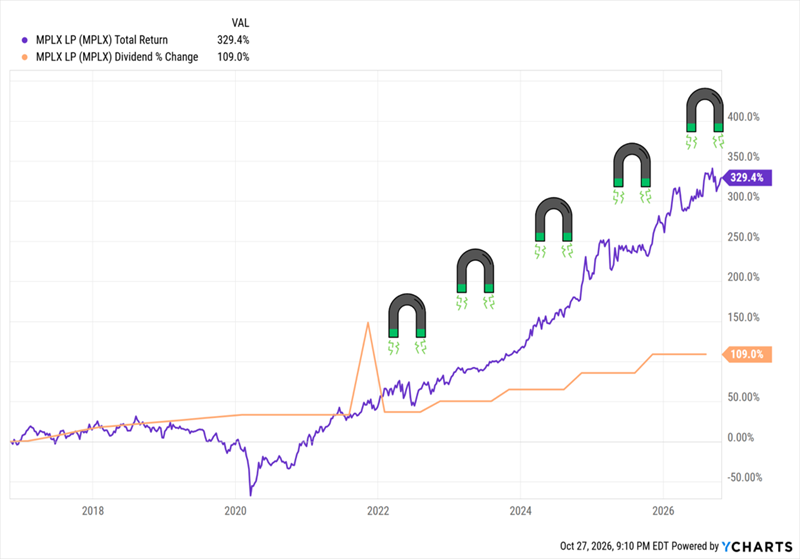
That’s not for lack of anywhere else to spend its cash—MPLX has been building out its Permian Basin gathering and processing capabilities and fracking capacity, and it has sent several growth projects live in 2026.
Energy and the broader market have largely traded opposite one another over the past year; MPLX has done so too, but in a less exaggerated manner, hence the -0.3 beta over the past year. The 0.5 five-year beta is more representative of the stock’s relatively chill movement compared to the index. Shares could lose some froth, though; enterprise value/earnings before interest, taxes, depreciation and amortization (EV/EBITDA) of around 12 is on the high end of where MPLX has traded over the past decade.
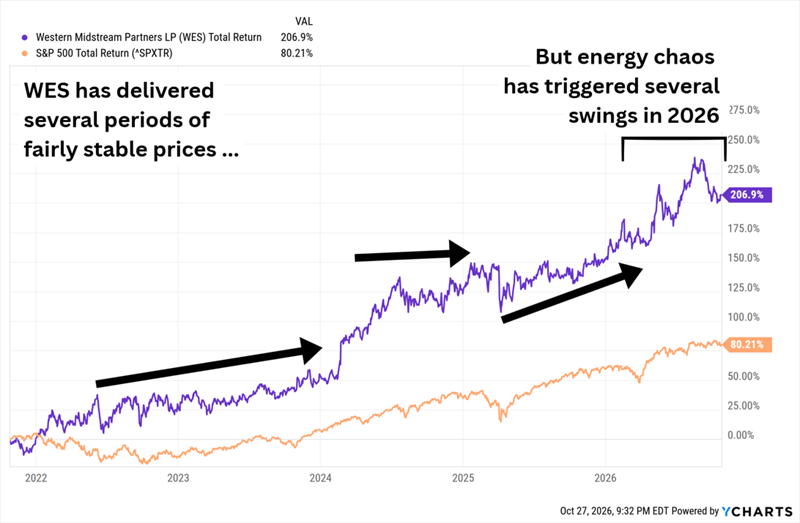
Same goes for Western Midstream Partners LP (WES, 8.2% distribution yield), which trades at one- and five-year betas of -0.3 and 0.7.
WES: Historically Calm, But It Has Acted Up This Year
Western Midstream manages assets including 17 gathering systems, 77 processing and treating facilities, and roughly 16,000 miles of pipeline across 18 crude oil, natural gas and NGL systems. It manages those assets for Occidental Petroleum, which owns about 38% of the company and manages WES via Western Midstream Operating LP.
Western didn’t keep up its distribution growth through the pandemic—in fact, it halved the payout in 2020, though it has since clawed back all that lost ground, and the distribution is now 50% higher than it was pre-COVID. Helping fuel that growth is an expanding water-gathering business that acts as a nice diversifier.
Like with MPLX, though, we’re paying for Western’s serenity with a higher-than-usual EV/EBITDA of around 11.
Regional banks can be a nice source of yield, but Mechanics Bancorp (MCHB, 10.3% dividend yield) is unlike anything else we can find in the industry.
Mechanics is a West Coast regional bank with 166 branches “spanning from San Diego to Seattle and Hawaii.” It’s a stellar deposit base that MCHB has turned into a profit-printing machine. It’s also majority-owned by Ford Financial Fund, a private equity fund that specializes in community banks and has a great M&A track record.
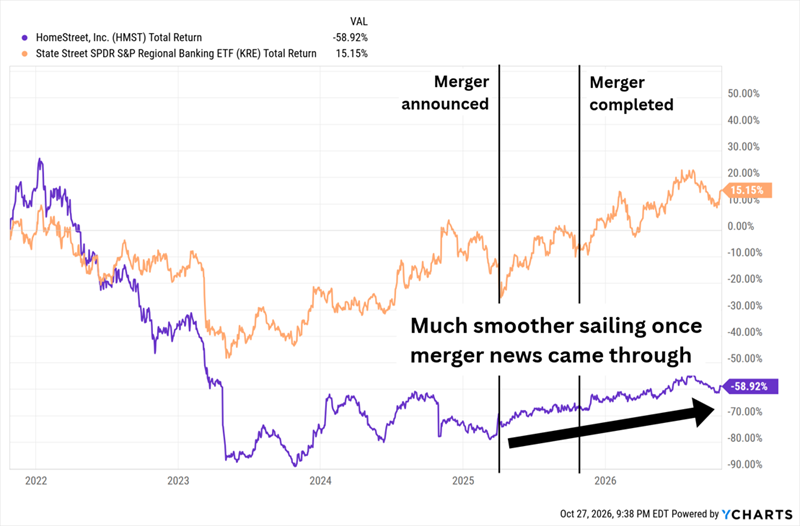
Despite being around for more than 120 years, Mechanics Bancorp has only traded on a major exchange since 2025, when it reverse-merged with HomeStreet. In that time, MCHB has not only moved more gently than the broader market (0.5 one-year beta)—but it has also been tamer than the S&P Regional Banks Select Industry Index.
Joining Forces Really Settled This Stock
If a 10% yield from a stock this composed sounds too good to be true … well, it is, to an extent.
The company has very clearly made it a priority to reward shareholders, but it has so far done so via an extremely variable dividend program. MCHB’s first four dividends, starting with the most recent payout, have been 25, 70, 40 and 21 cents per share. Averaged together, it’s more than 10%. But annualize that small recent payout, and we’re still earning more than 6%, which beats the pants off most financial stocks.
The dividend stability could be better, but the generosity isn’t an issue.
We typically don’t buy business development companies (BDCs) for their stability. That’s because despite representing portfolios of dozens if not hundreds of companies, they are highly cyclical and rate-sensitive.
No, we buy BDCs for their outrageous yields—but if we can find even relative calm from this industry, we should dig a little deeper.
Trinity Capital (TRIN, 12.1% dividend yield) is a growth-focused BDC with a bleeding-edge portfolio that includes quantum computing firm Rigetti Computing (RGTI), emergent hair color startup Madison Reed and propulsion specialist Impulse Space.
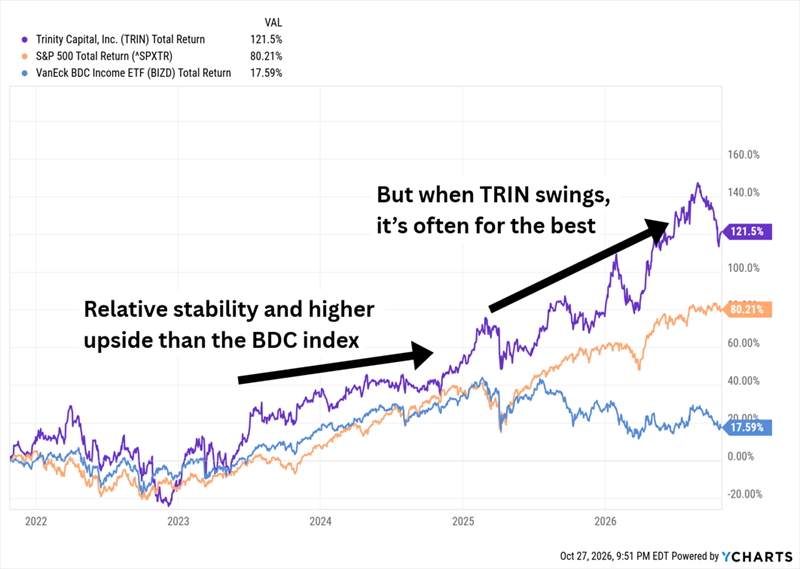
It’s not much less volatile than the markets, at one- and five-year betas of 0.89 and 0.70, respectively. Much of that longer-term metric came from relatively smooth returns, while the nearer-term metric is a product of exaggerated moves both with and against the market.
Either Way, TRIN Is Giving Us Something Better Than the Broader BDC Industry
Trinity is a well-run BDC that still butters its bread with debt financing, but it has branched out in recent years to add sponsor finance, joint ventures, asset management and more. Portfolio quality is generally high; non-accruals (the borrower has stopped making payments, usually for at least 90 days) are at just 1.33% at fair value. And it’s a monthly dividend stock, to boot, combining optimal frequency with a monster 12%-plus yield.
TRIN’s floating-rate debt mix is lower than many other BDCs, which isn’t ideal in a rising-rate environment. But the biggest black mark on the stock is a sky-high valuation—investors have bid this BDC up to 25% more than its net asset value.
My 2027 Dividend Plan: Book Big Income Every Single Month
Trinity actually checks many of the boxes I look for in my “Monthly Dividend Superstars” portfolio:
- Double-digit yield
- Monthly payments
- A boring-enough business model that won’t give us ulcers
But why should we overpay for B+ opportunities when we can pay fair value (or less!) for A+ “forever” holdings?
My “Monthly Dividend Superstars” let us collect an enormous portion of return in generous, frequent dividends.
How generous? If we invest a mere $600,000 nest egg—less than half of what most financial gurus insist you need to retire—into this trio of 11%+ payers, we can generate a wild $66,000 annual income stream. That’s $5,500 every month in regular income checks!
More importantly, these are truly stable businesses, which means we don’t have to freak out over every last jobs report, Fed meeting or global flare-up. We just sit back, relax and live our lives instead of doomscrolling our brokerage accounts every day.
I’m loading up on these monthly dividend stocks ahead of 2027 as long as they remain in our “buy zone” … which they might not be for much longer! So click here to learn everything you need about these generous monthly dividend payers right now!