
This market is in a weird place: rising but scared.
Disconnects like these are exactly what make our contrarian income strategy work.
Here’s the state of play: Stocks, of course, have risen this year, with the S&P 500 up around 12%. That’s because, even though investors are dour, enough of them see that corporate America is in a “profit boom”: According to the latest numbers from FactSet, S&P 500 companies are set to report profit growth of 33.1% for all of 2026, on 12.8% revenue gains.
These are huge numbers, and they fully justify this year’s gains.
But if you’ve been watching the movements of the overall market (and I’m guessing you probably have), you’ll have noted that it’s been mostly grinding sideways since around mid-summer, with occasional sharp moves—some of them major—up and down.
That’s because these strong fundamentals keep bumping up against the laundry list of worries out there, the latest being the panic around debt issued by cloud-computing providers like CoreWeave (CRWV), whose yields have recently touched double digits.
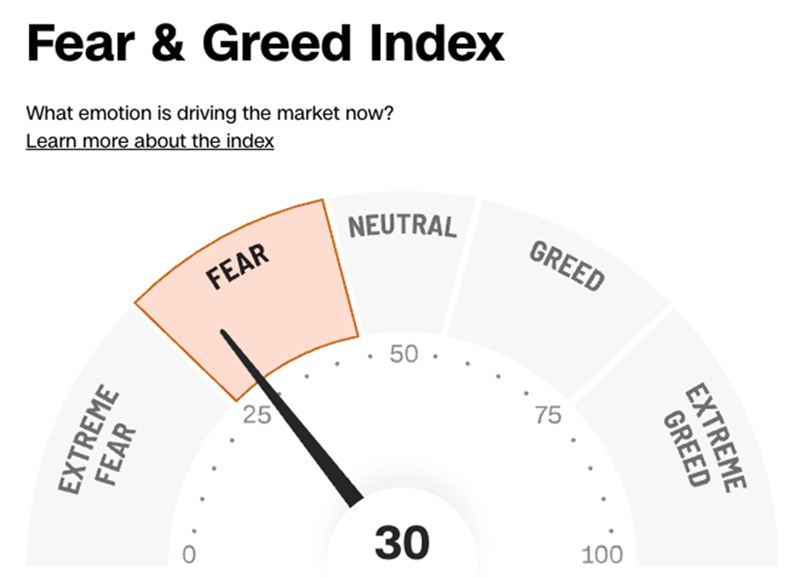
Lately, that panic has been hitting picking up, according to the CNN Fear & Greed index, a decent indicator of investors’ mood:
Source: CNN
This “collision” between strong profit growth and these fears is where our opportunity lies. It’s made the vast majority of our CEF Insider service’s equity CEFs (which yield between 6.5% and 13% today) buys.
But it’s really showing up in corporate-bond CEFs. Their underlying portfolios (or their net asset values, or NAVs, in CEF-speak) are holding up well, but their returns based on their market prices are sliding:
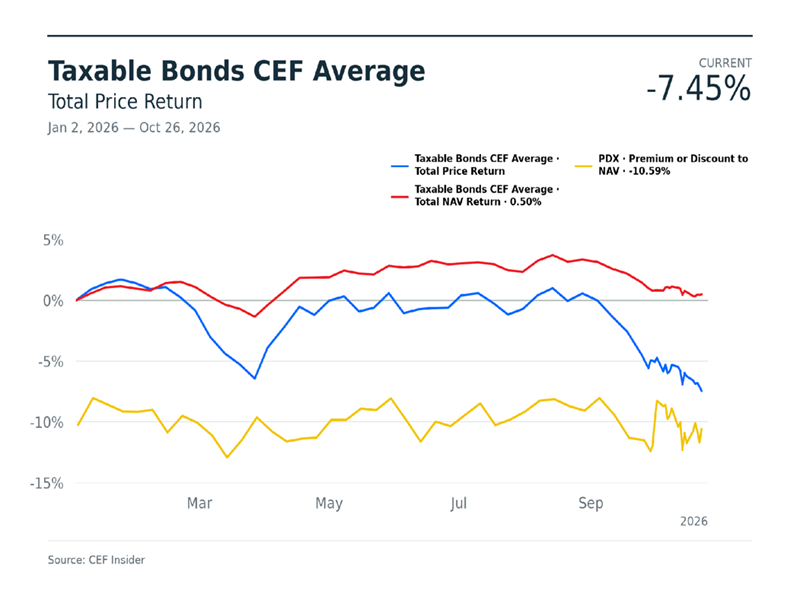
This setup, which is unique to CEFs, is all about overdone investor panic—so much so that investors are tossing perfectly sound bond portfolios over the side! You can see it above, with corporate-bond CEFs’ overall NAV (in red) moving sideways, while their returns based on market price (in blue) have plunged.
That’s our opportunity. It’s why all seven of the corporate-bond CEFs in our portfolios are buys today. But they’re not all buys because their market prices are lagging their NAVs. One, in particular, is a buy because both its return based on its market price and its return based on NAV have put up strong performances this year.
That, plus this “stock/bond hybrid’s” 11% discount, makes it a buy for a different reason: To hedge against volatility while the bulls and bears fight it out.
The fund in question is the PIMCO Dynamic Income Strategy Fund (PDX). As I write this, PDX yields 9% and trades at a 10% discount to NAV. That’s essentially 90 cents on the dollar.
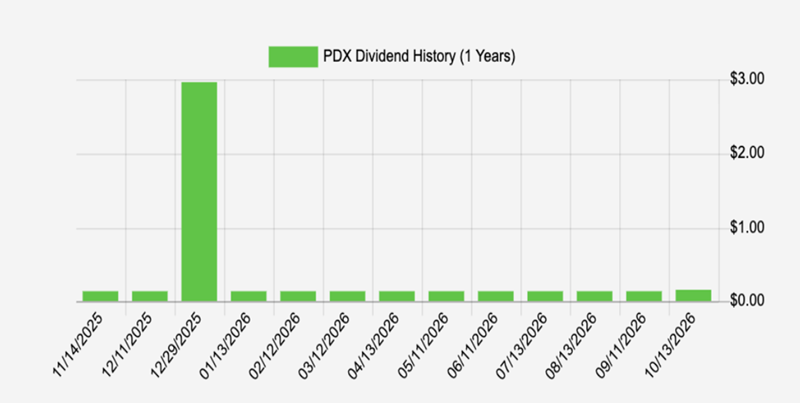
Let’s start with the dividend, because payouts are a big reason why we buy CEFs. Since we bought PDX in March 2025, its payout has not only held steady, it’s grown, with the October payment rising 15% from September (PDX, like many CEFs, pays dividends monthly). Late last year, we were rewarded with a special dividend, too:
Source: Income Calendar
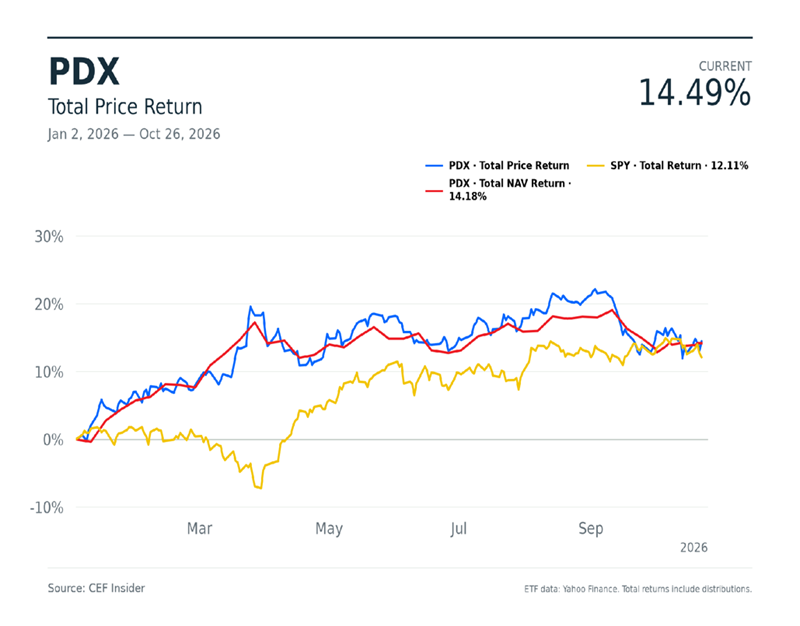
That sturdy income stream is one reason why we own PDX. The next? Its resilience. As you can see below, PDX’s return based on market price (in blue) and NAV (in red) have both marched higher this year. It’s even marginally ahead of the S&P 500 (in yellow) as of this writing:
That’s in part because PDX holds about 23% of its portfolio in US equities, with a focus on pipeline-operating master limited partnerships (MLPs) like Energy Transfer LP (ET), Enterprise Products Partners (EPD) and MPLX LP (MPLX).
That resilience and diversification make PDX a particularly strong addition as a hedge against volatility.
Moreover, the slice of its portfolio in pipelines helps it benefit as these firms expand to provide the natural gas needed to fuel rising electricity demand. That demand is expected to keep growing, no matter what happens to the CoreWeaves of the world.
Then you’ve got PDX’s management firm: California-based PIMCO has a stellar reputation in the CEF and fixed-income worlds.
Zooming out a bit, the fact that investors have so suddenly and aggressively oversold corporate-bond CEFs relative to their NAV returns could be suggesting we’re at or near a bottom, which would be a plus for the bond portion of PDX’s portfolio.
There are plenty of reasons this could be the case: Corporate defaults are low and falling, and that “profit boom” we discussed a second ago suggests defaults are likely to stay low, at least in the medium term.
What’s more, the yield on 10-year Treasury notes has fallen back below 5% as of this writing, suggesting the bond panic could be easing.
If that’s the case, PDX’s discount could narrow. How much is hard to say, but as recently as September it was as narrow as 7.6%. Going back to early January 2025 (when 10-year Treasury notes were yielding around 4.8%, not far from today’s level), it got within 0.5% of premium territory.
In any event, a “bond bottom” could be the catalyst PDX needs to push its discount back toward par. Beyond that, the fund’s credit holdings are well-diversified, and its technology exposure is only about 6.1% of its total assets—far too small a slice for an AI panic to really matter to this fund.
Where does that leave us? With a stock/bond hybrid that’s a nice pickup to help smooth the ride if volatility rears up. It also provides a potential source of upside if the bond panic continues to cool—narrowing PDX’s discount as it does.
These 10% Payers Invest in AI the Right Way (and They’re Criminally Overlooked)
One of PDX’s hidden strengths is its ability to profit from AI’s surging power demand through pipelines.
Sure, renewables are growing. But the wind doesn’t always blow and the sun doesn’t always shine. That’s when natural gas is needed to power all those queries to Claude, ChatGPT, Gemini and the rest.
Pipelines are there for just these times—a perfect “backdoor” play on the tech.
This is far from the only way to profit from AI this way.
My AI “Pivot-Point” Portfolio holds 4 CEFs that do the same, but from different angles. They also yield a robust 10% on average.
Here’s a quick breakdown of each one:
- A 9.1% yielder that benefits as robots take over the factory floor.
- An 11.1% dividend dialed into AI’s growing use in drug development.
- Another fund (yielding 8.1%) that cashes in as mid-sized businesses put AI to work.
- And a 12.9% payer profiting from AI’s surging power demand, even more directly than PDX.
That’s AI upside backed by steady cash flow. It’s just the kind of income that can help smooth the ride in a “rising but scared” market like this one.
I’ve put all four funds in a free Special Report, The AI “Pivot-Point” Portfolio: 4 Funds for 10% Dividends. Click here and I’ll tell you more about these 4 funds and give you this free report.