
Social Security recipient? You’re set to receive a 3.6% raise in January.
How about your dividend portfolio? Well, it depends on your positions! So let’s talk about the stocks and funds that will give us that magical COLA (cost-of-living adjustment) we love to sip versus the static divvies that can become a bit stale year after year.
We’re all about the 7% to 8% yields here at Contrarian Outlook. Generous dividends are good! But often these come with fixed paychecks that are, well, fixed.
Year after year we collect the same check. In January, we’ll have some COLA FOMO. Inflation is our hidden nemesis. I mean, it now costs a cool $30 to DoorDash a sandwich.
(Your editor takes serious heat from his wife for DoorDashing pints of ice cream from a shop that is three short blocks away. My defense? First, vanilla is a must-have with apple pie. Second, the one she and I agree to disagree on: once my comfy sweatpants are on I am not leaving the house until tomorrow. Alas, DoorDashing a pint is an infrequent but admittedly expensive habit that requires COLA support.)
You are likely more responsible with your discretionary dividend cash than me, but either way we need to engineer payout growth. It matters! Let’s take a hypothetical million-dollar portfolio and apply a fixed 8% yield to it. That’s $80,000 per year—not bad!
But let’s say inflation runs at 3% per year. It eats away at the buying power of our yearly $80K! After a decade we’re down to $59,500 worth of today’s groceries, and after 15 years we’re down to $51,300.
So, we need raises. But first, we need some math. Often (not always, but usually) stocks likely to boost their dividends tomorrow yield less today. Generally, the faster the growth, the lower the current yield. Let’s look at some tradeoffs to see how raises can add up over time.
We’ll compare a $100K investment prepared three ways:
- An 8% yield with no raises.
- A 6% yield that’s raised 5% per year.
- A 4% yield boosted 10% per year.
By year seven, the yearly check from the 6% yield that grows 5% every year passes that flat 8%. By year nine, the annual divvie from the 4% yield also passes the fixed 8%.
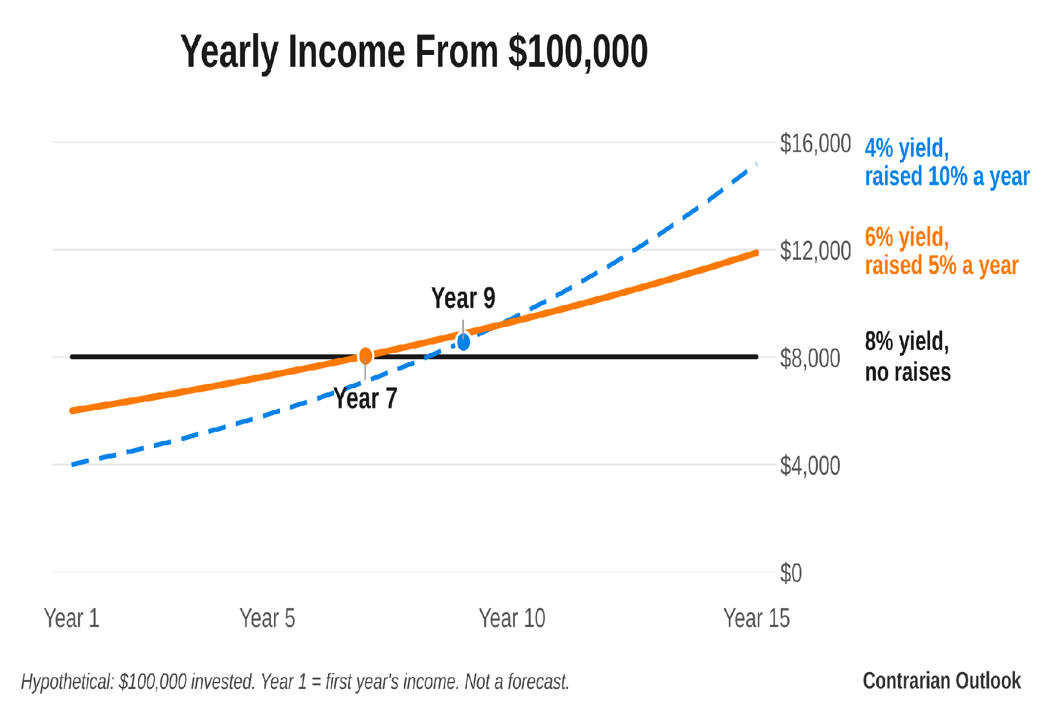
Looking at 10-year total payouts received, the flat payer wins, with $8,000 per year, or $80,000 for the decade in dividends on that initial $100K. (This is why we still own fixed-rate investments like bonds—they pay a lot.)
The trade-off here is that when we buy growers, we’re accepting less income today in hopes of larger checks later. But how many tomorrows do we have to wait, and do we want to wait?
Let’s consider Reaves Utility Income Fund (UTG). UTG is a closed-end fund built for income investors like us that focuses on utility stocks. We buy it, collect a dividend paid monthly and don’t need to sweat individual utility earnings events thanks to the diversified portfolio.
We originally bought UTG in June 2023 in my Contrarian Income Report service, and “way back then” UTG owned a basket of old-school utilities such as Duke Energy and Southern Co., companies that collect steady regulated returns simply for keeping the lights on. It paid an elite 8.5% and the fund had the potential to grow its income as its holdings grew profits. A big payer with upside!
In July, this upside delivered. We received a divvie raise from Reaves! A 5% summer bump brought the monthly payout from $0.20 to $0.21 per share. As I write my CIR readers have enjoyed 61% total returns including dividends in three-plus years.
Please note that UTG’s hike is a bigger discretionary payment, up to management—not an automatic annual COLA.
Which is why when we buy dividend payers we research more than the sustainability of their payouts today. We also want a portion of our portfolio to consist of payers that can raise tomorrow.
Of course, a future raise is only as good as today’s profits!
In CIR I’ve got you covered with a blend of current payers and future raisers. Our portfolio yields a nifty 9.3% as I write, up from 8.3% when 2026 began. With yields like this we can live off a nest egg as modest as $500K practically forever—here’s how.