
When most people think about the soaring stock market, they’re really only thinking back to the end of 2022, when it feels like it all started.
I know. 2022. A year we’d all like to forget.
But looking back only that far ignores the fact that the S&P 500 is a long-term wealth generator—a really long-term wealth generator, in fact. Over the last century, it’s posted a 10.6% annualized return.
Over the last 10 years, it’s done even better, returning a robust 14.6%.
I bring this up because it’s easy to lose sight of that these days, with the news cycle constantly amping up the fear, most recently on worries about an AI bubble.
That’s just the latest scare. Remember when tariffs were going to destroy the US economy back in April? It feels like a distant memory. But if you locked in any losses when markets dropped back then, you know the pain of falling for scare stories like these.
Now is not the time to make a similar mistake. Because the truth is, stocks are primed to keep rolling, and for the oldest of reasons: The next generation of Americans is doing much better than the last. And that’s going to directly benefit everyone who invests in stocks—and 8%-paying closed-end funds (CEFs), too.
I know that statement flies in the face of everything we’re hearing these days. But I’ve got the data to back it up. Let’s get into it. Then we’ll talk strategy.
Maybe It Is Your Parents’ Stock Market After All
Young people’s rising wealth is starting to get on the media’s radar—if only a bit. There was a Vox piece in mid-November titled “Is Gen Z ‘Utterly Screwed’?” The answer was surprising: “Gen Z is doing better economically than previous generations at the same age.”
The next day, CNBC noted that Americans under 35 have seen their wealth rise by 142%, while Business Insider grappled with the question of why Americans under 40 feel cash-strapped, although they’re “richer than their boomer parents.”
And, I should note that The Economist wrote about this a year and a half ago, noting that Millennials and Baby Boomers were “poorer at this stage in their lives” than Gen Z.
This shift in the media’s tone is based on the Survey of Consumer Finances, a massive study conducted by the Federal Reserve in 2022. The study contains all kinds of neat data points, but this is the one that caught journalists’ attention:
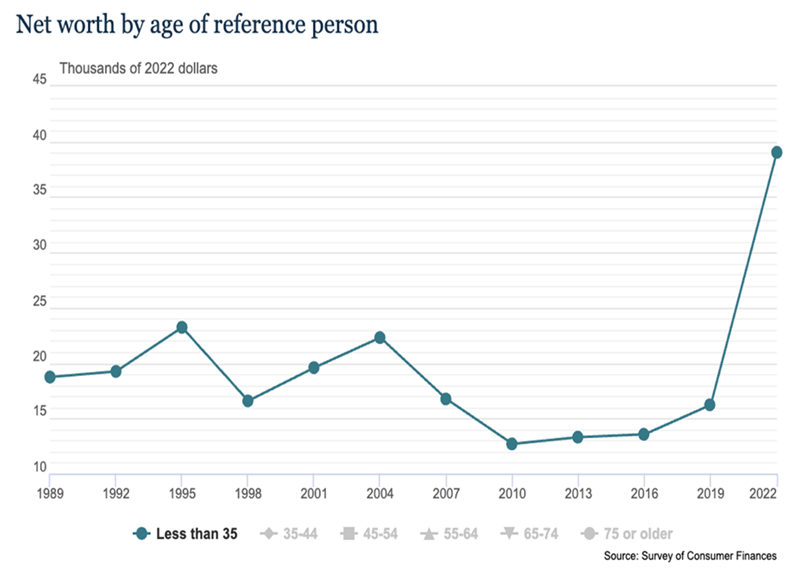
There are two things to note here. First, net worth for Americans under 35 dropped in the 2000s, when that group consisted of younger Gen Xers, whose wealth was depressed from a historical perspective for more than a decade. That started the narrative that “Things are getting worse for young people” that continues to this day.
Second, the spike begins after 2019, which leads one to suspect that this jump in younger people’ wealth is pandemic-related. Could government handouts or speculations on meme stocks and crypto be driving it? If so, that would be a bad sign for the economy, and fuel for a stock-market bubble.
Fortunately, this is not the case, at least in America:
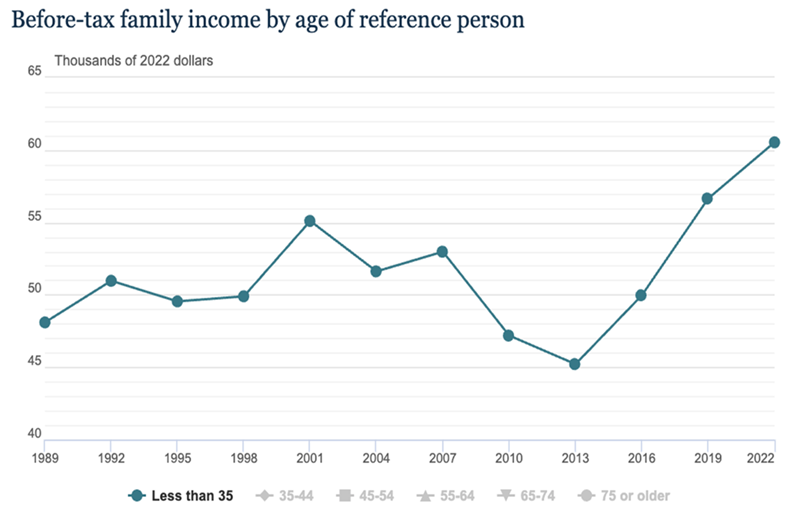
The data shows that young Americans are earning more than they were in prior eras (note these are inflation-adjusted numbers). This trend actually began before the pandemic, so speculative moves are not the story here.
Now it is true that this survey was done three years ago, so I can understand the urge to say that things have gotten worse since then. But they haven’t.
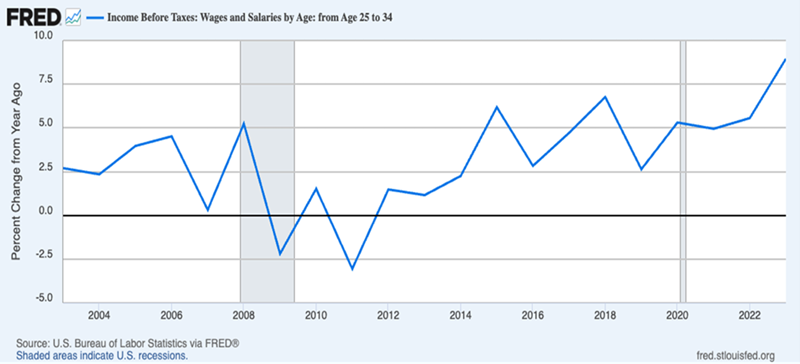
Here we see that work income rose 9% year-over-year in 2023 for workers between 25 and 34. That’s even more than the unusually strong gains we’ve seen over the last decade. And if you look at the median worker in this age group in 2024, you see the same pattern: higher growth in the late 2010s that is sustaining itself into the 2020s.
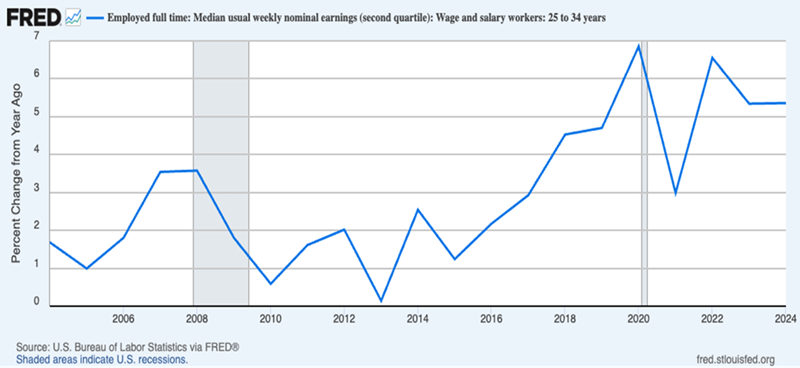
Granted, this chart is messier, but you get the point: Generally speaking, young people’s incomes and wealth are growing quickly, and the trend is continuing.
Again, I bring this up because it’s a sign of a healthy economy, and it justifies that 14.5% annualized return the stock market has posted in the last decade. It just makes sense when young people are earning more, saving more and are making more than their parents or grandparents were at the same age. Stocks are simply reflecting that.
This 95-Year-Old CEF Profits From Richer Young People
All of this is music to the ears of the asset managers at Adams Funds, who run the 8%-yielding Adams Diversified Equity Fund (ADX), a long-time CEF Insider holding.
I’d argue that ADX is the best investment to benefit as younger Americans’ growing wealth drives up stocks. I say that because ADX delivered profits based on many previous generations’ wealth, having been launched way back in 1929.
Nowadays, ADX holds a range of big-cap stocks, with a bent toward tech, at 34.5% of the portfolio. Financials (13%) and consumer discretionary (11%) are the next-biggest sectors, giving the fund a nice profile to tap rising spending by younger people.
Microsoft (MSFT), Alphabet (GOOGL) and Amazon.com (AMZN), among other big- tech mainstays, are all among ADX’s top-10 holdings, as are non-tech firms like JPMorgan Chase & Co. (JPM). ADX is also a bargain, trading at an 8.2% discount to net asset value (NAV, or the value of its underlying portfolio).
Now let’s talk performance: Since we added ADX to the CEF Insider portfolio way back in 2017, it’s solidly outrun the S&P 500 on a total-return basis while paying us its healthy dividend the entire time.
ADX Crushes the S&P 500
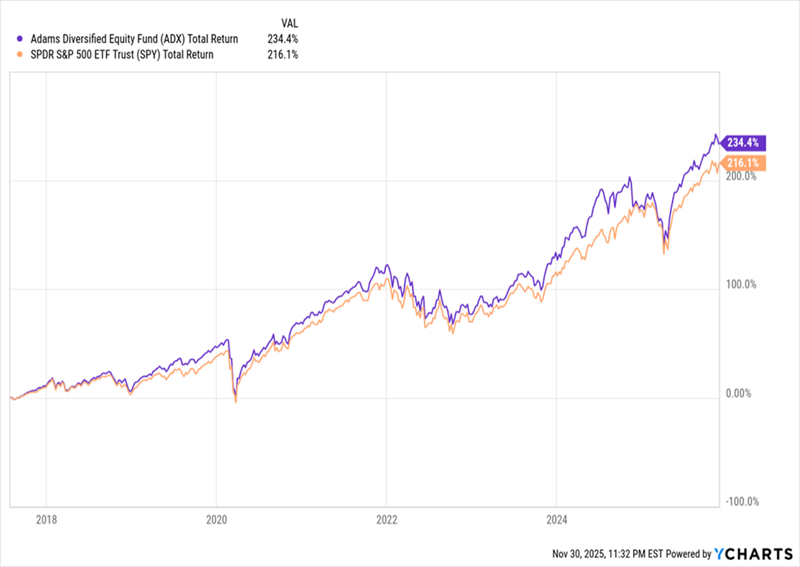
Of course, we have seen some pullbacks along the way. About a year and a half into our holding period, the fund dropped alongside the market and nearly wiped out all of our profits. This was a stressful time, but it’s a barely visible blip in the chart of our entire holding period above.
That’s the power of staying in the market, tuning out the noise and staying focused on long-term trends (like the growth of Gen Z’s wealth). Best of all, with CEFs like ADX, we get paid healthy dividends while we ride out any storms.
The 5 Best 9%+ Dividends to Profit From Gen Z’s Surging Wealth
This is the perfect megatrend for us to capitalize on: The media is just starting to pay attention to Gen Z’s growing wealth, but the idea that this generation is “screwed” is still common “wisdom.”
As this overly gloomy take fades, it’ll throw a lift under stocks. And we’re here for it.
ADX is a great start, and we’re going to build on it with a complete 5-CEF package that yields 9% on average now, These 5 funds—which hold top bonds, stocks and real estate investment trusts (REITs)—are also in the bargain bin, so much so that I’ve got them pegged for 20%+ upside in the next 12 months.
And that’s in addition to the 9% average dividends they kick out!
Now is the time to buy them—and lock them away while “quiet megatrends” like this one push them higher. Click here and I’ll tell you more about this “hidden” portfolio of high-paying CEFs and give you a free Special Report revealing their names and tickers.