
Today we’re going to talk about a closed-end fund (CEF) that not only helps us protect our portfolio as this market wobbles—it gives our income stream a boost, too.
The situation in the Middle East (and the market reaction to it) is behind our opportunity here. That and the fact that this fund has proven that its strategy is purpose-built for times like these.
But that said, this isn’t a fund we can “set and forget”: Timing matters (on both the buy and sell side)—and the current moment is particularly well suited to its portfolio and strategy.
The fund we’re going to discuss holds everyday stocks, like those in the S&P 500. But what sets it apart from, say, a garden-variety ETF like the State Street SPDR S&P 500 ETF Trust (SPY) is that it sells covered-call options on its portfolio.
These options let the buyer purchase this fund’s stocks at a fixed future price and date. No matter how those trades play out, the fund uses the fees it charges for these rights to fund its 8.4% dividend.
If you’re a member of my CEF Insider service, this likely sounds familiar, since we regularly hold funds that sell covered calls. They tend to be popular at times like these because covered-call strategies do best in volatile markets.
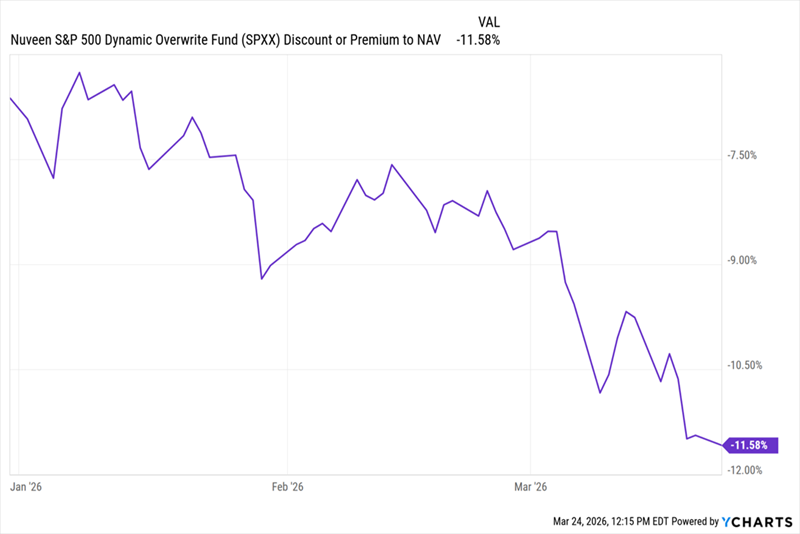
That’s where our opportunity comes in—because the fund we’re going to talk about today, the Nuveen S&P 500 Dynamic Overwrite Fund (SPXX), has gone the other direction: As the market has gotten more panicky, this fund has gotten cheaper.
And now its discount is so deep—11.6% as of this writing, miles below its 2.7% average over the past decade—that it’s hard to ignore:
“Volatility Hedge” Gets Cheaper …
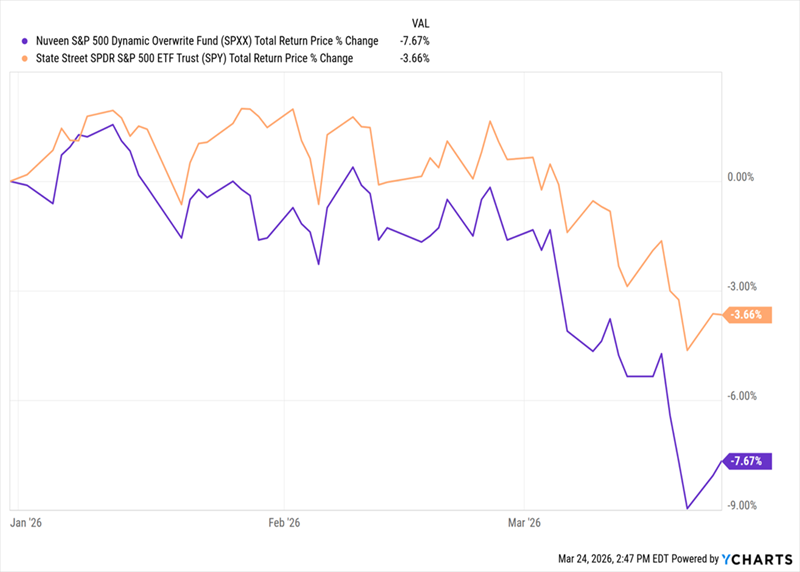
That widening discount has, in turn, caused SPXX (shown in purple in the chart below) to lag SPY (in orange) on a total-return basis this year, even though both funds hold the same stocks and, yes, this kind of market should be fuel for the covered-call fund:
… And Drags Down Returns
That mispricing exists for a couple of reasons. First, market anxiety is running so high that it’s not only caused investors to generally pull back from stocks—it’s also caused them to sell some stock-focused funds designed to hedge against volatility, too.
Moreover, investors are also likely responding to the fact that covered-call funds tend to lag in rising markets (more on this in a moment). As a result, those positioning for a rebound are probably looking elsewhere.
My take? The longer this fear goes on, the more likely investors are to come back to SPXX and bid its discount closer to the usual level, especially when they can get an 8.4% dividend from this fund—far above the 1.1% SPY pays.
Moreover, that dividend has grown—up 38% in the last five years:
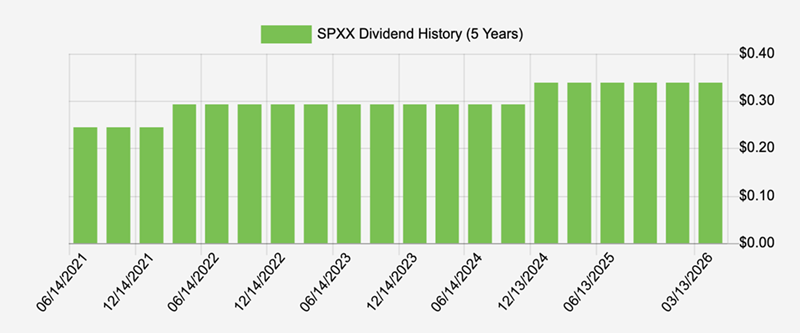
Source: Income Calendar
And there’s another reason to believe this discount could be short-lived:
Sentiment Aside, SPXX Is Outperforming
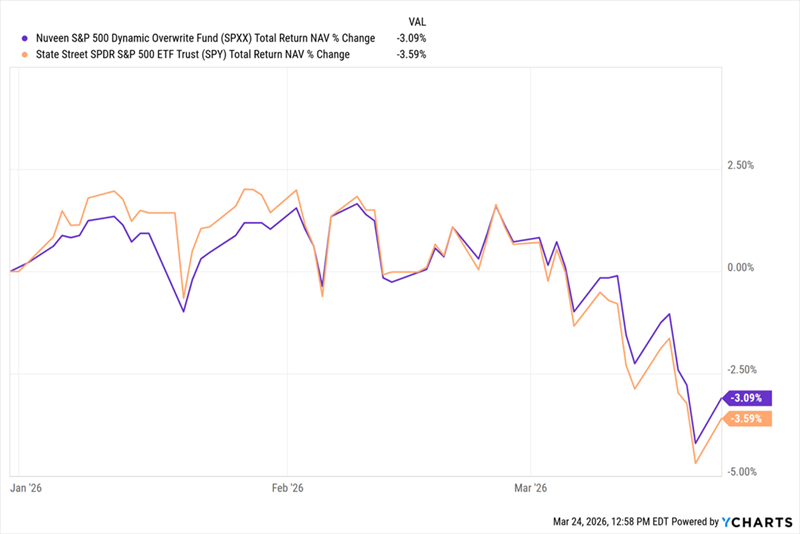
Now, to be sure, neither SPY nor SPXX have looked great this year, but note the purple line above. That’s the performance of SPXX’s underlying portfolio (or its total NAV return, in CEF-speak).
It’s showing us that on a NAV basis, SPXX is modestly outperforming SPY year to date. In other words, relatively speaking, the fund’s holdings and option strategy are holding up well in the current market. This also tells us that the fund’s underperformance based on market price is more about sentiment than strategy.
That’s at the heart of our opportunity here, and as long as SPXX’s portfolio continues to perform well, the fund’s wide discount will be under pressure to return to the norm. That makes SPXX particularly appealing now.
But that’s not quite the end of the story. Remember a second ago, when I said timing matters with this fund? Well, one downside of its covered-call strategy is that in a rising market, it tends to lag the benchmark index. That’s because more of its options are exercised, and its best performers are sold, or “called away.”
This highlights a key takeaway about covered-call funds: They tend to perform best in sideways or volatile markets, but lag during sustained rallies.
That doesn’t diminish SPXX’s appeal now, but it does put something of a stopwatch on the fund. Once we see sentiment improve, and the S&P 500 start to climb in a consistent way, we’re better to sell SPXX and move into a “pure” equity fund. Fortunately, there are plenty of those in the CEF world, many of which sport yields as high—or higher—than SPXX.
The 5 Funds in My “60-Paycheck Dividend Plan” Go Beyond SPXX, Pay 9.3%
SPXX is a great CEF for this market moment, but I’ve got 5 more that bolster your portfolio with even bigger dividends: I’m talking yields to the tune of 9.3%.
These funds come from across the economy, and they’re all trading at exceptional discounts due to today’s market fears.
Those deals are unlikely to last as investors come around to the 9.3% income and deep discounts on offer here—especially when they realize these 5 funds all pay monthly.
Think about that for a moment: 5 monthly paying funds = 5 dividend “paychecks” every month. That’s 60 payouts a year!
This “60-paycheck” income plan is purpose-built for volatile markets. Click here and I’ll tell you more about it and give you a free Special Report revealing the 5 funds that make it work.