
If you ask the average investor what, say, an ETF is, you’ll likely get a good answer. A closed-end fund (CEF)? Likely a blank stare.
That’s because CEFs are a tiny corner of the market, with only about $300 billion in assets among them. ETFs? About $13.5 trillion. The scale is way out of whack here.
At CEF Insider, of course, we like it this way. It’s why “Insider” is in the service’s title.
Since CEFs are obscure, we can easily find overlooked ones trading at big discounts to net asset value (NAV, or the value of their underlying portfolios). Then there’s the income: Right now, the average CEF yields 8.7%, with many paying dividends monthly.
CEF discounts make our upside play straightforward: Buy when the discount is unusually wide, ride along (and collect our payouts!) until it narrows or flips to a premium. Then sell for a profit and move on to the next overlooked CEF.
Rinse and repeat.
CEF Obscurity Sometimes Attracts Celebrity Investors
But even though CEFs are off the radar, the odd famous investor does dip their toe in every so often. One such person is Bill Ackman.
Ackman is a value-investing maverick and multibillionaire whose public fights against corporate management teams have grabbed headlines worldwide.
He dramatically took on Herbalife (HLF) via a huge short position in 2012. He ended up on the losing end of that one, but his aggressive moves did turn Chipotle Mexican Grill (CMG) around. Similar tactics with Valeant Pharmaceuticals (VRX) and Canadian Pacific Kansas City (CP) had mixed results.
But overall, retail investors who’ve ridden along with Ackman haven’t seen great returns.
Below you can see the performance of his hedge fund, Pershing Square Holdings (PSHZF), in orange, versus an S&P 500 index fund, in purple, over the last decade. Since Pershing is based in London, we’re looking at its US-listed over-the-counter (OTC) stock here:
UK-Based Pershing Square Has Underperformed for Years …
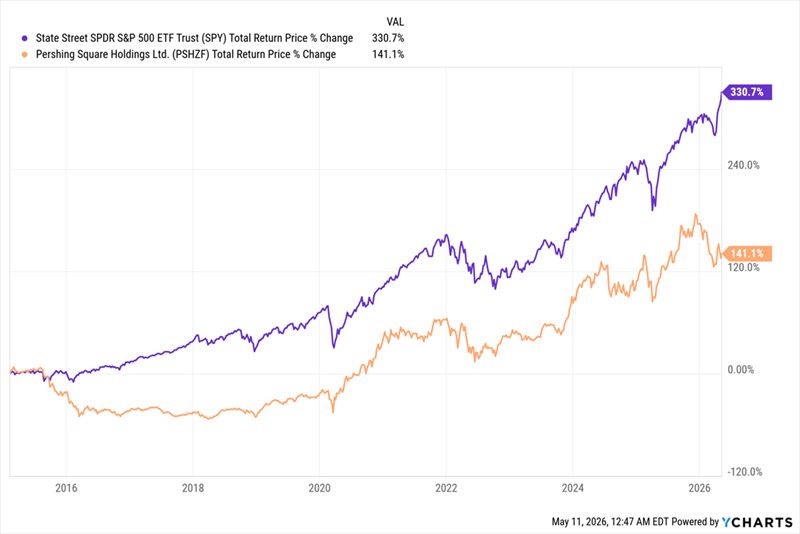
As a result, PSH has traded at a wide discount to NAV (around 30% much of the time) for years. That’s a steeper markdown than all but the six cheapest CEFs tracked by CEF Insider.
Note that since PSH is London-based, its structure is a bit different than the CEFs we cover in CEF Insider (which is why you won’t find it on a screener like CEF Connect). Also, unlike our CEFs, PSH—whether bought under the London or US listing—pays no dividend, another (big!) strike against it for us.
Nonetheless, let’s continue, because Ackman’s CEF efforts do hold useful lessons for us, especially since, in April, he debuted a US-listed CEF: Pershing Square USA Ltd. (PSUS). That fund fell sharply after its IPO:
… And Ackman’s US-Listed CEF Wobbled Out of the Gate, Too
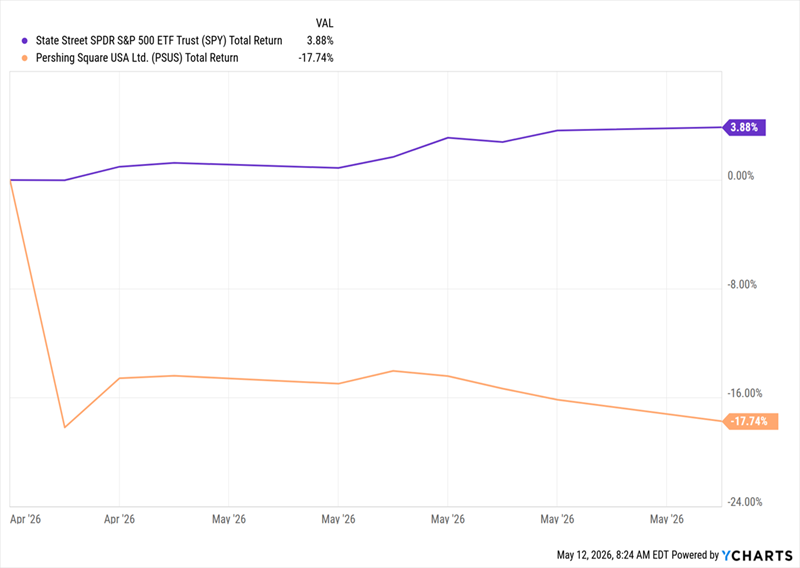
While the S&P 500 (again shown through the performance of an S&P 500 index fund, in purple) has done well in the last couple of weeks, as of this writing, PSUS (in orange) has gone the other way, with a 17.7% drop in value from its IPO date.
What does this tell us? With PSUS moving from par to a roughly 12% discount in a couple weeks, the firm’s London listing clearly wasn’t the problem. It’s simply that, right now, investors don’t see Ackman as a star manager deserving premium pricing.
Moreover, PSUS has mainly marketed itself as a vehicle to invest alongside Ackman, and has not revealed its holdings. (CEFs don’t have to do so at IPO, and the fund is so young it hasn’t had time to make this disclosure.)
That makes it tough to predict where the discount will go from here, but the roughly 30% markdown PSH typically sports is a decent guide. That, along with the fact that PSUS doesn’t pay a dividend, either, makes this a fund to avoid.
The Fee Issue
Then there are PSUS’s fees, which in my mind are a bigger issue than the lack of clarity around its future moves. According to their SEC filings, PSUS’s managers will charge investors a flat 2% fee:
“The Company [i.e., PSUS itself] pays the Manager [i.e., Ackman and his team] a fee, payable quarterly in advance on the first business day of each fiscal quarter, based on the Company’s NAV on the last day of the previous fiscal quarter equal to 0.50% (or 2.0% on an annualized basis).”
Technically speaking, this is less than the average CEF, which has fees of 2.6%. However, that figure is skewed by CEFs with very high fees, like the XAI Octagon Floating Rate and Alternative Income Trust (XFLT), whose fees are more than 5% of assets.
There are plenty of solid CEFs with much lower fees, like the Adams Diversified Equity Fund (ADX), a CEF Insider holding whose fees are just 0.49% of assets.
This is also a bit of an unfair comparison because many CEFs (like XFLT) look like they charge high fees because they include the cost of leverage in their calculation. Notably, that 2% fee PSUS discloses does not include the costs on the $50 million of preferred shares it plans to issue, or the 15% to 20% leverage ratio it intends to carry over time.
That points to potentially higher fees in the future.
That isn’t necessarily a bad thing for CEFs, as strange as that sounds! A heavily discounted CEF with high fees can still outperform a low-fee CEF trading at a premium. But it also lowers PSUS’s appeal, unless and until its discount gets even wider still. Otherwise, this is a fund to avoid, despite its high-profile manager.
These 4 “Pivot Points”—Not Ackman’s Flashy CEF—Are Where We’re Going Next
The great thing about CEFs is that, despite their small market size, they give us lots of ways to tap into the fastest-growing trends out there. And they let us do so at a discount!
I’m tracking 4 CEFs that are cheap now, while kicking out a solid 10% average dividend. Plus they give us “upside two ways”:
- Through their narrowing discounts: All 4 of these funds are unusually cheap, which can’t last because …
- They’re dialed into the biggest shifts AI is driving today, including the automation of manufacturing, fast drug development and surging power demand.
Wall Street is starting to notice these shifts, but there’s still time to get in. And overlooked CEFs are the perfect way to do it. With their way overdone discounts, our 4 pivot-point CEFs perfectly positioned to “ride the tide” here.
While flashy new funds like Ackman’s wobble, these 4 workhorses quietly build lasting wealth. Click here and I’ll lay out the details on all 4 and give you a free report with their names and tickers.