
Imagine a credit fund that yields 15.3% and is built to deliver strong returns in all rate environments. That’s the promise of a closed-end fund (CEF) called the XAI Floating Rate & Alternative Income Trust (XFLT).
But the fund has, unfortunately, not backed that up with strong performance. As we can see in orange below, XFLT has badly lagged the popular S&P 500 index fund (in purple) since its launch in 2017.
A Laggard, Even With a 15.3% Yield
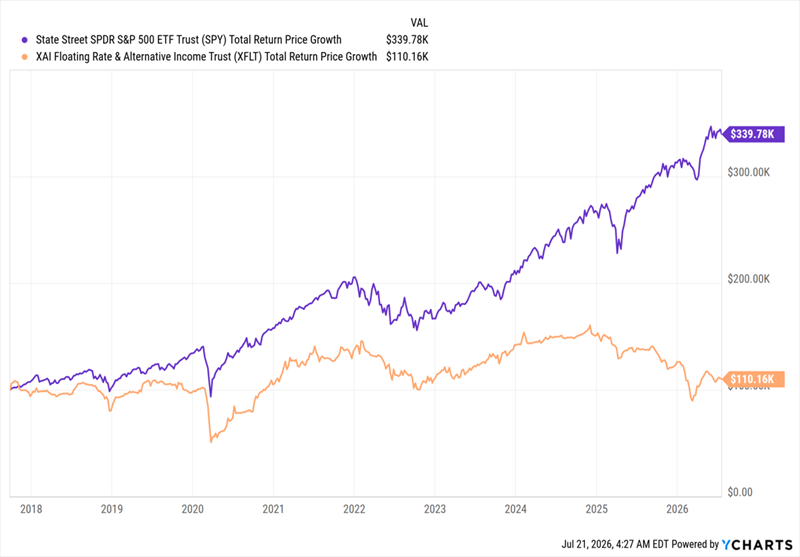
That performance amounts to just a 0.57% annualized total return! That’s less than many of the high-yield savings accounts offered by regional and national banks.
To make matters worse, XFLT comes with high fees, with a 7.56% total expense ratio, including leverage costs and 2.74% just for management. This is unsurprising given that the fund holds collateralized loan obligations (CLOs), which bundle floating-rate business loans and slice them into tranches by risk. The result is an asset that gives investors a piece of many different loans. These are most often used by large financial firms to diversify and to get exposure to different kinds of assets that each respond differently to interest-rate changes.
So what’s the appeal of this fund to everyday investors? Simple: the dividend yield.
If you look up XFLT on Google or Yahoo Finance, you’ll see an eye-popping number here: 15.3% as of this writing. That means that every $100,000 invested in XFLT would return around $1,275 in monthly income.
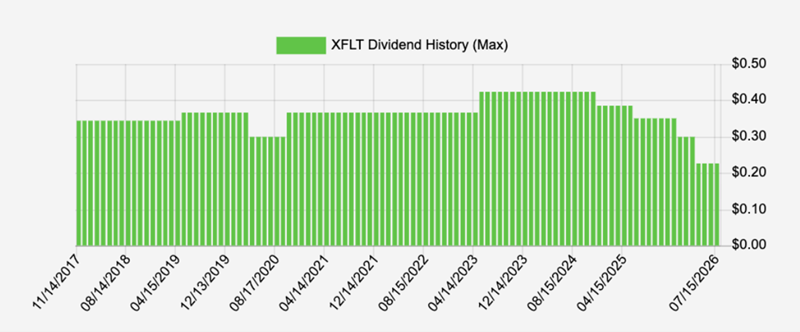
So the appeal is clear: a very large income stream—more than 15% of your investment back as dividends every year. Trouble is, XFLT’s income stream is far from reliable.
Source: Income Calendar
As you can see above, XFLT’s dividend has fallen over time, though most of that drop has been recent, so it’s possible to imagine an investor avoiding the payout cuts (or at least most of them) by selling within the last couple of years.
Unfortunately, making such a move would not have averted our second problem with XFLT: the crash in the fund’s share price.
XFLT’s Price Is a “Trapdoor” Under Its Dividend
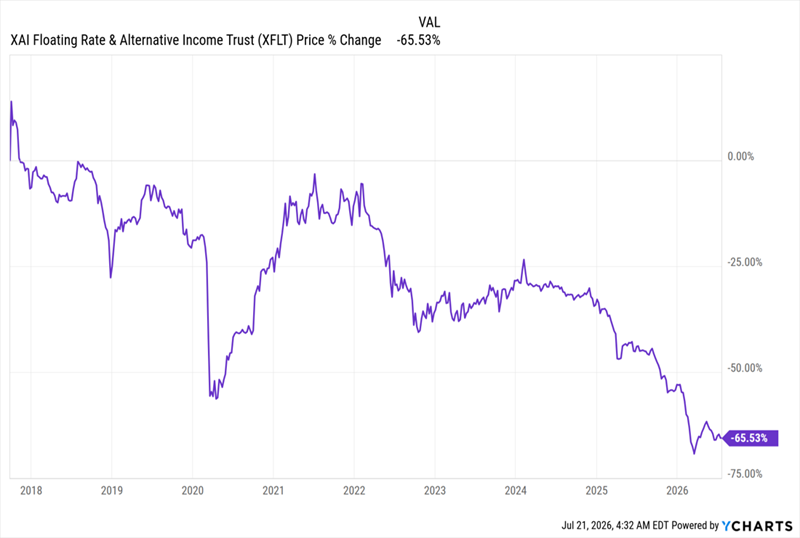
An investor who sold XFLT any time after the IPO would have done so at a loss, and that loss has kept growing. To wit, an investor who was in at the start would be down $65,530 on a price basis on a $100,000 investment, as of this writing, from the IPO date, but would have collected about $75,000 from dividends, just barely outrunning the loss on price. This is hardly a winning investment.
Which brings us to another change happening with the fund.
Management Shakeup Adds Uncertainty
The firm that advises XFLT and ultimately decides what it will invest in is called Octagon Credit Investors. XFLT’s overall management firm, XA Investments, is seeking to replace Octagon with a subsidiary of King Street Capital Management in a shareholder vote ahead of a July 30 special meeting of shareholders. (King Street has has $30 billion in assets under management and $12 billion in CLOs.)
There’s just one problem: King Street doesn’t have much in the way of publicly available information about the performance of its CLOs, so there remains a lot of risk here, no matter how the vote goes.
As a result, it’s a good idea to sit back and see what happens with XFLT. While its 22% discount to net asset value (NAV, or the value of its underlying portfolio) makes it look like a potential rebound candidate, the risk that a new manager isn’t any cheaper or better at managing the fund means it’s better to look elsewhere.
And there are better places to look.
MCI: Smaller Dividend, (Much) Bigger Returns
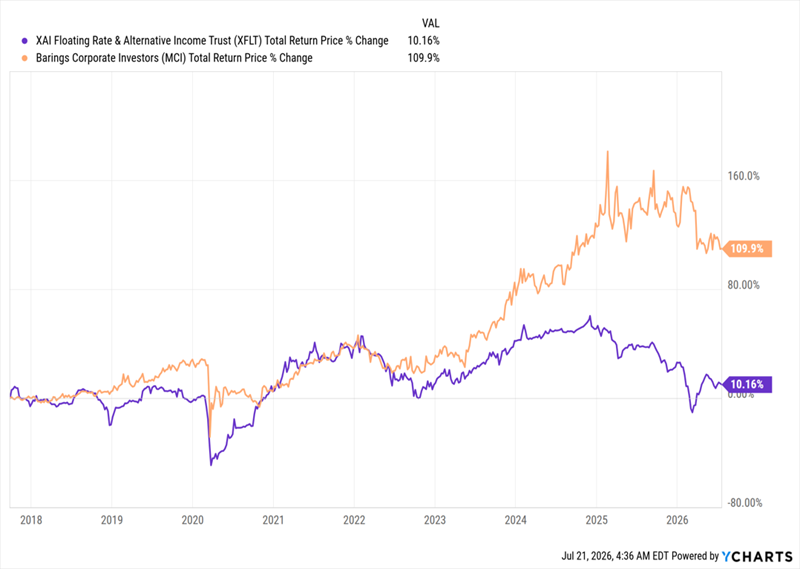
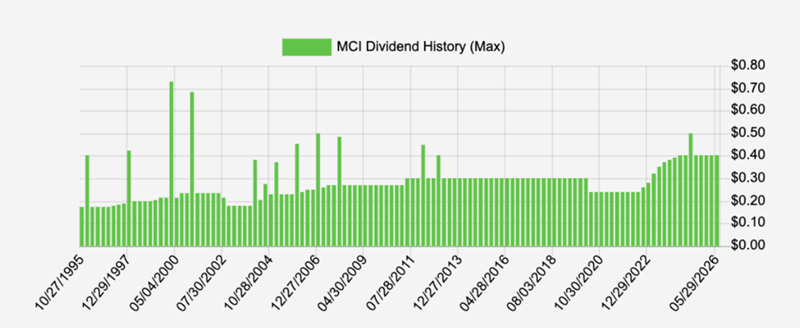
Instead of XFLT, I’d consider picking up shares in another CEF called Barings Corporate Investors (MCI), whose total return since XFLT’s IPO (shown in orange above) has been literally 10 times better. It also boasts a stronger record on the payout front:
Source: Income Calendar
With a long history of payout hikes (going back to the 1990s), MCI has proven itself as an income generator over many different kinds of markets. Moreover, its 10% annualized total return over the last five years is impressive, and one more reason why this fund is worth considering.
To be sure, MCI’s yield is smaller than that of XFLT, but it’s not small by any means. At 9.5%, it’s still above the roughly 8% CEF average. Plus you’re getting that high income stream without sacrificing capital gains here.
MCI’s Sturdy Share Price Supports Its Payout
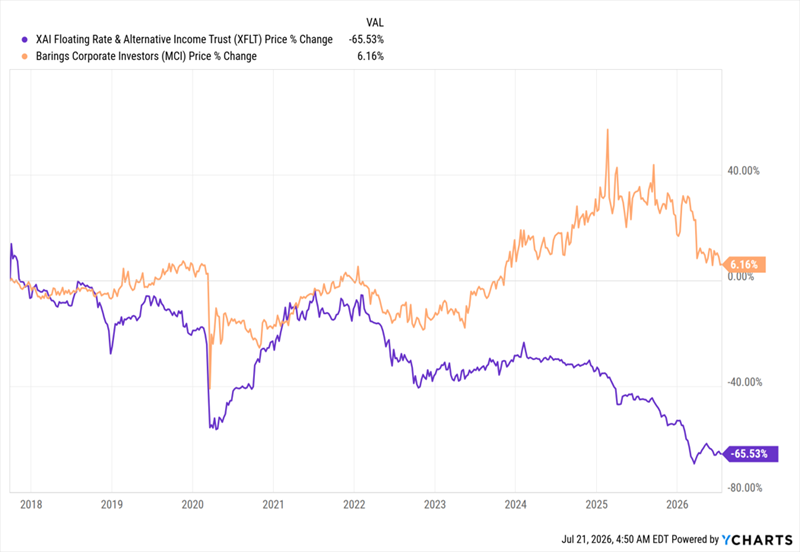
Above you can see that, purely on a price basis (or without reinvested dividends), MCI (in orange above) has vastly outperformed XFLT (in purple) over the last decade, putting it ahead of that fund on just about every count.
Finally, MCI is also a collection of business loans (in MCI’s case, mostly bank loans with some straight loans to corporations on the side), so we’re still getting cash flow from lending to firms, just with more sustainability and a stronger track record.
These 5 Funds Pay Dividends 60 Times a Year, Yield 9.7%
XFLT highlights the one thing we all crave in these uncertain times: payout predictability. And that starts with high, monthly paid dividends.
Monthly payouts are the ultimate in predictability—they’re unheard of among “regular” stocks and ETFs.
The 5 CEFs in my “60-Paycheck” Dividend Portfolio are my top picks in monthly payers. They yield 9.7% on average and, if you buy all 5, you’ll collect one payout from each of them every month.
That’s 5 new payouts a month—or 60 dividend “paychecks” a year!