
Hey, remember tariffs? Well, they’re baaaaaaaack!
As of last week, new import taxes of 10% to 12.5% were slapped on 60 trading partners. This covers a cool 99.4% of everything that America buys abroad. Let’s pile the tariff return on top of the recent Fed news and tensions that keep rolling in the Middle East. There’s obviously plenty of bricks in the current Wall Street wall of worry for this stock market to climb.
This climb, however, is no problem for “low drama” dividends like these. I’m talking about five companies yielding between 4.9% and, get this, 11.5%! No matter the headlines these payouts keep flowing.
Plus, these stocks hold up better than the broader market during pullbacks.
The technical term for low drama on Wall Street is “low beta.”A beta below 1 signals that a stock is calmer than the market. That’s what we want.
These five companies offer up low beta and high yields, an excellent combination.
The financial sector has generally been a smoother ride than the broader market in 2026, but First Interstate BancSystem (FIBK, 4.9% yield) stands out not just for its low volatility, but its relatively high yield of nearly 5%.
FIBK is the company behind First Interstate Bank, a Montana-based regional operator with 271 banking offices in 10 states across the Midwest and Pacific Northwest. Its offerings are what we’d expect: consumer products (checking and savings accounts, credit cards and mortgages), business products (commercial and SBA loans), wealth management and treasury solutions.
It’s a boring, under-the-radar company whose shorter-term struggles (such as loan declines and elevated payoff activity) are masking encouraging longer-term trends, including its expanding net interest margin. Its shareholder reward story is similarly mixed.
First Interstate Slammed the Brakes on Dividend Growth a Few Years Ago
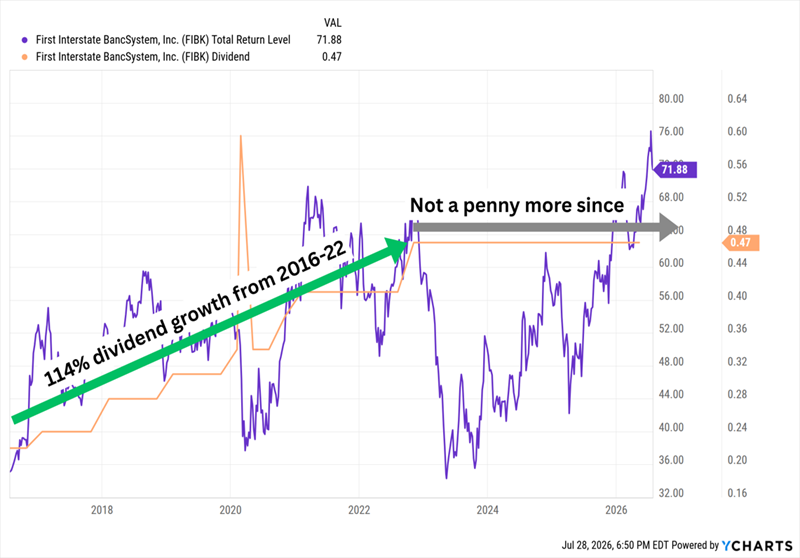
However, FIBK has been aggressively repurchasing stock since it announced a buyback program during the second half of 2025. It has so far clawed back roughly 8% of its outstanding shares, and the company just green-lit another $150 million, putting the total program authorization at $450 million. The open question: Will its improving bottom line eventually flow back into the dividend?
As for volatility: FIBK’s one- and five-year betas are 0.6 and 0.8, respectively, both of which signal that the company is less shaky than not just the S&P 500, but the financial sector, too.
Real estate as a whole has had every bit as much volatility as the broader market over the past few years—without the gains to show for it. But Sabra Health Care REIT (SBRA, 5.4% yield) has been less choppy on average while still delivering much better returns.
Sabra is a senior-focused healthcare real estate investment trust (REIT) with about 360 property investments across the U.S. and Canada. The biggest chunk of its business is skilled nursing and transitional care real estate, at a little less than half the portfolio’s annualized cash net operating income (NOI). The rest comes from managed senior housing, leased senior housing, behavioral health properties, specialty hospitals, and more.
The relative stock stability is great—the company boasts a five-year beta of 0.6 and a downright gentle one-year beta of 0.2.
But the Dividend Is Too Sleepy … For Now
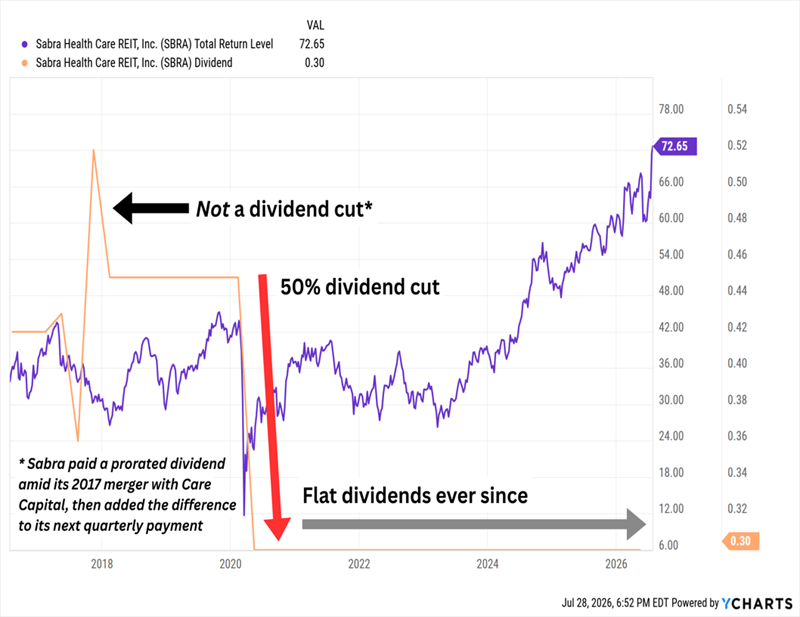
There’s reason to believe that could change. SBRA’s current 30-cent quarterly dividend comes out to $1.20 per year, which is 77% of estimates for this year’s funds from operations (FFO, a profitability metric for REITs). That’s a healthy coverage ratio for a REIT—one that leaves room for growth, in fact.
And Sabra just raised its full-year FFO and adjusted FFO (AFFO) guidance following a coup of a tenant transition. The company announced that all 26 properties currently leased to Avamere will be moved to a new tenant—Cascadia, a high-quality operator—under a deal that includes a nearly 30% increase in rent.
But Wall Street isn’t sleeping on Sabra. Shares now trade at roughly 14 times FFO estimates, which is on the steep side.
Getty Realty (GTY, 5.5% yield) is another well-grounded REIT. It owns more than 1,160 freestanding (aka single-tenant) retail properties across 44 states and D.C.
Retail generally isn’t synonymous with reliable, but Getty is built different. That’s because its tenant base includes convenience stores, express tunnel car washes, auto service centers, drive-through quick-service restaurants, gas stations, repair shops and more. It’s not flashy, but Getty prints cash as a result.
And the More It Prints, The More We Get
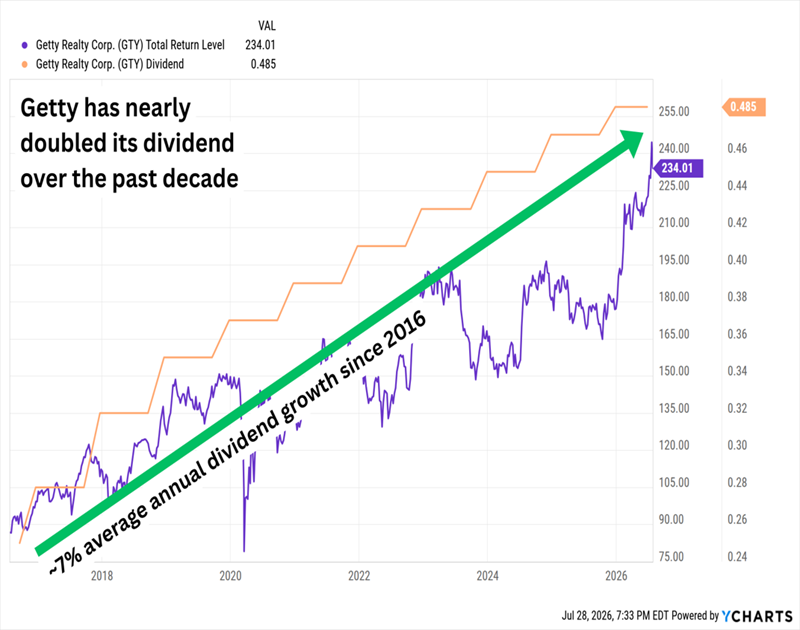
Getty’s 5%-plus dividend accounts for less than 80% of FFO estimates, and it’s backed by sturdy tenants with good credit. It’s no surprise that GTY shares are historically cool cucumbers—their five-year beta is under 0.8, and their 1-year beta is close to zero.
The flip side? Getty grows like a defensive stock, too. It’s also coming up against some near-term headwinds, including weakness in lower-end consumers that’s weighing on its convenience store and gas station tenants.
Kinetik Holdings (KNTK, 6.6% yield) is a midstream energy company that operates in Texas’ Delaware Basin, which is part of the larger Permian Basin. Its assets include 200 miles of crude oil pipeline, 90,000 barrels of crude oil storage, 3,500 miles of steel natural gas gathering lines, 2.2 billion cubic feet of nat-gas processing capacity, 360 miles of water pipelines and more.
KNTK, and the energy sector as a whole, also help illustrate how a low beta doesn’t always tell the whole story.
Kinetik Is a Stock in (a Lot of) Motion
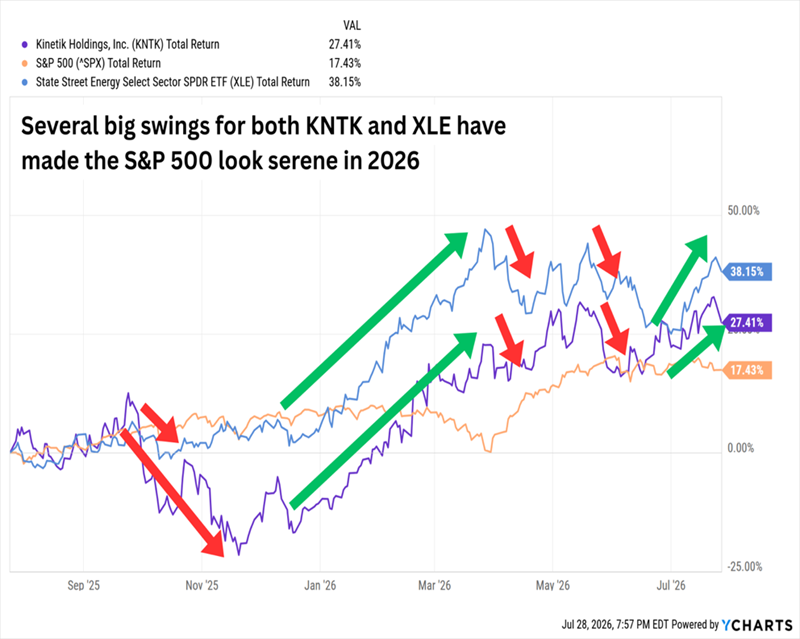
While beta is used as a gauge of volatility, what it really does is measure how an investment moves relative to a comparable index. So while a low beta can mean a stock isn’t volatile, it can also mean something else—like in this case, KNTK’s almost nonexistent one-year beta is really saying that the stock hasn’t been at all correlated with the market.
Kinetik is more sensitive to commodity prices than many midstream peers, so it has been prone to larger swings—and yet its performance is merely par for the industry. So we can’t rely on KNTK for defense. Upside is a question mark, too. It operates in one of the fastest-growing formations in the country, but it has at times been dogged by weak Waha Hub natural gas prices and price-related volume curtailments from its customers.
The dividend is a bright spot, albeit not blinding. Kinetik was formed in 2022 from the merger of Altus Midstream and BCP Raptor Holdco LP. It quickly started paying 75 cents per share. After a couple years of holding flat, it raised by 4% in 2024, then by another 4% or so in 2025.
Ellington Financial (EFC, 11.5% yield) is a mortgage REIT (mREIT) that deals not in physical properties, but instead “paper” holdings such as residential transition loans, residential and commercial mortgage loans, commercial mortgage-backed securities (CMBSs) and collateralized loan obligations (CLOs). It also deals a bit in agency MBSs, though it’s reducing that business.
The game is pretty simple here: mREITs borrow money at short-term rates to buy mortgages and other paper tied to long-term rates. They pocket the difference. So they need short-term rates to be lower than long-term rates (which they usually are), and they thrive when the spread between the two is wide.
Ellington’s five-year beta is around 0.9, so it has been only a little less volatile than the market over that time. The one-year beta of 0.5 implies it has been much calmer of late—not an advantage given that EFC’s stock has been flat while the S&P 500 has climbed. But check this out:
EFC’s Total Returns Are More Tightly Tied to the Market
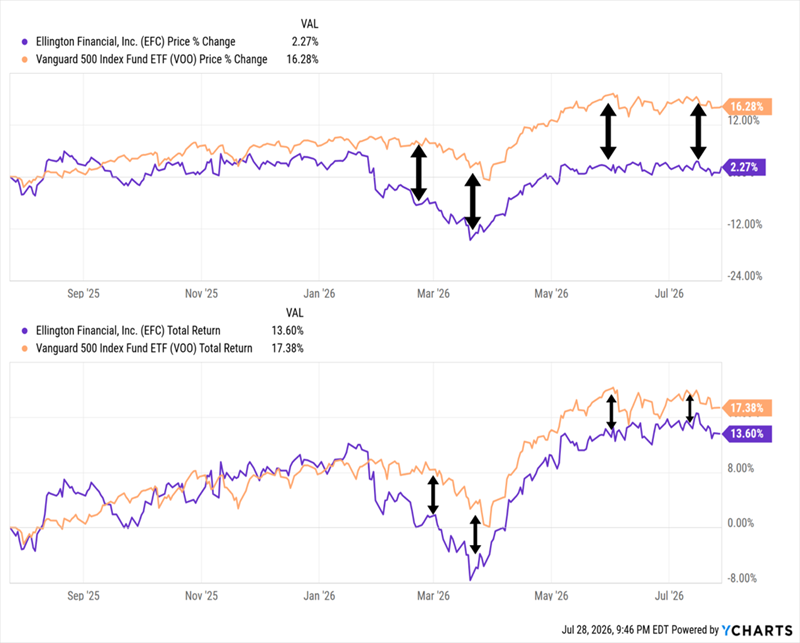
Like with many mREITs, the lion’s share of EFC’s returns come from its super-sized monthly dividend, not stock movement—but financial-data sites usually calculate beta from pure price performance. The good news? Ellington might be more volatile than the numbers suggest, but it has still been relatively less wiggly.
Whether we’d want to hunker down in Ellington is another matter.
The yield, while sky-high, looks safe for now. The company’s adjusted distributable earnings guidance of 45 cents per share comfortably covers the 39 cents it pays out every three months. However, the fate of EFC’s stock is largely tied to interest rates—shares likely would react well to signs of a cut, but if the market thinks hikes are inbound, this mREIT could be in for a bumpy ride.
This 11%+ Dividend Is My Favorite Way to Fight Off Market Chaos
The news cycle is back into overdrive, which means the market is a minefield of headline risk right now. That’s why I’m always on the lookout for double-digit yields like what EFC offers right now. That massive income can go a long way toward stabilizing our portfolios while helping us come out ahead.
But we need the right payers.
The best double-digit yielder on the market right now isn’t a single company, but a diversified fund with a highly skilled manager who has a track record of running up the score on his competition.
His bond portfolio not only shells out a wild 11% yield, but it’s also set up for stock-like gains.
This fund checks off just about every income box I can think of:
- It pays a whopping 11% in annual income!
- It has increased its dividend over time
- It has paid out multiple special dividends
- And it pays its dividends each and every month!
And that superstar manager I mentioned? Morningstar previously named him a Fixed Income Manager of the Year, and he’s been inducted into the Fixed Income Analysts Society Hall of Fame.
That’s about as good a resume as we’ll find, and his fund will pay us $1,100 for every $10K we invest.
But the window is closing fast! Premiums on funds like these tend to rise as volatility ticks higher and as investors rotate out of growth stocks and into reliable sources of income like this. I don’t want you to miss your chance. Click here and I’ll introduce you to this incredible 11% payer and give you a free Special Report revealing its name and ticker.