
You didn’t think the US Treasury Secretary was just going to sit back and watch interest rates rise, did you? Of course not. We careful contrarians knew better!
This country can’t afford high rates. Not on a $40 trillion debt pile! The interest payments are already too much for Uncle Sam to handle.
Yet the bond market decided to test Secretary Bessent, who replied emphatically.
Or did he?
I’ve argued in these pages that rising long-term rates would not be allowed. At some point, they would draw a reaction from the Treasury Secretary. And now that we have the reaction, I ran the numbers to see what happens during similar bond operations to the one Bessent just announced.
Bottom line: What should we expect from Treasury yields? The answer? The unexpected.
First though, Bessent’s announcement: Uncle Sam is going to buy back some of his own IOUs. And make no mistake, this is not anything like a stock buyback. The US government does not have spare cash lying around to return to shareholders or take advantage of its stock valuation.
This is the Treasury selling more short-term IOUs and using the money to buy long-term ones. This is a “recycling program” for Uncle Sam’s debt that buys back at least $4 billion of longer-dated Treasuries (10+ year bonds) per “operation.” (What a funny word for all of this, by the way. Sounds… so… tactical.) The idea: borrow at lower (short-term) rates and then buying and retiring higher (longer-term) rates. Reduces the rate owed.
The “operations” start September 9 and run for about two months. Note there was already a $38 billion budget for these “long for short” exchanges. This is simply Bessent moving the target of this bond recycling money to the long end of the curve. A lid means a level yields cannot punch through, because Uncle Sam steps in every time they get close. He is trying his best to put one on the 10-year and 30-year Treasury and everything in between and related, including mortgage rates, which move with the 10-year.
So how much rate relief did Bessent’s bazooka buy? Two sessions later, the 30-year sat five basis points below where it started. (Five means just 0.05%.)
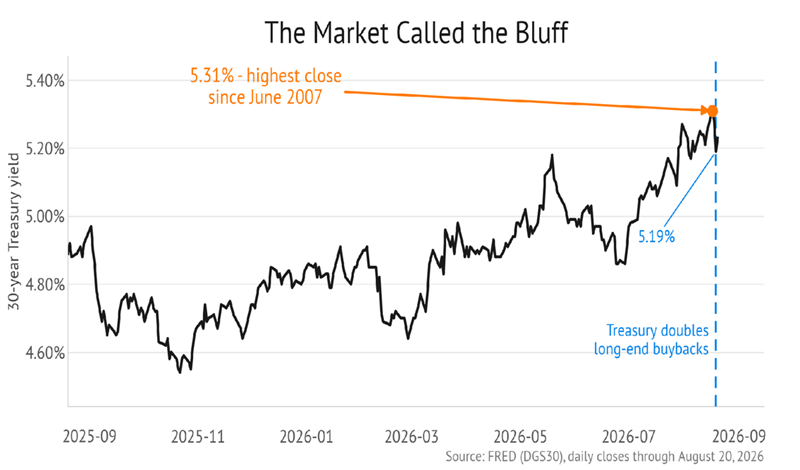
Here’s why the Secretary had to do this: Uncle Sam paid $963 billion in interest in the last 10 months, up 14% year over year. That’s what Uncle Sam’s $40 trillion debt load costs—let’s call it the mortgage on America Inc. With today’s higher rates, Uncle Sam is refinancing a 2%-to-3% mortgage at 5%. Higher rates lead to a bigger and bigger bill, which leads to more borrowing, which leads to higher interest rates.
Bessent believes the buyback will lower long-term rates. But here’s the part that surprised me, and it’s why I DIY instead of headlines. I look at the data: How many days until these yields are right back where Bessent started?
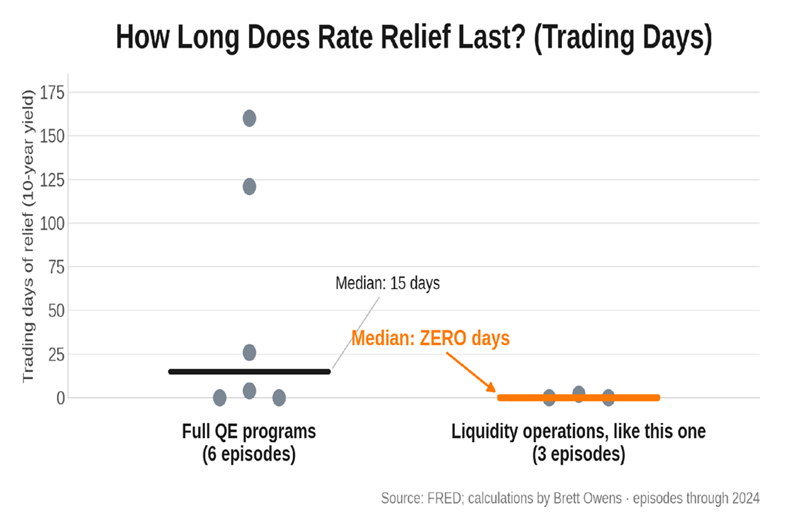
Remember full-blown QE—or quantitative easing, when the Federal Reserve created trillions of dollars out of thin air—bought a median 15 days of relief. (Yikes, expensive!) The two “tall dots”—bringing 100+ days of relief—were the panics of 2008–09 and 2020, when the Fed went full free money.
This latest announcement is not QE—at least not yet! It is a “liquidity operation” (there’s that word again) which means no newly printed money (sell short term, raise cash, buy long, no net change in money supply). This is the third “operation” in seven years and they’ve brought a median zero days of rate relief. Zero! Two of the three never saw yields close below where they started at all.
The best of the three bought two days, back in June 2024, before yields climbed right back. Bessent’s dip is still holding as I write—barely. (And yes, this surprised me. The talking heads say the opposite! This is why we calculated contrarians spend the time to, you know, run the calculation.)
So Bessent may be wasting his time. But there is an operation outside of the US from this time period that held yields down. And oh, is it ironic how it worked. Mario Draghi, president of the European Central Bank—Europe’s version of the Fed chief—promised unlimited buying back in 2012. You probably remember: He said they would do “whatever it takes” to lower rates. Financial podcast intros still quote these dramatic Draghi words.
But get this: He never actually purchased a single bond after he uttered the famous words. Yet Spanish yields stayed down for nearly two years afterwards!
The skeptics today who say the size of Bessent’s operation isn’t big enough? They’re correct on that front. But the size doesn’t necessarily matter. What we learn from Draghi is that it’s all about the threat. And since this announcement has bought all of five basis points so far, Bessent is going to have to step up this threat sooner or later.
All right, so what do we do as income investors? It’s dicey today, because we don’t necessarily have a lid on long-term rates, which puts bond prices in jeopardy. Bonds move opposite interest rates: as rates continue to rise, the bonds in existing portfolios become less attractive, and hence their prices decline.
So, where do we look for value and yield today as contrarian income investors? Abroad. The reason the US is playing this debt game is that we sit at 119% debt-to-GDP. Bessent has no choice but to take on the market when he’s trying to finance that pile. But believe it or not, Brazil and Mexico do not face that choice.
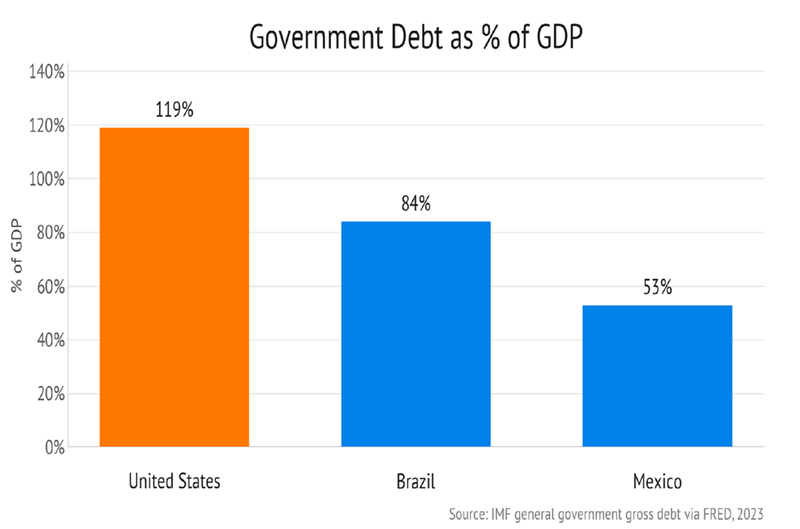
The rating agencies are upgrading their debt thanks to more responsible debt-to-GDP levels (Yes, high, but compared to us? Practically clean!). So, we look to a fund that benefits from the fiscal responsibility of others: The iShares J.P. Morgan USD Emerging Markets Bond ETF (EMB), which holds government bonds issued by emerging markets, pays a monthly dividend and yields nearly 6% today.
Yes, that’s not our usual juicy choice, but there’s more. EMB benefits from a weaker dollar. And, wouldn’t you know it, the greenback slid to a three-month low last week after Bessent’s announcement. Apparently, the bond world thinks money printing is ahead.
A weaker buck makes it easier for the Brazils and Mexicos of the world to pay their dollar debts: Their own currencies fetch more of the dollars they owe. All they have to do is have balance sheets better than ours. And their government debt loads of 84% and 53% of GDP, respectively, are downright modest compared to ours.
The contrast shows up in emerging-market bond returns: They beat US bonds by more than six percentage points in 2025, and EMB itself still yields roughly 5.9% while ours pays roughly 4.7%—a meaningful 26% difference. No wonder we’re up 31% on EMB since our November 2023 Contrarian Income Report recommendation! That’s a healthy 10.1% average annual return with dividends reinvested.
EMB’s Monthly Dividend, Last 12 Months
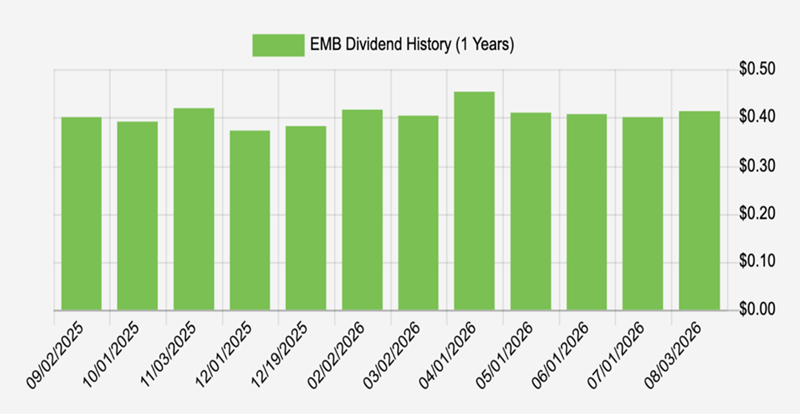
If you’re not yet a Contrarian Income Report member, EMB is one of the monthly payers in my “Retire on Monthly Dividends” plan—each position pays every month, with my best buys dishing up to 11% in dividends annually.