
Don’t look now, but crude oil is back over $100 a barrel. Prices are on fire, rising 20% since July, and the Strait of Hormuz is still shut. Diesel fuel, the transportation fossil fuel of record, sits at a record $6.23 per gallon.
WTI: Up, Up and Away
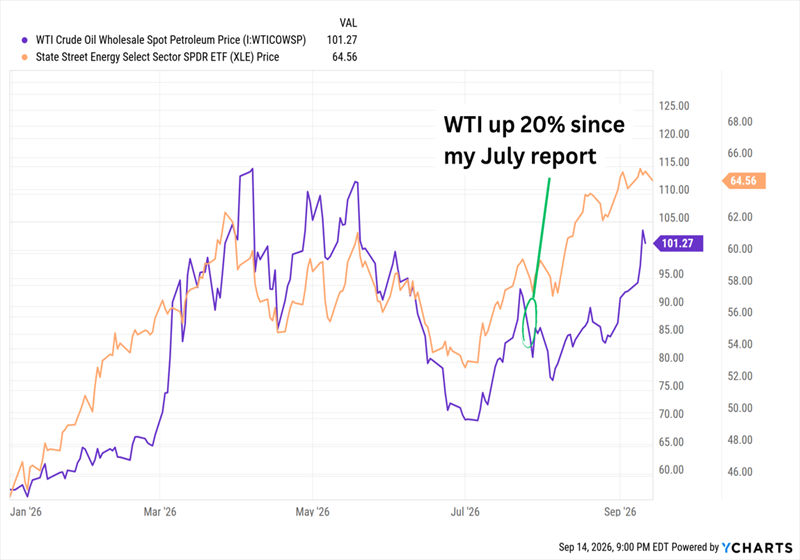
Now, betting on geopolitical outcomes is a dicey game, so placing a bet on the crisis extending or world peace breaking out is tricky. The sure bet is looking at five closed-end funds (CEFs) paying 8.5% on average. Four of these five funds have had an impressive run, and they now trade at narrower discounts than their five-year norms, so we’re watching.
I’ll start with BlackRock Energy & Resources Trust (BGR, 6.7% distribution rate). It owns integrated energy firms, exploration-and-production (E&P) companies, distributors and more. It has enormous weights in Exxon Mobil (XOM, 19% of assets) and Chevron (CVX, 12%). It also owns household names like ConocoPhillips (COP) and Valero Energy (VLO).
If we closed our eyes really tight, we could almost convince ourselves that BGR is just the State Street Energy Select Sector SPDR ETF (XLE). But there are a few noteworthy differences: It’s actively managed, for one—Alastair Bishop and Mark Hume aren’t limited to the S&P 500, and they use this freedom. A quarter of assets belong to international majors such as the U.K.’s Shell (SHEL) and France’s TotalEnergies (TTE).
Also, BlackRock’s fund, which pays us a consistent monthly distribution, yields almost three times the XLE. But that distribution isn’t dividends alone—its monthly paycheck typically consists of varying amounts of dividend income, capital gains and return of capital. That’s common practice in the CEF space.
BGR also used to sell covered calls to generate income—a practice that it stopped in November 2025. This kind of strategy results in high income and a less volatile fund than many plain-vanilla energy ETFs, but it also limits upside. As a result, BGR historically has never been able to fully take advantage of rip-roaring bull runs.
And the Strategy Change Hasn’t Been Much Help, Either
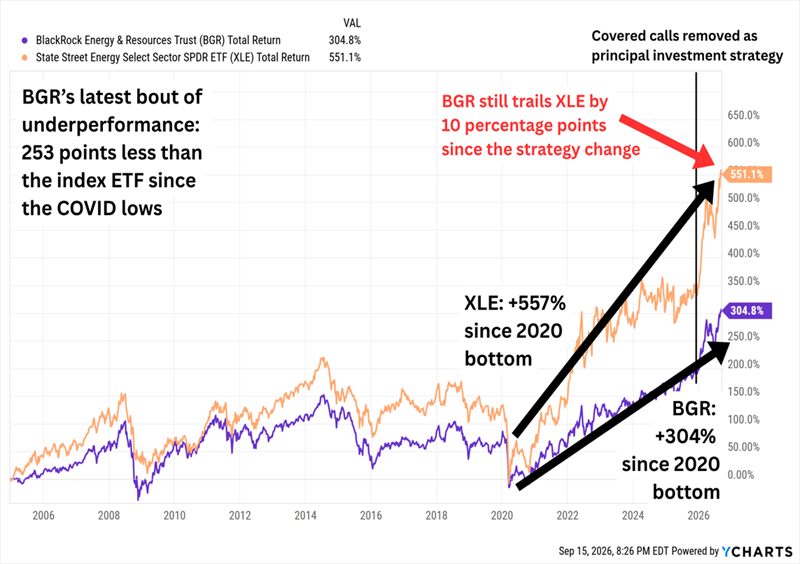
Another feature of closed-end funds is that they can trade at a different price than their net asset value (NAV). That’s because, unlike mutual funds and ETFs, CEFs have a set number of shares. Right now, buying BGR gets us its holdings at a 10% discount to their value. Unfortunately, that discount is merely on par with its five-year average—and given the historical underperformance of BlackRock’s fund, we should only consider it at a steep relative discount.
Adams Natural Resources Fund (PEO, 7.4% distribution rate) is a much more competitive fund, though it has its own twist: It travels a little outside the energy sector.
More than 80% of PEO’s assets are invested in energy stocks like Exxon, Chevron and Williams Cos. (WMB). But we also get high-teens exposure to basic materials companies such as multinational industrial gas supplier Linde (LIN).
That’s not much help to us now—it has actually been a heavy weight on performance over the past month or so. But longer term, that materials exposure and lack of a covered-call cap have made PEO much more competitive, with occasional bouts of outperformance.
PEO’s distribution system is wonky, but it has improved in recent years. The fund is committed to paying at least 2% of average net asset value quarterly, and it’s plenty generous at more than 7% right now. It used to pay them in tiny quarterlies and a big annual true-up. Now, though, Adams’ fund is on a schedule that’s closer to a traditional ETF.
PEO’s Payouts Aren’t Perfectly Smooth, But They’re Much Better Than Before
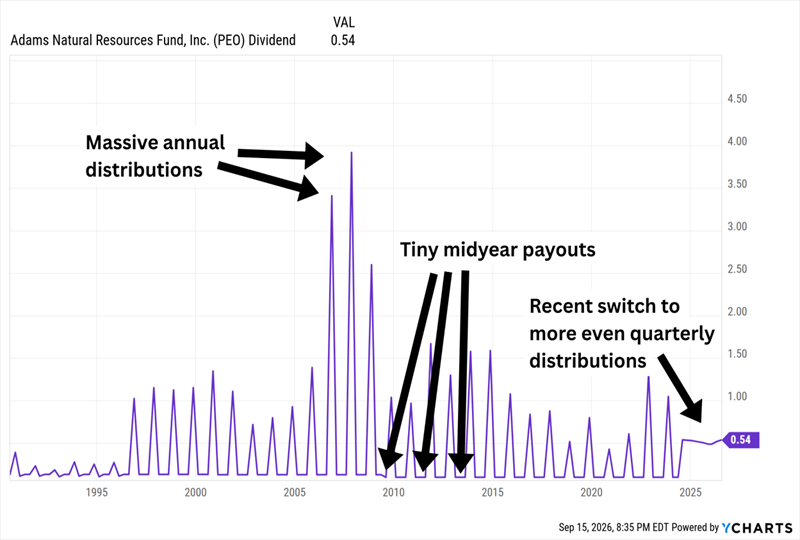
A little more concerning is that PEO trades at a smaller discount to NAV (8%) than its five-year average (13%). However, given its stronger historical performance, that’s not as concerning as it would be with BGR.
As contrarian income investors, we don’t like to bet on producers. Producers are more of a gamble—it can go in your favor, or it can go against you. Producers are a leveraged bet on the future of prices. A steadier stream of income we can find from the toll collectors.
These are the companies that make money whether oil prices go up or down in the near term. They are priced based on volume. As long as the global economy continues to grind along, these companies do just fine collecting their dimes and quarters on every dollar that is passed through.
Infrastructure firms, which own assets such as pipelines, storage facilities and terminals, and are often structured as master limited partnerships (MLPs). The downside to owning MLPs is that they kick us a K-1 tax form around our return deadline that will annoy us and our accountants. But MLP CEFs typically simplify things for us and issue a tidy 1099 instead.
I’ll start with Neuberger Energy Infrastructure and Income Fund (NML, 7.8% distribution rate), which is a blended energy fund that’s heavy in midstream names like Targa Resources (TRGP), Energy Transfer LP (ET) and Enterprise Products Partners LP (EPD), but also larger integrated energy firms such as Exxon and Occidental Petroleum (OXY) that have midstream operations.
That tends to produce more volatility compared to midstream funds. So does NML’s use of “debt leverage.” This is another CEF advantage: They can borrow funds that they then reinvest into their highest-conviction picks; leverage boosts distributions and amplifies gains, but it can also result in precipitous declines.
All of these traits have translated into returns that are better than straight-up infrastructure funds and on par with broad-energy sector products—not to mention a rich yield of nearly 8%.
The monthly dividend does fluctuate, but not nearly as wildly as PEO’s. This is a monthly payout that tends to remain the same for a few years at a time before being revised—typically in the same direction of the fund’s performance.
NML Has Generally Offered Consistent Distributions, But COVID Was Chaotic
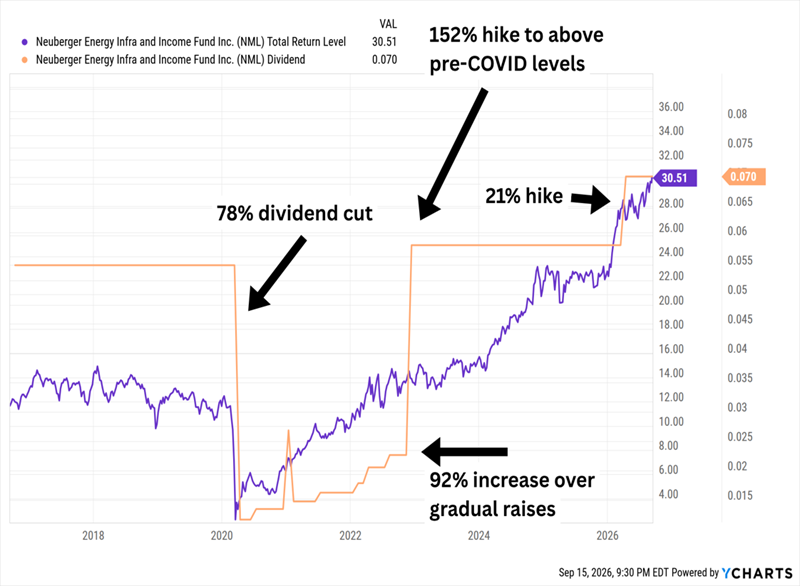
The pricing situation is similar to the Adams fund, though: A discount to NAV of about 8% is lower than the 14% five-year average, which isn’t ideal, but it’s also not disastrous.
The ClearBridge Energy Midstream Opportunity Fund (EMO, 7.9% distribution rate) is a pure-play infrastructure fund. Co-Managers Peter Vanderlee and Patrick McElroy run a tight portfolio of just around 20 midstream companies such as the aforementioned Targa, Energy Transfer and Williams, and other large MLPs including Western Midstream Partners LP (WES) and MPLX LP (MPLX).
I highlighted EMO in July among other cheap CEFs, pointing out that this Franklin Templeton product has historically underperformed the Alerian MLP Index benchmark since inception in 2011. But the leverage (currently 25%) that caused it to underperform during long down-to-flat periods for energy structure is what has been ripping it past the benchmark since COVID.
EMO: A Fair-Weather Fund, But the Weather Has Been Mighty Fair
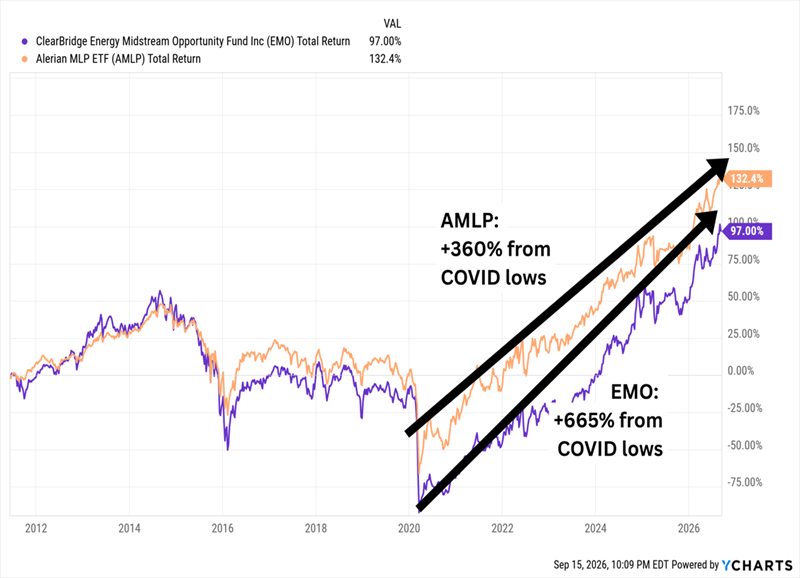
The discount has dropped from about 13% (also its five-year average) to 8% now. Again, that’s not necessarily problematic given EMO’s history when midstream stocks take flight, but it does open us up to sharper downside if energy reverses.
One of the highest oil-powered yields is ironically another “hybrid”: Tortoise Energy Infrastructure (TYG, 12.9% distribution rate). This fund owns a roughly 55/45 blend of energy infrastructure and utility companies. MLPs such as MPLX and Energy Transfer are mixed with the likes of Sempra (SRE) and Entergy (ETR).
It’s only technically cheap at a 1% discount right now, but it’s relatively expensive when we compare that to its 14% five-year average.
But this fund is still worth watching. Even with a healthy 27% debt leverage at work, TYG is a little restrained compared to full-blown energy portfolios—but it’s a lot more lively than its portfolio would indicate.
The Strategy Has Merits, But We Do Get Jekyll-and-Hyde Moments
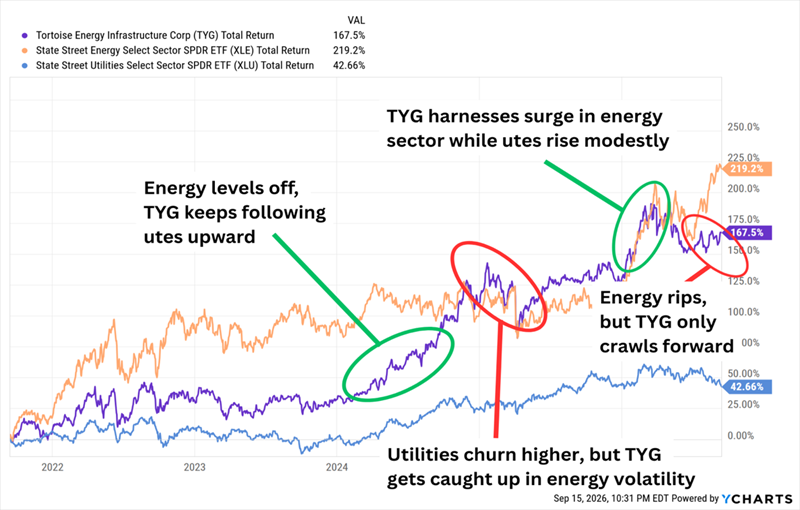
TYG also pays us monthly, and despite its lofty price, it’s still paying us a lavish yield of almost 13%.
Avoid the Retirement ‘Death Spiral’: Collect 8% or More for Life
Why are we looking for riches in these energy funds? Because sky-high yields like theirs are what we need to retire on dividends and interest income alone.
Millions of investors cross their fingers and hope that the S&P 500 and the “4% rule” will get them through retirement. Fat chance. The 4% rule works until it doesn’t. Every few years, the market will dip and force you to sell more shares when prices are low—which means when shares rebound, you need an even bigger gain just to get back to your original value.
It’s a retirement death spiral.
But sky-high dividends change the equation. Instead of sweating every market dip, we just collect income and let the portfolio do its job. We just need more stability than funds that live and die by the price of a barrel of oil—and that’s where my 8% “No Withdrawal” Retirement Portfolio comes in.
The “No Withdrawal” portfolio produces a high enough level of income that we can fund our retirements without even touching our nest eggs.
The math is simple: An 8% average yield can make a $500,000 nest egg pay an annual $40,000 retirement salary. If you have a cool million saved up, you’re breezing through retirement on $80,000 a year.
Let me show you the stealth payout plays that Wall Street overlooks—names that yield 8%, 9% or even more that can help us coast forever on dividends alone. Please click here and I’ll share the details on these secure funds with very generous dividends!