
“He hasn’t picked up a basketball since…” My fellow dad winced slightly, and I completed the sentence for him.
“Since last season.”
He shrugged.
“I get it,” I admitted. “He’s a seasonal hooper.”
My friend’s son has a body built for basketball. Tall. Loooooong arms.
He’s athletic, too. There’s just one thing holding him back: He doesn’t actually care about the sport of basketball. I know this because I’ve coached him (let’s call him Seasonal) since he was seven.
Every November, Seasonal shows up with his friends. He puts forth a somewhere-between-minimal-and-reasonable effort in practices. In games he has more fun and works harder. His parents get into it as he improves along with the team and starts to look like a player by the end of the season.
Then, by late February? It’s over. And next season, it starts anew with our boy Seasonal.
He has the natural size and ability to play anytime he wants. The question that his parents and I have is what type of effort are we going to see. The raw materials are there; it’s a question of will.
A lesson that, won’t you believe it, REIT (real estate investment trust) investors sometimes learn the hard way! Here we chase yield rather than buckets. We must analyze not one but two aspects of a payout:
- Can a company pay its dividend? (As in, does it generate enough cash to fund it?)
- Will the company continue to pay its dividend? (Separate from ability—this is the will of the Board of Directors to keep the payout!)
Question one is the easy one. Dividend coverage shows whether the payout is earned via income. But it does not tell us whether the Board values future dividend payments over other goals such as lower payout-ratio targets, future acquisitions, debt paydowns, or other management dreams.
Here’s an example with an open question. Innovative Industrial Properties (IIPR) is a landlord to cannabis growers that we discuss from time to time, always making a joke about what a high yield the stock boasts. On September 15, its board declared yet another $1.90-per-share quarterly dividend, which annualizes to a blazing (sorry, couldn’t help it) 14% yield.
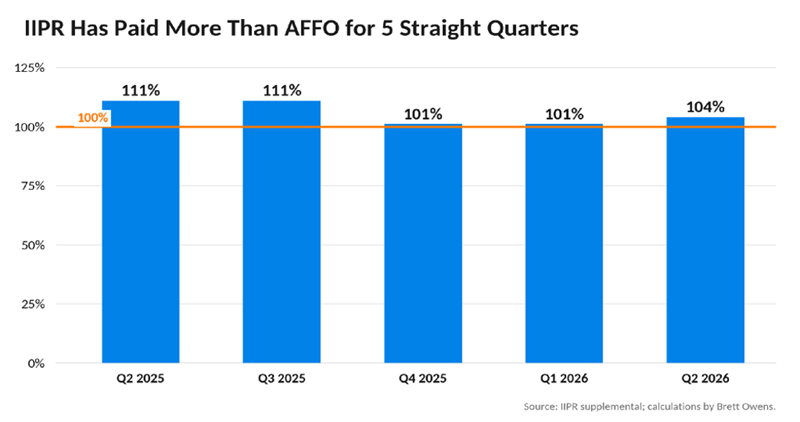
Problem is, the landlord generated only $1.83 per share in AFFO (adjusted funds from operations, the REIT version of cash flow) in the second quarter! By the company’s own supplemental, its payout has run above 100% of AFFO for five straight quarters. It’s possible short-term to supplement a divvie with cash saved up but dicey the longer it goes. Will management keep the payout where it is?
(A reminder for REITs that we look at funds from operations (FFO) or adjusted funds from operations (AFFO), to measure cash flows. REITs must pay out at least 90% of their taxable income to keep their REIT status. But the legal floor says nothing about whether or not a particular dividend is safe!)
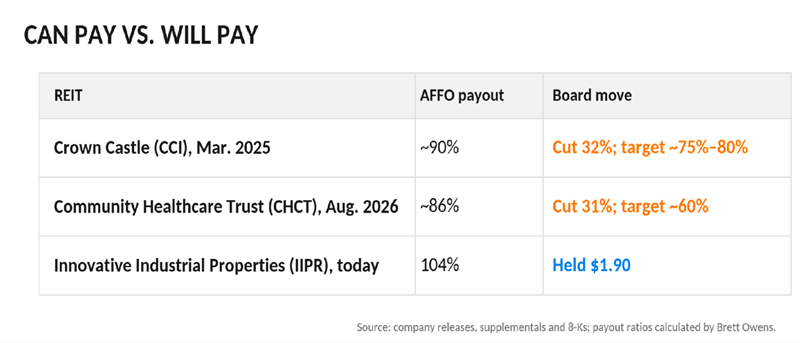
Some REITs decide a dividend cut is prudent even when not paying out 100% or more of AFFO. Community Healthcare Trust (CHCT), a little healthcare landlord, recently cut its dividend for less! Since its 2015 IPO, CHCT raised its dividend every single quarter, nudging it from $0.375 to $0.48 per share. What a run! And the payout was covered at 86% of AFFO.
The Board wasn’t having it, though. On August 4, it decided 86% was more than it wanted to pay and cut the divvie by 31%. The new target ratio was “approximately 60%.”
The AFFO was there! But the Board wanted to keep more of it for the business. It could have paid but chose not to.
We saw the same thing at Crown Castle (CCI) last year. In 2024, the cell phone tower REIT generated $6.98 per share in AFFO versus $6.26 in dividend payments. Its payout consumed about 90% of AFFO, so it was covered by that year’s AFFO.
But in March 2025, the Board cut it a whopping 32% from $1.565 to $1.0625 per share quarterly—from a juicy $6.26 to less so $4.25 a year—and, alongside the sale of its fiber business, set a new policy of paying out 75% to 80% of AFFO. Yes, the dividend was covered. The Board simply decided 90% was more than it wanted to pay.
Back to IIPR. Its $0.07 per share “coverage gap” between AFFO earned and dividends paid costs the company $2 million per quarter out of savings. But earnings just took a hit this summer when a big tenant shut down operations at two Florida properties, jeopardizing 5.2% of IIPR’s annualized rent and loan income.
Meanwhile, management is writing other checks! Last week, the company committed another $245 million to its loan to life-science developer IQHQ, bringing the total commitment to $400 million.
Can IIPR afford fattening its IQHQ loan and its dividend? Technically, yes—the company had $204.7 million in cash on June 30 and net debt of just 14% of gross assets. But will management keep using its balance sheet as a bridge loan?
Last earnings call, management didn’t mention the dividend, whose next declaration is due in mid-December.
It could work out and the dividend may be fine. But it’s like Seasonal, my player who hasn’t touched a ball since February. Maybe he walks into the gym and makes his first five shots. But if the will isn’t there, it’s tough to bank on the results.
If you’re buying high yield stocks without researching whether management has the ability and the will to fund its next payout, you’re gambling with your retirement funds! Fortunately, I have a quick fix for you. Let me do the due diligence. I vet every payer in my Contrarian Income Report portfolio and regularly publish payout ratios and management motivations. And my number-crunching leads me to this life-changing 12% payer!