
Ten-year Treasuries yield 5.3%. We’re still not buying.
Because the truth is, that 5.3% yield is an illusion, for two reasons.
First, inflation is at 3.4%. Knock that off your 5.3% yield and you’re left with a real return of just 1.9%.
And second, if the government continues to print money to meet its obligations (likely!), it could fuel more inflation, and higher bond yields. That increases the likelihood that anyone buying a Treasury today will sell at a loss if they do so before maturity.
So where does an income investor turn?
Two words: US stocks.
Trouble is, the S&P 500 yields a mere 1%. That’s deeply negative on an inflation-adjusted basis!
You might argue that with the S&P 500 up some 15% this year, you could “liquidate” some of your stock gains from time to time to fund your lifestyle.
That’s not wrong, but with the market having gained for three straight years—and 2026 looking like it could be the fourth—stocks are likely to correct at some point (even though we do see them rising in the long run, on record earnings and AI adoption).
That raises the prospect of having to sell into a downturn to get the funds you need. This is the worst of all worlds: It shrinks your net worth. It shrinks your income stream. And it weakens your ability to make these losses back in the ensuing bounce.
We need a better way. Which is where my favorite income plays, closed-end funds (CEFs)—and particularly equity CEFs like the 9.4% payer below—come in.
CEFs “Convert” Stock Gains Into Regular Payouts
CEFs are an alternative few investors pay attention to, in part because there are only around 400 CEFs out there, managing hundreds of billions of dollars. Compare that to ETFs, which number in the thousands and manage trillions of dollars.
The main thing drawing investors to CEFs is their yields, which, at a 9.6% average (and rising), are high by any measure.
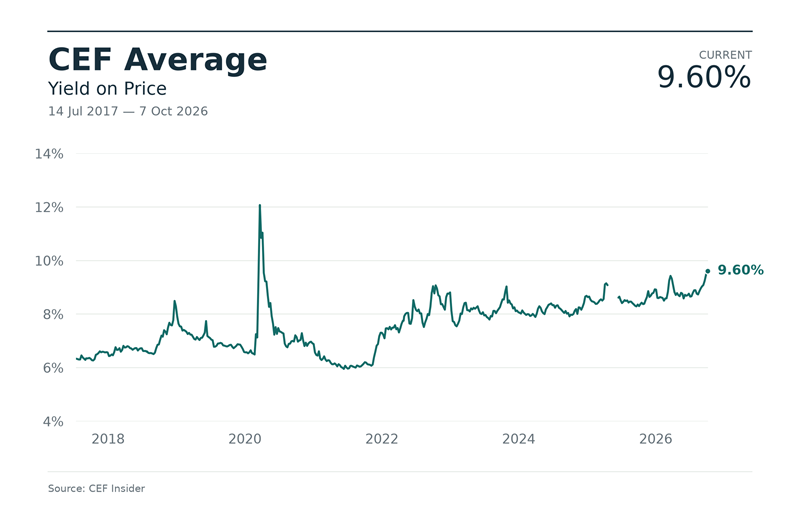
This doesn’t surprise us at CEF Insider. With US stocks doing so well, equity CEFs have seen their underlying portfolios (called “net asset value,” or NAV, in CEF-speak) put up strong numbers. Management is then “converting” those gains into dividends.
And that, combined with CEFs’ outsized yields, is why equity CEFs are a terrific replacement for Treasuries (even though, yes, CEFs do move with the market). Or, frankly, any other asset whose yield can’t keep up with inflation.
A 9.4%-Paying Equity CEF on a “13%-Off Sale”
One of our favorite “gain converters” is the Liberty All-Star Growth Fund (ASG), a holding in my CEF Insider service.
Check out how the fund’s total return NAV (or its portfolio gains including dividends, in orange below) has risen in the last three years, with its dividend (in purple) following.
ASG’s Dividend Tracks Its Portfolio Gains
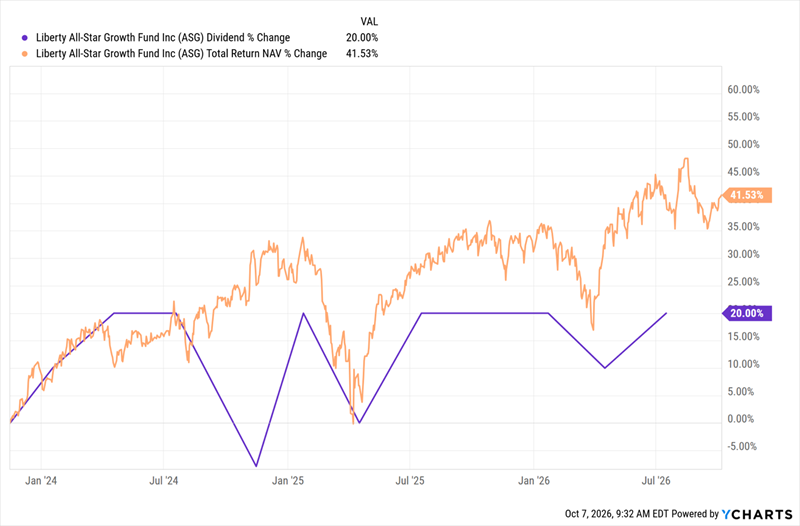
You can also see that lately, the gap between the fund’s NAV return and its dividend has been growing, suggesting the next payout could be higher than the current one—or at least hold at these already-high levels.
We also get reassurance from the fund’s dividend policy, under which management aims to pay 8% of NAV per year, in four quarterly installments of 2% of NAV.
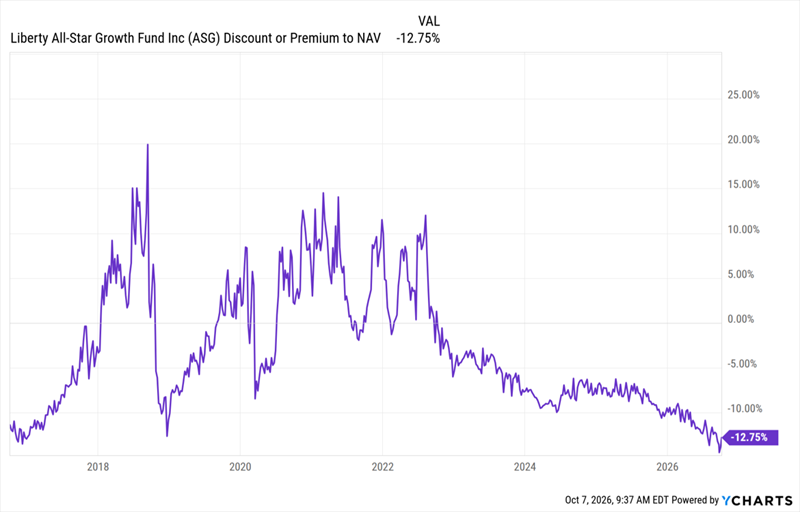
In other words, ASG does the selling for us, on a fixed schedule. And we get an extra margin of safety from the fund’s 12.8% discount to NAV. This is another way of saying ASG’s shares trade for less than its portfolio is worth.
ASG now sells for around 87 cents on the dollar. That’s near the discount’s widest point in eight years:
ASG Gives Us a Once-in-8-Year Buy Window
Further, when you calculate ASG’s dividend yield based on NAV, you get 8.1%—right on management’s 8% target. The fund’s 12.3% annualized NAV return over the last three years is much higher than that. This suggests the payout, which yields 9.4% based on the fund’s discounted market price, is well covered.
We also like ASG because it’s a “one-stop shop” for US market access, splitting its portfolio among small-cap, mid-cap and large-cap growth stocks.
Among its top-10 holdings are NVIDIA (NVDA) and Apple (AAPL), as well as smaller companies like Halozyme Therapeutics (HALO)—a maker of systems for administering drugs—and Moog, Inc. (MOG.A), which makes hydraulic and mechanical systems for the aerospace, medical and manufacturing sectors.
Neither Apple nor NVIDIA (nor, indeed, many of ASG’s holdings) pay meaningful dividends, but ASG “converts” their gains into income for us.
And with smaller companies being more domestic-focused, we’re benefiting from the ongoing onshoring of manufacturing into the US, as well as broader trends, like AI adoption. ASG plays that shift from two angles: through AI builders, like NVIDIA and Microsoft (MSFT), and users, such as manufacturers and pharma companies.
That’s a far better setup than simply parking your money in Treasuries and hoping for a reversal in rates. It’s why, 10 years out, I expect anyone who buys ASG today will be a lot better off than those who were lured by Treasuries’ “high” yields.
9.2% Dividends, Paid Monthly: 5 Funds That Do What ASG Doesn’t
ASG gives us plenty that Treasuries don’t. But there’s one thing it doesn’t do: Pay us a steady amount every month.
That’s fine for a lot of investors. Stocks go up over time, and ASG’s portfolio has, too. So its payouts are positioned to grow in the long run (with the usual ups and downs).
But some folks need predictable income.
I get it. And it’s why I’ve hand-picked 5 other CEFs that yield 9.2% on average, close to what ASG pays, and send those payouts our way 12 times a year.
That’s $767 a month on every $100K invested. On $500K, it’s $3,833 a month. That kind of monthly income is a game-changer in retirement.
$500K in Treasuries? That’s only about $2,208 a month. And that’s before inflation takes its cut.
Better yet, the bond selloff has put these funds on sale. For example, one of them trades at a 6% discount today, while another is near 9%. We do not want to let the clock keep ticking here. Every month we wait is a monthly payout we don’t collect.
Click here and I’ll tell you more about these 5 funds and give you a free Special Report, “5 ‘Must-Own’ Monthly Dividend Funds Yielding 9.2%,” with all 5 names and tickers. Plus you’ll get to take CEF Insider on a 60-day no-obligation “road test.” The report is yours to keep either way.
And with these 5 funds paying monthly, your first dividend could land in just a few weeks.