
Let’s break down this cloud of pessimism hanging over the economy. As far as I can tell, it’s mainly coming from two sources:
- The bond market.
- The labor market.
Concerns around both are overblown, and that’s been a plus for us at my CEF Insider service. It’s pushed out the discounts to net asset value (NAV) on these funds, setting up some nice buying opportunities over the last few months.
It’s increased the dividend yields on some of these funds, too. In some cases near double digits.
General American Investors (GAM), one of the more popular equity CEFs, tells the tale here. As I write this the fund’s market price trades at a 13.1% discount to its portfolio value (or its NAV, in other words). That’s cheaper than this 9.9%-yielder was just one year ago.
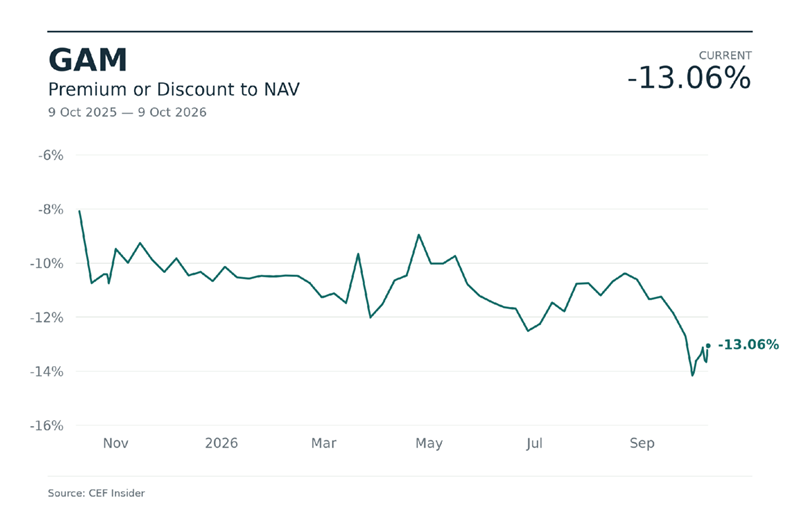
That doesn’t make any sense, both in terms of the composition of its portfolio (which we’ll talk more about in a moment) and the state of the US economy as a whole.
Which brings us back to our two “anchors” on investor sentiment. Let’s start with bonds.
Even though yields have spiked, defaults are low. According to recent numbers from Fitch, they’re at about 2.8% on a trailing-12-month basis, within the rating agency’s forecast of 2.5% to 3%. But the media, negative-biased as it is, focuses on weaker corporate borrowers, which naturally raises investor fears.
In short: While bond yields are up, credit stress isn’t. And corporate America’s results? They’re more than fine.
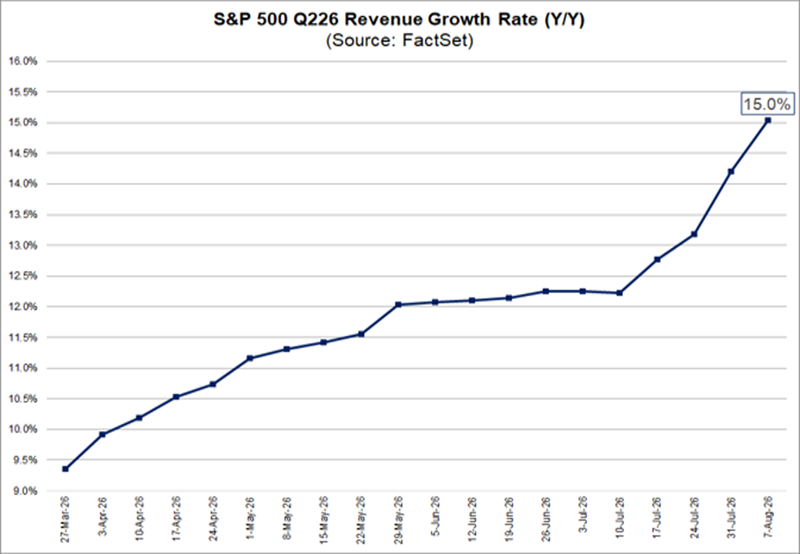
As we can see in the above chart from FactSet, S&P 500 revenue growth has surged over the last year. Moreover, jobless claims are falling, suggesting layoffs are not spiking. And so far at least, AI is not weighing on jobs.
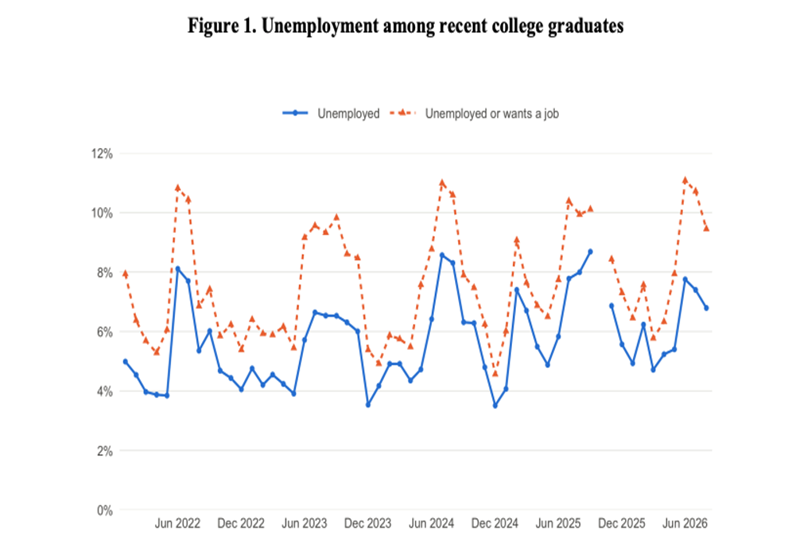
This chart comes from a recent academic study by economists at UCLA, and it shows that unemployment among recent college graduates is really just moving in its usual up-and-down range, despite the advent of AI back in 2022. Another study, from Berkeley and LSE economists, shows that the use of AI in software engineering has not hit jobs in that sector. Moreover, it’s boosted programmers’ productivity.
In reality, all of this suggests that AI is more like spreadsheets, word processors, the smartphone and, going way back, the printing press: yet another technology that’s making people more productive.
An “Old” 9.9%-Paying Fund for a “New” World
This new world of both strong economic gains and economic pessimism is one where an investor can position themselves for quiet, solid gains. One channel for doing so is GAM, a nearly 100-year-old fund that has weathered some of history’s biggest crises.
The fund survived the pandemic, the 2008/2009 financial crisis, the dot-com bubble, and even older disasters, like the Great Depression.
GAM’s IPO was in 1927, so it’ll hit the century mark next year. And my use of the word “survived” sells it short: GAM has thrived, with a 16.2% annualized total return, based on its market price, over the last 10 years.
And yet, we have a 13.1% discount on the table here, which doesn’t make sense given the diversification of GAM’s portfolio, including high-value, high-performing companies like GE Vernova (GEV), Berkshire Hathaway (BRK.A), TJX Companies (TJX) and Republic Services (RSG).
GAM also holds a lot of major tech firms, such as Apple (AAPL), Alphabet (GOOG), semiconductor maker ASML Holding NV (ASML) and Amazon.com (AMZN).
That discount makes even less sense when we note that GAM yields 9.9%, based on its December payout. The fund also has a policy of paying out substantially all of its yearly net investment income and realized capital gains as dividends, mainly as a year-end distribution. That payout is made in the form of shares, though you can request cash.
GAM’s payout will vary depending on its NAV returns, but at 15.3% annualized over the last 10 years, a payout in the 9.9% range has been well supported.
The bottom line? GAM is a strong fund to consider for the market’s current moment, especially with the fund’s wide discount and strong history.
4 “AI-Powered” Funds Yielding 10% (One Pays 12.9%)
GAM shows how today’s overblown pessimism is putting quality funds on sale. But the biggest bargains are often in smaller CEFs—the ones skittish investors dump first.
That’s where I’ve uncovered 4 high-yielding funds tied to what I call AI’s “pivot points.” These are the places where the technology is boosting productivity and cash flow right now.
Think factory automation, faster drug development, lending to fast-growing (and AI-using) companies, and AI’s bottomless appetite for power.
And few people—least of all the doomsaying media—are talking about it.
These 4 funds yield 10% on average, and the top payer hands us an outsized 12.9% dividend. All four trade at discounts I expect to snap shut as the crowd catches on.
I’ve put the names, tickers and my full analysis in a Special Report, The AI “Pivot-Point” Portfolio: 4 Funds for 10% Dividends. I want to give you a copy for free. Click here and I’ll tell you more about these 4 AI-powered 10% dividends—and show you how to claim this exclusive Special Report.