
The market has served us up a tidy opportunity on a closed-end fund (CEF) yielding an eye-popping 13.1%.
What’s more, this fund is oversold, at a 12.1% discount to net asset value (NAV).
Before I name this CEF, let me explain why this opportunity is in front of us. And since the fund in question holds corporate bonds, we need to start with interest rates.
It’s not news that since the end of the pandemic, the Federal Reserve has focused on fighting inflation. Whether or not it’s brought enough firepower to that fight is something we can debate, but the end result is that borrowing costs have been going up.
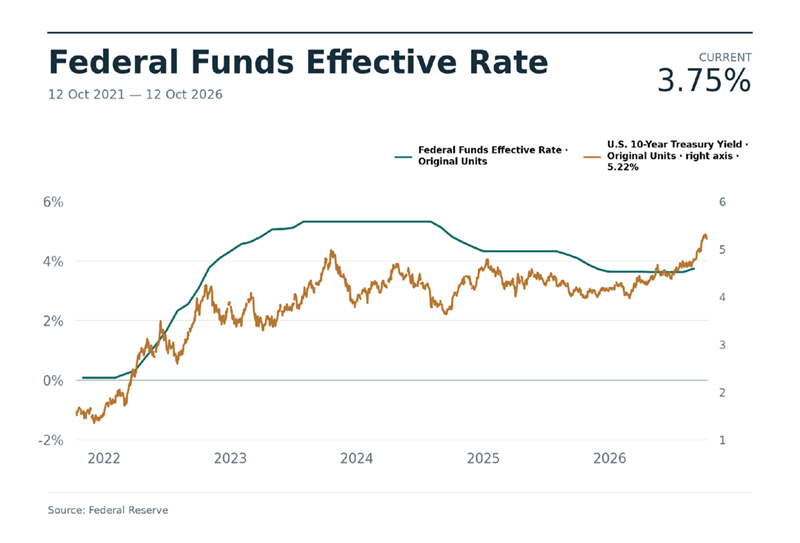
The Fed has tried to put the brakes on rising prices by raising its rate target (the green line above). The Fed, of course, does not control long-term borrowing costs. Those are influenced by the bond market and tracked by the yield on the 10-year Treasury note. And we can see by the orange line above that those costs rose to match the Fed’s higher baseline.
Then the Fed started cutting rates in 2024, as inflation seemed to be cooling. But long-term borrowing costs kept going up. They’re now higher than the Fed’s interest-rate target.
That’s given investors the opportunity to buy newly issued bonds with higher yields. The bad news? Rising yields have weighed on the value of investors’ current holdings, which yield less. This has created a very unusual situation (read: a buy window) for CEFs holding high-yield bonds.
Let’s zoom in on that, starting with the fact that over the past five years, corporate-bond CEFs (as tracked by my CEF Insider service’s Taxable-Bond Sub-Index—in green below) have trailed the high-yield-bond benchmark, the State Street SPDR Bloomberg High Yield Bond ETF (JNK), in orange:
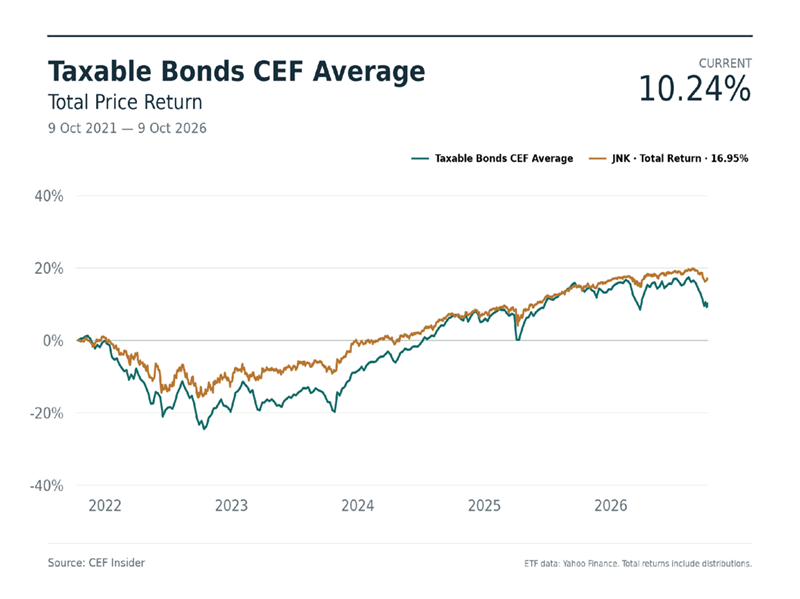
This is not normal. In the years before the Fed started hiking rates, high-yield bond CEFs handily beat JNK:
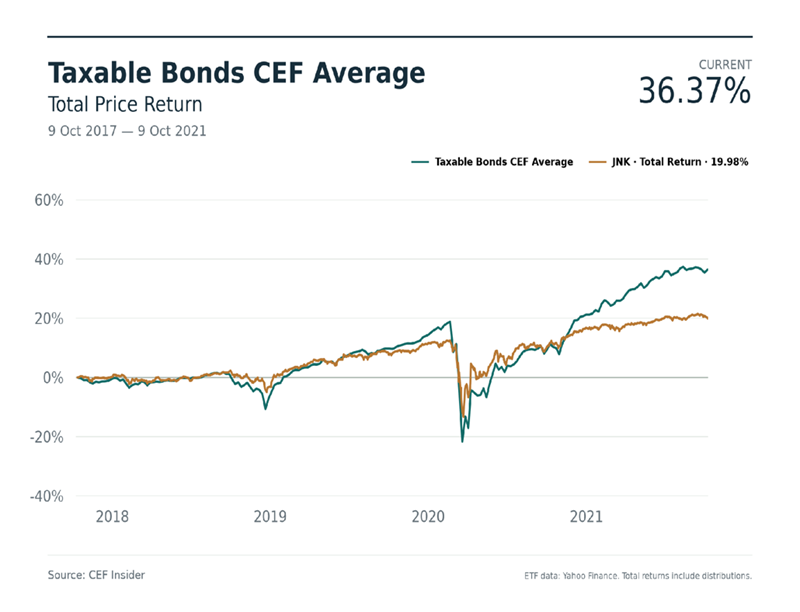
That is normal, because corporate-bond CEFs are run by human managers with deep contacts. That makes a difference in the cozy world of corporate bonds. It also builds in an automatic advantage over index-tracking ETFs like JNK.
So why have high-yield-bond CEFs lagged? Two reasons: Worries about rate hikes and concern over rising default rates.
That latter concern hasn’t materialized. Corporate-default rates remain relatively low and are starting to fall, from 4.5% in August to an expected 3.6% in December, according to Moody’s, despite higher interest rates.
In part, that’s because S&P 500 companies are posting their highest revenue growth in five years (yes, AI plays a role here). That growth is expected to accelerate further, to 12% in the third quarter of 2026, and earnings are booming. They’re expected to rise 29.5% at the same time, after a jaw-dropping 35% rise in the second quarter.
That is an opportunity, especially since, even after the Fed shifted back to hiking with a quarter-point increase in September, markets are pricing in just three more hikes over the next year. That’s already priced into corporate-bond CEFs. And the Fed is signalling it doesn’t wish to go much further.
To sum up, all of this has left high-yield-bond CEFs oversold and boasting higher yields. Plus, companies can afford to pay higher interest rates and defaults are not a concern. So we can say that the risks around corporate bonds appear to be priced in.
And that is why I’m eyeing that CEF I mentioned earlier: the 13.1%-paying Western Asset High Income Opportunity Fund (HIO).
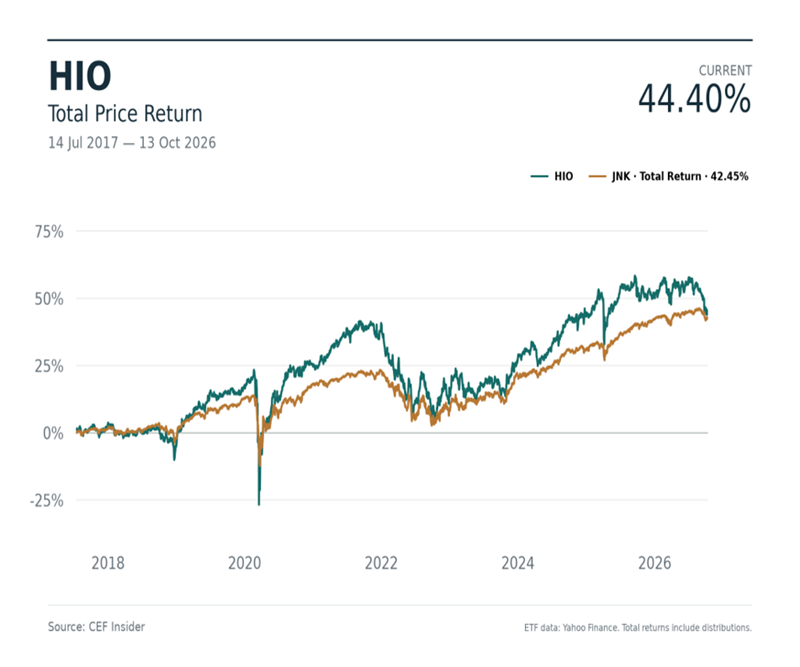
The fund, now overseen by Franklin Templeton, was performing well before the interest-rate hikes of 2022 (shown in green above), far ahead of JNK (in orange). But like all corporate-bond funds, it struggled once rates started rising.
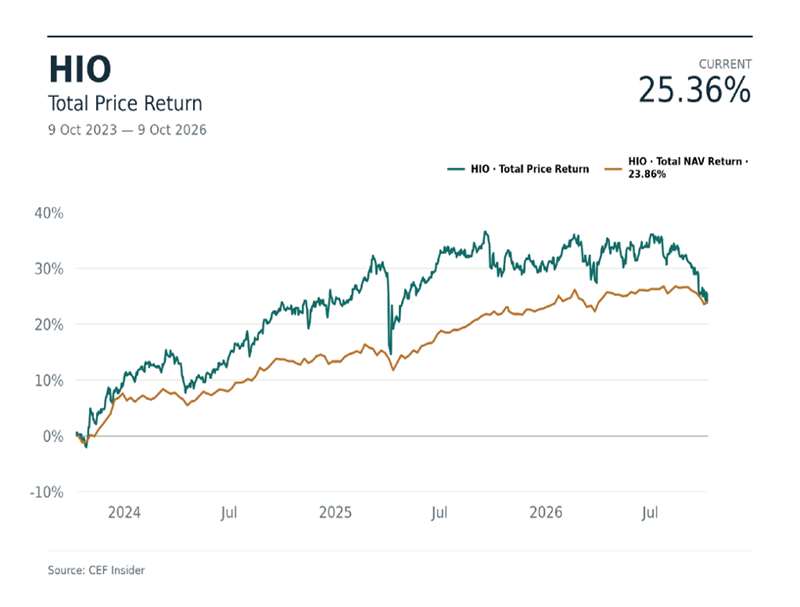
Over the last three years, however, HIO has steadily returned to form, with a 7.8% annualized total return based on market price (in green below) and a similar return on NAV (in orange):
Which brings us to the fund’s discount to NAV:
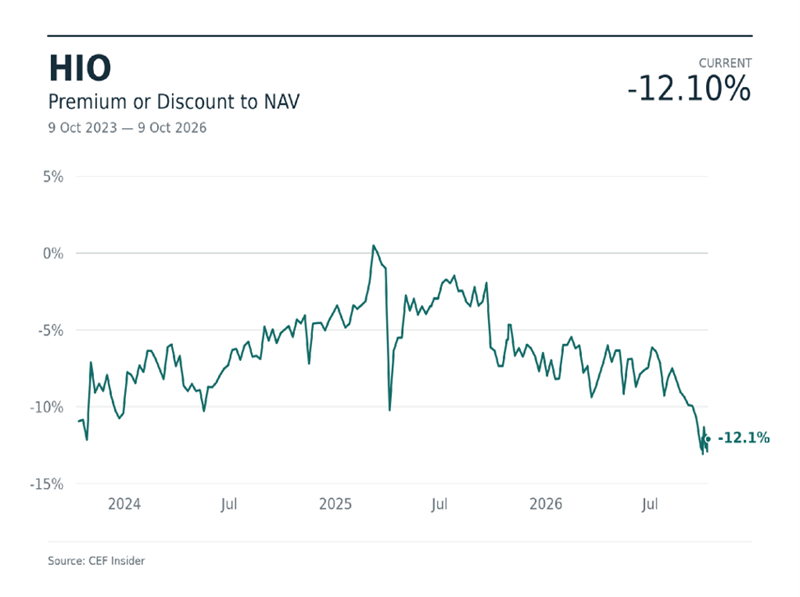
As you can see above, HIO’s strong performance was being rewarded with a shrinking discount, but then the discount suddenly widened this year, and has blown out to its widest level in three years. That’s despite those three years being a period of recovery.
What’s more, today’s discount is much wider than the fund’s five-year average of 7.4%.
Before I wrap, one quick note on the payout: It has run ahead of HIO’s NAV return in the past year (which is around 2%), so it’s worth watching. But on the other side of the ledger, the fund carries no leverage, which cuts its risk when rates rise.
To sum up, the fund’s unusual discount makes HIO especially attractive now. It also points to a broader inefficiency across CEFs (which yield around 9% on average): CEF investors are pessimistic—at a time when the bulk of the economic data is positive.
That disconnect has created unusually generous discounts on a lot of high-quality funds. HIO is just one.
5 Monthly Payers Yielding 9.2%, All on Sale Now
HIO isn’t the only bargain this market’s pessimism has created. As I said, it’s just one of many high-quality CEFs trading at unusually wide discounts right now.
I’ve picked out five of the best. They yield 9.2% on average, and each one pays monthly, so your income keeps pace with your bills.
I’ve put all five, with names, tickers and my full analysis, in a Special Report: 5 “Must-Own” Monthly Dividend Funds Yielding 9.2%. It’s yours free today.