
Investors are dumping top dividend growers. And they’re doing it at the worst possible time.
This is the kind of moment we contrarians live for: When investors look at short-term worries and panic—and forget the longer-term (and much rosier!) setup before them.
This is the basis of the old market adage that “Stocks climb a wall of worry.”
They do—and we’re here for it.
I’ve got two dividends for you below: one that’s taken too heavy a beating, and another that’s overlooked but just starting to get on the crowd’s radar. Its surging dividend (up 358% in the last decade) sure helps.
Before we get to them, let’s talk about that “wall of worry” that’s frozen the crowd in its tracks—and the ignored “ladders” stocks can use to climb that wall in the months ahead.
Wall Street’s “Worry List” Keeps Growing …
It’s easy to see why investors are fretting. The midterms are a week away. Ten-year Treasury yields recently hit 5.3%, their highest level in 24 years. Companies that provide “compute” for AI, like CoreWeave (CRWV), are running up a mighty bar tab. The Fed hiked in September, and its next meeting starts today.
But let’s take a breath.
Because underneath all this is a strong economy: FactSet sees 32.8% earnings growth for 2026. Unemployment is just 4.2% and has actually moved lower in the past year.
Meantime, CoreWeave and its ilk are the riskiest corner of the AI world. The main players—Microsoft (MSFT), Alphabet (GOOGL), Meta Platforms (META) and the like—are doing fine.
I’m not saying none of this is a problem. Inflation is too high, for sure. But few expect a return to 2022’s 9% peak. And the debt worries are mostly contained to one part of the AI business. We’re not talking about millions of mortgage holders here, à la 2008.
Then there’s the calendar, which is probably the most overlooked driver here.
… But It’s Mostly Short Term
No matter our politics, I think we can agree that next week’s election is causing a lot of worry. But we need to do what the crowd isn’t and look past the vote.
Let’s start with next month: November has been the best month for US stocks for the past century, according to Morningstar, with a 1.7% average gain.
That’s one tick in favor of our timing here.
Beyond that, next month ushers in the typically strong November-to-April season (the basis of the “Sell in May and go away” one-liner). There’s something to that: According to Fidelity, stocks have delivered average price gains of 7% in that span, compared to just 2% for the rest of the year.
Two ticks.
Finally, the third year of the presidential cycle is typically the strongest. And it’s no small gain, either: an average return of 17.2% for the S&P 500 going back to 1950, according to Opening Bell Daily.
Three ticks.
Of course, there are no guarantees, but buying when a strong economy and seasonal trends are bumping up against that “wall of worry” has historically been a smart move.
Here’s where the fourth tick comes in: It’s another pattern that points us to exactly which stocks to buy. It’s what I call the “Dividend Magnet.”
It’s simple: Where the dividend goes, the share price typically follows. And when a dividend grower’s stock parts ways with the payout, that’s the time to buy—and ride along as the gap closes.
Let’s get into those two stocks now. We’ll “set the table” with a 4.4%-paying snack-food maker that’s oversold. Then we’ll get to the main course: an overlooked lock maker that’s one of my favorite dividend-growth buys now.
This Dividend Magnet Is Powering Up—But You’ll Need Patience
PepsiCo (PEP) has been the definition of “dead money.” The stock is down for the year while the S&P 500 is up double digits. It’s currently about 22% below its 52-week high.
But over the past decade, PEP’s payout has nearly doubled, up 97%. Its share price followed until a little more than a year and a half ago, when the stock and the dividend parted ways.
PepsiCo’s “Powered Up” Dividend Magnet
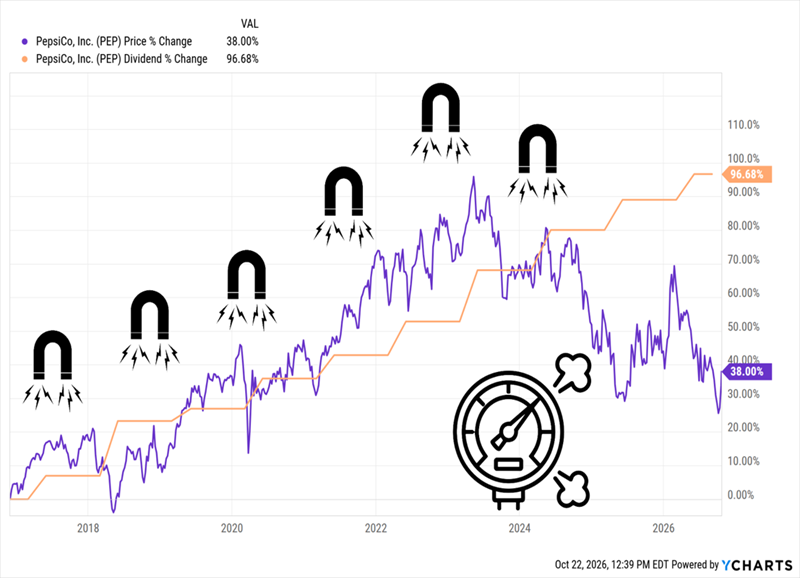
That’s a big gap, and it gives us a healthy “starter yield” of 4.4%.
Why the share-price drop? Inflation has driven up input costs, squeezing margins and profits. Management also reduced its earnings guidance for the year by roughly half. Then there are GLP-1s, which are spreading quickly in America, with about one in nine adults taking them.
Here’s what’s being overlooked: The business continues to grow, thanks in part to overseas markets, where GLP-1s are less common. Third-quarter revenue rose 5.6% to $25.3 billion, beating estimates. Core EPS also topped forecasts. And while the dividend eats up 75% of free cash flow, that’s down from 111% a year ago.
This bodes well for the payout’s future, but PEP does have a lot more cost cutting to do, while focusing more on healthier products and markets beyond the US.
Even so, its big “dividend lag” suggests these issues are priced in. So does the fact that the stock trades at 16 times its last 12 months of free cash flow, less than half its five-year average of 32.7. That makes PEP worth a look now—but it’s the “patience” pick of our pair.
Allegion: A 1.3% Yield Hiding a Soaring Payout
Allegion plc (ALLE) doesn’t fire up many investors’ imaginations—at least at first. For one, the stock yields just 1.3%. For another, this company, a recommendation of my Hidden Yields service, makes locks, including under its flagship Schlage banner. (“Boring!” yells the mainstream crowd.)
Let’s take that supposedly “low” yield first, because it masks something critical: In the last decade, this company has hiked its payout an eye-popping 358%.
Investors who bought back then got a 0.75% yield. Today they’re collecting about 3.4% on their original buy. And these long-term ALLE holders can look forward to continued growth in their yield on cost as the dividend keeps marching higher.
Dividend Magnet? Check. Look at how the divvie has pulled the stock up in that time:
Allegion’s “Magnetized” Dividend …
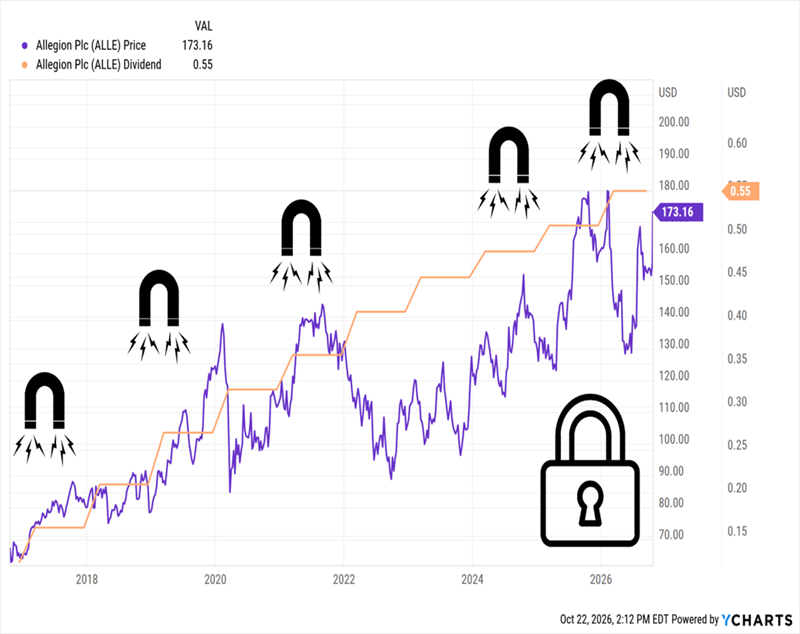
The pattern is clear. And look at the right side of that chart—you can see that Allegion’s stock has slipped behind the payout. Zeroing in on just the last five years gives us an even clearer snapshot of that gap:
… Gives Us Another “Lag” to Pounce On
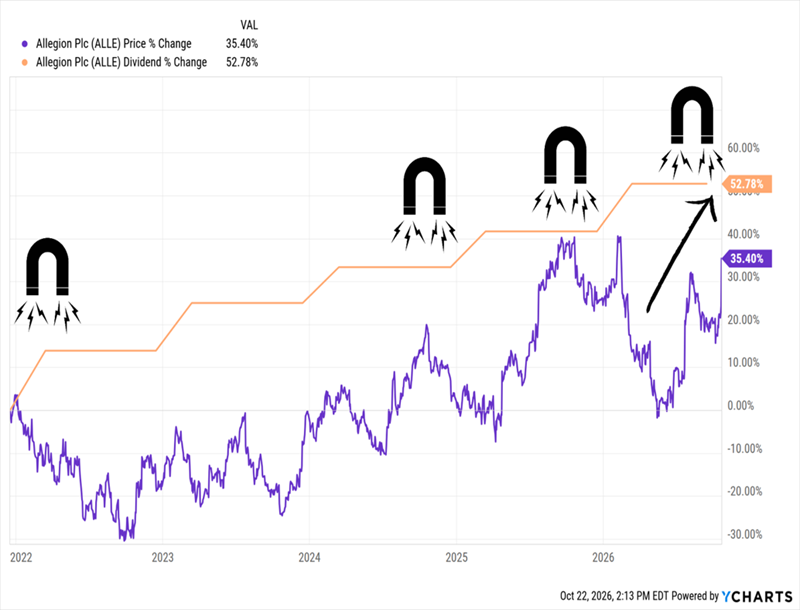
This suggests now is a good time to buy, especially with a stock like Allegion, whose products hold up well through economic cycles.
It’s also a “back-door” (sorry, couldn’t resist!) tech play through its focus on “smart” locks. If you’ve installed one of these, you know how convenient they are, compared to “old-school” locks and their often-lost keys.
No wonder smart-lock demand is soaring. Recent figures from Fortune Business Insights say the market will grow at a 19.7% annualized clip from 2026 to 2034.
The stock returned 84% in Trump 1.0 and has already gained 36% in Trump 2.0, including an 11% pop last Thursday on strong earnings. I expect the business to keep delivering and backstopping the dividend, which is already well-supported, occupying just 27% of the last 12 months of free cash flow.
That’s well below my 50% “safety line.” Add rising revenue (up 9.6% in the third quarter) and adjusted EPS (which soared 13%) and the case for payout hikes looks pretty, er, secure, for Allegion.
358% Dividend Growth? We Love It. But This Stock Has Hiked More
Allegion is the kind of stock we contrarians love: a dividend grower pumping up its payout fast, while investors shrug it off due to its 1.3% current yield.
And while the lock maker’s “payout pace” is quick, my Hidden Yields service holds stocks that have grown their dividends even faster.
Like a financial company investors have also unfairly shunned. Its payout has rocketed 379% in the last decade, pulling up its share price in lockstep—until a gap recently opened.
When the share price has lagged the payout in the past, it’s paid to buy.
Our Next “Dividend Magnet” Play Sets Up
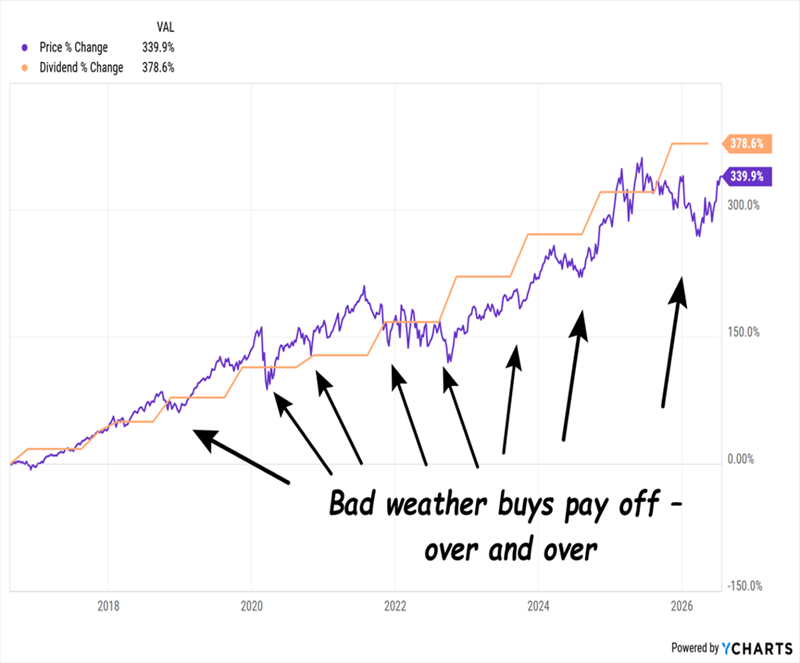
This is just one of my top 5 “Dividend Magnet” plays to buy now. I’ve put them all in a Special Report, “5 Recession-Resistant Dividend Stocks With 100% Upside,” complete with names, tickers and buy-up-to prices. It’s yours free.
As we just discussed, investors’ mood is darkening ahead of November. That makes now, before our longer-term tailwinds kick in, the time to buy these overlooked dividend growers.