
There are hundreds of closed-end funds (CEFs) out there, and almost all of them have an investor they’re perfect for.
I say “almost” because there are a few that are, in my view, not appropriate for any investor. These CEFs are highly speculative and, for the most part, don’t provide a dividend. That flies in the face of a key reason to own CEFs in the first place: high payouts! These funds typically yield around 8%.
We also generally want to be wary of new CEFs with little performance history. When you combine that with a lack of payout focus, you can find yourself taking on some very significant risk.
I’ve got three examples that put this into focus. Two of them—RoboStrategy (BOT) and Powerlaw Corp. (PWRL)—only began trading publicly around the middle of this year. And, to be fair, while RoboStrategy doesn’t offer a dividend, Powerlaw did just begin offering one: Its first monthly payout was declared in September and will be paid October 30. It yields 8.1% on its market price.
Our third fund is called Destiny Tech100 Inc. (DXYZ). It also yields 0%, though it’s just a little bit older, having hit the public markets back in March 2024.
The thing that might appeal to investors about all three is that they provide access to private tech companies. That includes AI giants OpenAI and Anthropic, one or both of which feature in the portfolios of PWRL and DXYZ.
However, that appeal is quickly blunted by the funds’ performance. All three of them—BOT, in red below; DXYZ, in yellow; and PWRL, in blue—are down so far this year, in a period when the S&P 500 is up 12.8%.
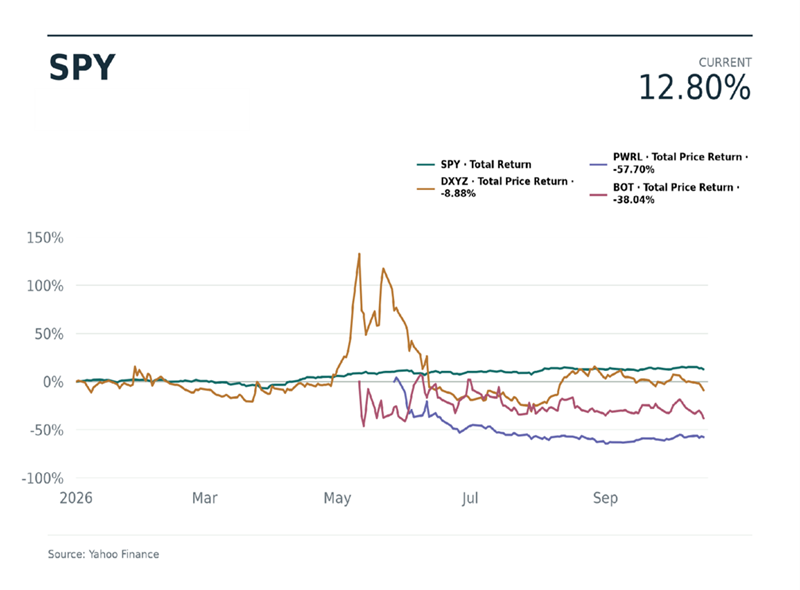
That’s a problem, especially as tech has done even better: The NASDAQ 100 is up 17% as I write this.
To be sure, since BOT and PWRL are so new, we’re looking at a very short sample period here. DXYZ, however, is a more interesting case. Take a look again at the yellow line above. You can see that the fund was up over 100% on the year at one point. And if we zoom back further, we see that DXYZ is still up since it listed in March 2024.
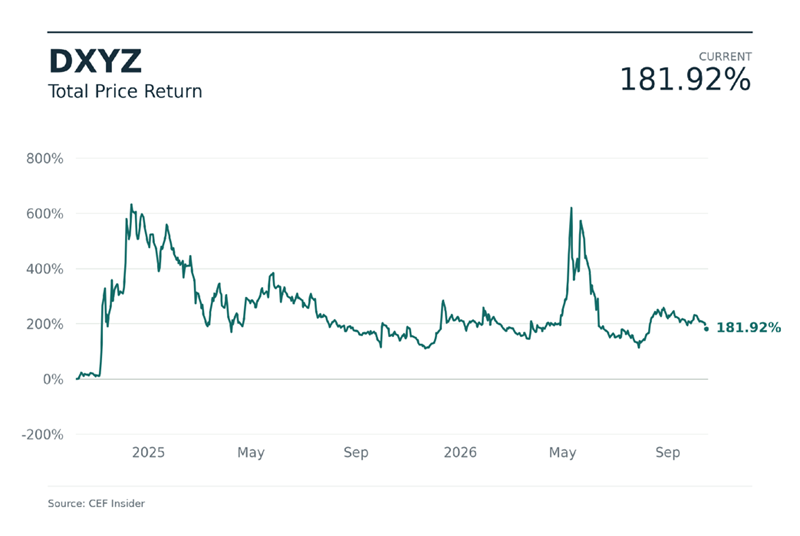
That’s a lot of volatility. But that overall strong return is due in large part to the fund’s holdings: privately held Anthropic and OpenAI, along with Space Exploration Technologies Co, (SPCX), are the top three.
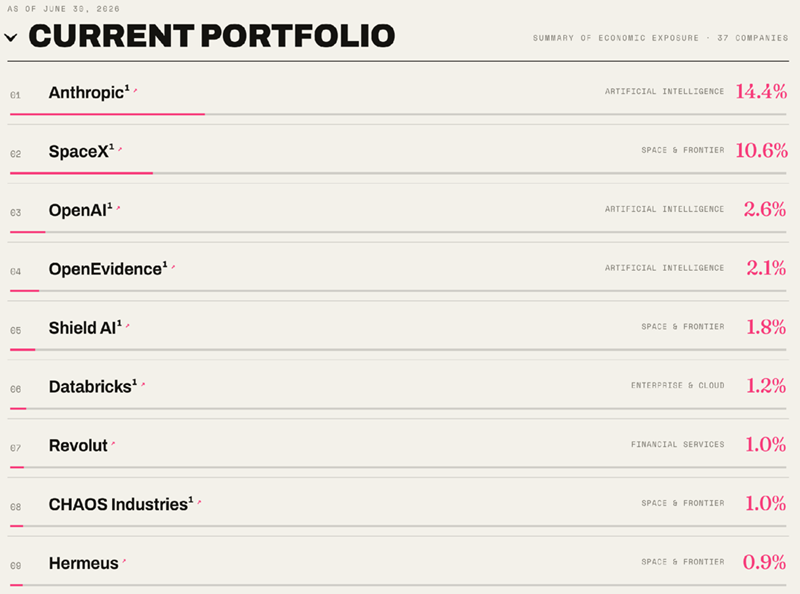
Source: Destiny
This setup has powered DXYZ’s growth, but as we just saw, that growth has been uneven. And because of that volatility, you had to get the timing right to profit. And that’s before we get to the fund’s valuation, which has another tale to tell us.
Consider that when I first wrote about DXYZ for Contrarian Outlook, on February 25, 2025, it traded at an 807% premium to net asset value (NAV, or the value of its underlying portfolio), which I pointed out at the time. That huge premium is why I recommended avoiding DXYZ then.
Since then, the fund’s total return, based on its market price, is negative 33%. This decline comes in a period in which tech gained a lot, as I’m sure I don’t have to tell you.
This is the real risk with speculative CEFs like DXYZ: if you buy when they’re overpriced relative to fundamentals, they can fall significantly, even if their underlying assets grow. Anthropic and OpenAI are worth more than they were in February 2025, but that 807% premium meant DXYZ shareholders did not benefit, even as those who held these shares by other means did.
This case also illustrates another important facet of dividends: The need to cover them helps ensure management stays disciplined. Moreover, strong funds with long track records have demonstrated they’re serious about building lasting wealth.
But despite all that, DXYZ still attracted investors, even when it was priced over eight times its actual NAV. It just goes to show the power of FOMO, especially around breakthroughs like AI.
What about BOT and PWRL? As I write this, PWRL has a 28% discount to NAV, and BOT has a roughly 100% premium. Meantime, both funds are down significantly since their IPOs. That suggests BOT’s premium could shrink—and PWRL’s already-deep discount may not be deep enough.
By the way, none of this is to say that tech and CEFs can’t be a wonderful combination. One of our biggest total returns at my CEF Insider service so far this year came when we booked 48% on the Columbia Seligman Premium Technology Growth Fund (STK) in 10 months, having bought it in November 2025 and sold in September 2026. The fund yielded 8%, on a trailing-12-month basis (thanks in part to a year-end special dividend) when we bought it.
But the recent bull run and intense enthusiasm about private AI companies means there is a new crop of tech-focused CEFs that entail a lot of hidden risks (not to mention scant attention to dividends). Those are the ones we need to be wary of.
Why Settle for 0% Payouts (When You Can Bank 10% “AI-Powered” Dividends)?
You don’t need to pay a ridiculous 807% premium or settle for a 0% dividend to profit from AI.
My AI “Pivot-Point” Portfolio goes in the opposite direction: It throws off a 10% average dividend and holds 4 CEFs that profit from AI’s true growth.
It does so by going beyond tech and investing in companies that are putting AI to work—and starting to profit as a result.
Its focus: 4 underappreciated areas of the economy where AI is having a big impact. Each fund taps into one of these “pivot points”:
- A 9.1%-payer dialed into the growth of robotics in manufacturing.
- An 11.1% dividend backed by AI’s acceleration of drug development.
- An 8.1% dividend that benefits as mid-sized businesses integrate AI—and grow.
- A 12.9%-payer that holds the utility and infrastructure plays best positioned to profit from AI’s surging power demand.
That’s AI upside backed by steady cash flow, not speculation.
I’ve put my research on all 4 of these funds in a Special Report, “The AI “Pivot-Point” Portfolio: 4 Funds for 10% Dividends.” Click here and I’ll tell you more about these 4 income plays and give you a copy of this free report.