
The nervous types are being chased out of Bondland. Fear! Higher rates forever!
Well, no, not likely. Bonds have a “killer feature” for income investors. When their prices drop, their yields rise. We can then snag better deals and secure more dividends for our dollar. That is, if we have the smarts and guts to buy low.
Not everyone does, by the way! Few vanilla investors are taking advantage of the bond bargains right now. They are applying a different approach—panicking.
This is reflected in the MOVE index, which is the VIX (stock market volatility index) equivalent for bonds. The MOVE measures how much traders expect bond prices to swing. Higher numbers mean traders are bracing for unusually big changes in interest rates.
Just a few weeks ago, on September 22, the MOVE sat at 79. Then Treasury yields popped, the 10-year yield topped 5.3%, and the MOVE moved to 114 by October 5. That’s a 45% jump in two weeks!
The selloff hit closed-end funds (CEFs) too, including some that were already slipping. Take Nuveen Preferred & Income Opportunities Fund (JPC). As recently as early August, buyers paid full price for it. Its discount to net asset value (NAV), the fair value of the preferreds it owns, was zip. No deal!
But by the end of August, the discount was 5%. Then on September 22, before bond fear spiked, it was about 8%. The selloff briefly pushed it to nearly 10%. As of October 16, it’s under 8%.
Which means that a payer that traded for about 100 cents on the dollar in early August now goes for about 92 cents on the buck. The fund’s yield, therefore, has reached an elite 11%. Which oh by the way, it pays monthly!
So the vanilla beans are running for the exits. Meanwhile, yield chasers are blindly buying the 11%. Who is right?
Well, let’s ask ourselves why the price dropped in the first place. A CEF’s price can pull back two ways. First, the securities it owns lose value. Its NAV falls, and then its price drops with it. This is a legit markdown.
Or, the NAV can be fine, but buyers panic. They pay less for the same portfolio, and the discount window widens. This deal can be a gift!
From August 5 to October 14, JPC’s shares fell about 13% while the value of its holdings fell only about 5%. That gap is the discount widening.
But we’re here for the dividend, so we must do something that many rushed income investors skip: Check the security of the payout.
JPC cut its dividend last December, but even with that “savings” the fund still doesn’t earn its full payout. The preferreds in the portfolio brought in just 70% of the dividends paid through the fiscal year that ended in July. August was better—barely—with the fund estimated to cover 74%.
Where does the rest of the divvie come from? Nuveen estimates about a quarter of August’s payout was a return of capital, not net investment income. That doesn’t automatically mean the fund lost money, but the 11% headline isn’t fully covered by recurring income.
So, JPC’s 11% comes with an asterisk. I’d rather collect a smaller payout that’s better covered by what the fund earns, even if that means owning lower-rated bonds. And this bond selloff served one up.
Bond fund AllianceBernstein Global High Income Fund (AWF) traded for just 88 cents on the dollar on October 9. Its discount to NAV expanded with the panic:
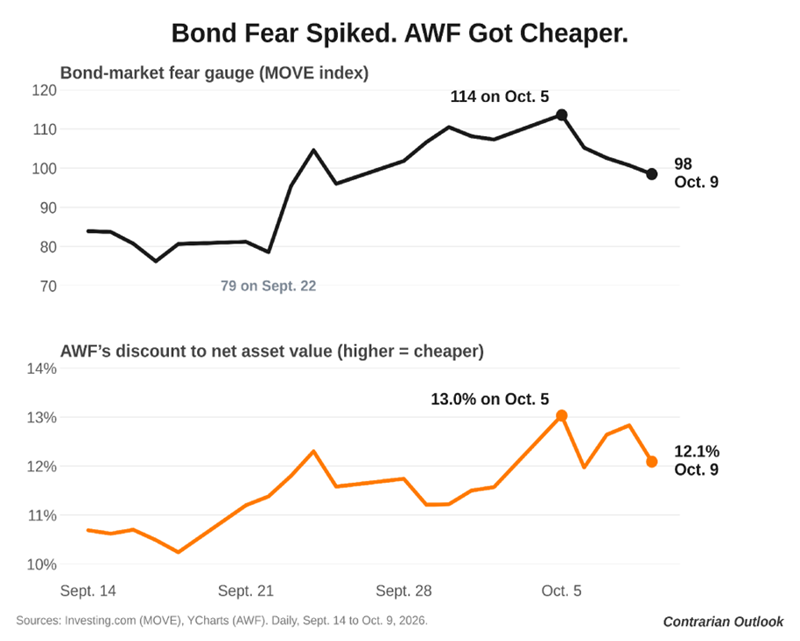
The “right edge” of both panels is where things turn interesting. Fear is cooling down to 98, but AWF’s discount window remains wide open. At the chart’s right edge, October 9, AWF traded 12.1% below its NAV. Since then, AWF’s price has edged up. That’s fine. We can be patient.
About 78% of AWF’s portfolio sits below investment grade. Here we often find the deals because many “whale buyers,” like pension funds, face limits on owning this paper. It’s perceived as risky, which works to our contrarian advantage. We take the margin of safety from the discount and trust a reputable bond manager like AllianceBernstein to navigate the waters. That’s real credit risk, though. If junk-bond prices fall or defaults pick up, losses in the portfolio could swamp any gain from a narrowing discount.
Contrarian Income Report readers will know this fund well. We owned AWF for many years. It was a solid albeit (I’ll admit) unspectacular holding. Unlike other CEFs, this fund uses rather low leverage levels and its long-term returns are middling. Over the last 10 years a $10,000 investment in AWF grew to about $16,200 with dividends reinvested. Fine.
But we can aim for better than “fine” by trading AWF instead. We needn’t buy the fund today and hold it for 10 years. It’s low thanks to the panic in the bond market. If we think of AWF’s typical valuation as a “rubber band,” it is currently stretched to the downside.
So, we bought it, and if the band snaps back, we’ll sell into the rise. In the meantime, at its current rate, AWF pays $0.0655 per share every month, 8.2% annualized. Not a bad income stream while we sit and wait for this trade to work.
And AWF earns most of that payout. In the quarter ended June 30, its net investment income covered about 90% of its distributions. That’s close to its record: 92% to 93% in each of its last three fiscal years. Compare that with 70% for JPC over its last fiscal year and an estimated 74% in August. The time frames differ, but AWF is much closer to “being whole” on its payout. Paired with a 12% discount as of October 9, it’s a deal worth waiting for at the right price.
In addition to AWF, I actually like three monthly payers even more right now and (believe it!) they dish even bigger dividends too—averaging 11%! Click here for my report on how to retire on monthly dividends.