
Do you pay too little in federal taxes?
How about state taxes? Is your yearly tab not enough?
Forty-one out of fifty states levy an income tax. That’s 82% according to my math, so if you’re getting “state taxed” and you want a break on your dividends, read on.
Municipal (“muni”) bonds are often afterthoughts. Their headline yields look modest but remember, they often dish divvies that Uncle Sam can’t touch. Some are even safe from your state governor’s greasy, greedy palms!
Munis are issued by cities and states to fund infrastructure projects. Let’s say a state is building a new highway. It will need the money up front to pay for construction. So, it will issue $30 million or so in muni bonds paying, say, 6%. These muni bonds need to be bought, so the powers-that-be will make phone calls to their contacts in Bondland to buy up these 6% coupons.
Six percent is not bad and it gets even better when we consider the tax breaks. Uncle Sam won’t tax the income at the federal level, so that 6% can really be 8% or better.
But wait, there can be more! If you live in the state that issued the muni, they’ll give you a break on the state taxes, too! So, in a high tax state, that initial 6% can really be 10% or more if you’re a high earner.
Now, buying muni bonds one at a time can be a hassle. A highway here, a convention center there. It would be a bit of an odd portfolio and not particularly diversified. Fortunately, there is an easy industry solution—just buy a fund! For example, my Contrarian Income Report portfolio owns three “national variety” funds from Nuveen, with bonds from many states, totaling nearly 3,000 collectively.
So, is this a free dividend lunch? Close to it, but we need to keep an eye on the kitchen! A bond carries the full faith, credit, and taxing power of the entity that issues it. In Uncle Sam’s case, that means the printing press behind him. In the case of the cities and states that issue munis, we’re looking at their taxing power versus their spending obligations. Defaults are historically rare when it comes to munis: Moody’s reports that investment-grade munis have defaulted at a 0.10% clip over any ten-year stretch since 1970, versus 2.2% for comparable corporate bonds. They really are the next safest thing to Treasuries.
But states don’t have printing presses. They’re not allowed to print money, so our worries shift from the asset class itself to the specifics of the issuer.
And here we have a paradox. The high-tax states collect the most revenue, yet they tend to run the worst profit and loss statements. So, we must pay specific attention to state finances for confidence whether these states will make good on their bond obligations.
Now let’s read the fine print. If we buy a “national” muni fund, the income is exempt from federal taxes—but only federal taxes. Your state gives you a tax break for its bond income, but it taxes the slice of the fund invested in other states’ bonds. In most cases, that’s nearly all—90% to 95% of the dividends, on average!
As I mentioned earlier, nine states charge no income tax—Texas, Florida, and Nevada among them. If that’s you, buy a national fund, skip the state-tax worry entirely: Your state taxes none of your in-state or out-of-state muni bond income, and you can glide past the next couple of paragraphs.
But if you live in a state with income taxes—or, like me, in California, a state with high ones—keep reading.
California has a 50% rule: If a fund holds less than 50% California or US-exempt paper, then our beloved state taxes the entire dividend—including the income thrown off by California’s own bonds inside the fund. There’s no hiding from Sacramento! (Unless you clear the 50% for a tax-free California slice.)
Illinois goes further. If you own Illinois munis through a fund, the exemption vanishes. They only waive the tax on certain direct holdings! (Which is why you won’t find them in our lists below.) And Minnesota requires 95% of the fund to be Minnesota bonds. Otherwise, it taxes the whole thing.
So how do we get out of this? We buy state-specific funds that are double tax-free. The feds aren’t touching the payout, and the governor (for once!) is not messing with our income. These funds come from bond shops like Nuveen and BlackRock, and each portfolio’s mix satisfies the stringent requirements of our own state.
You can check the eight biggest state-specific closed-end muni funds in the following table. Now, let’s make sure we’re not overpaying! Pay attention to the premium versus discount column on the far right:
8 Largest State-Specific Muni CEFs
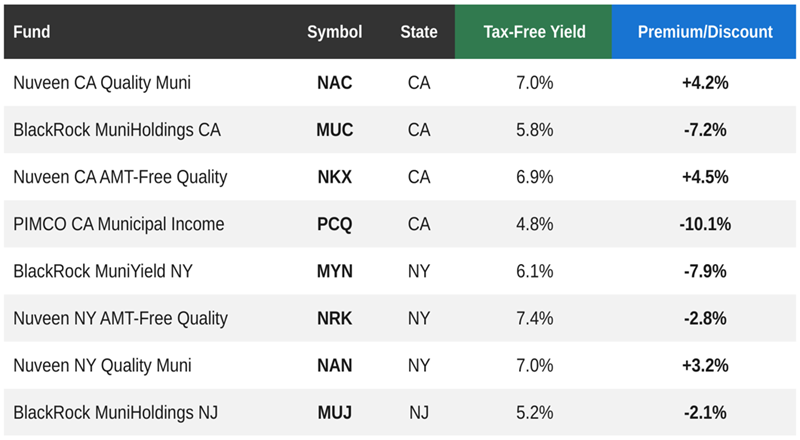
Exhibit A: two California muni bond funds. One is selling for $1.04 per dollar of bonds, while its neighbor sells for 93 cents on the dollar.
Why the premium? Nuveen recently hiked its payouts across these state funds to prop up share prices and close previous discounts. It worked. But we always use caution when paying a premium for a fund. It’s like paying a high P/E for a stock: it can work out, but the ceiling is near.
Discounts are generally better deals. Shopping for dividends is similar to the grocery store!
Now, would I close my eyes and buy and hold the California munis for years? In a word… no. Over the past two budgets, Sacramento pulled $12.2 billion from its rainy-day fund and skipped $5.4 billion in scheduled deposits in order to declare a balanced budget! That’s like me offering to take my oldest out for sushi and raiding her piggy bank to buy my cookies ‘n cream milkshake. (I said I’d pay for your ice cream…)
Here’s a look at the Golden State’s current and projected piggy bank:
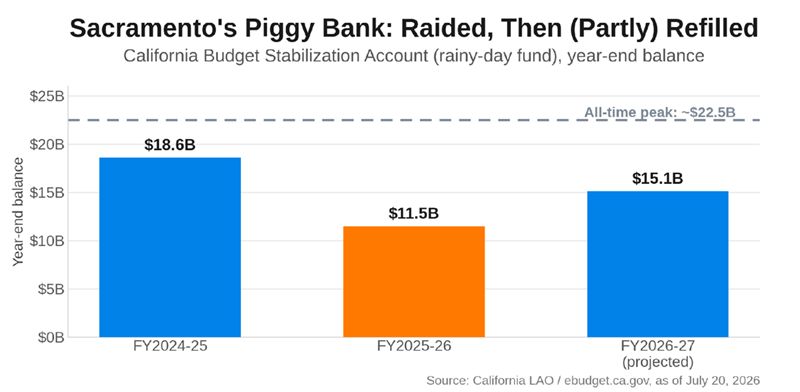
Why the bullish outlook? The stock market is up year-to-date so, if it holds, California will collect capital gains on taxpayer stock sale profits. A source it is highly dependent on. Plus, we have an AI boom in the state, a rising tide lifting the state’s broken finances!
Still, I would keep a leash on any CA munis. Most state budgets are in better long-term shape. Yet there’s another challenge. Nuveen has a reduced appetite to run these closed-end funds. Many are being consolidated into the national vehicles! New Jersey, Pennsylvania, and Missouri were recently devoured into a national fund. Minnesota and Virginia are next, with shareholders voting this fall.
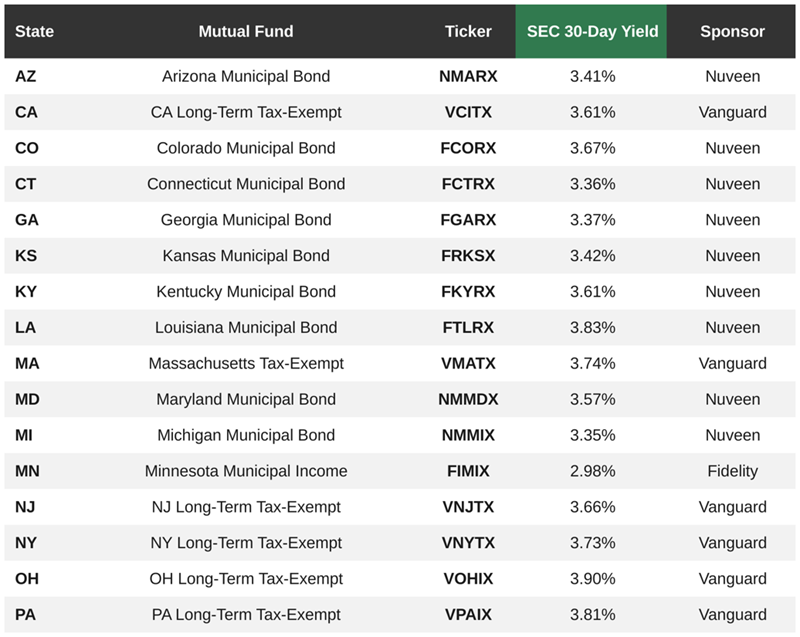
But some single-state mutual—as opposed to closed-end—funds remain. Here’s a sampling from Fidelity, Vanguard, and Nuveen—T. Rowe Price runs several more:
State-Specific Muni Mutual Funds
Another benefit of muni bonds is they pay monthly. And if that’s how you like your dividends in retirement—well, do I have some more ideas for you! I’ve got monthly payers powering yields up to 16.2% annually (that’s right, 16.2%!). These are my monthly dividend superstars, and you’ll find my full research right here.