
This has got to be the most “hidden” (maybe hated?) stock-market run I’ve ever seen.
The headlines are all doom and gloom (I think you’ll agree), but behind it all, the stock market is on a roll—returning 31% in just the last year. That’s more than triple the market’s long-term average yearly return of around 10%.
Where does that leave those of us who look to stocks for growth and income? Is there more runway ahead, or is it too late to buy in?
In my opinion, this 31% gain is setting the table for more, and we’ll get into exactly why in a moment. The setup we’ll break down is doubly attractive for investors in closed-end funds (CEFs), where we can get a discount on what we’d pay if we bought stocks through an ETF or directly on the market.
9%+ Yielding CEFs Give Us a Discount No Matter What the Market Is Doing
Our discount opportunity on CEFs exists in part because the CEF market is tiny, containing only about 400 funds. And CEF buyers tend to be individual, conservative investors.
That second point is key because these investors buy and sell predictably—and they always leave a “discount window” open for us somewhere. Plus, with CEFs, we can forget about the 1% dividend your typical index fund pays. CEFs often yield 9% and more, which means we’re getting the bulk of our return in cash.
I bring CEFs up now because I want to take on today’s stock-market setup—and our plan to buy into it—in two tracks.
First, we’re going to look at why this stock-market run is justified and not at all a bubble. Simply put, this means that a 31% gain in the rearview does not preclude a similar rise looking ahead.
For the second track, we’re going to move from the general to the specific, with a CEF seemingly purpose built to get us into this rise at a discount and a 10.3% dividend, too.
Track 1: An Economy Rolling Through Gloom
Before we go further, I know my bullishness on the economy might seem a little out of step right now, with the Strait of Hormuz closed, cutting off vital resources like oil and fertilizer; rising fear of job losses; and consumer sentiment that hit record lows in April.
Let me counter that gloomy narrative by starting where we always need to start when we’re talking about stocks: earnings.
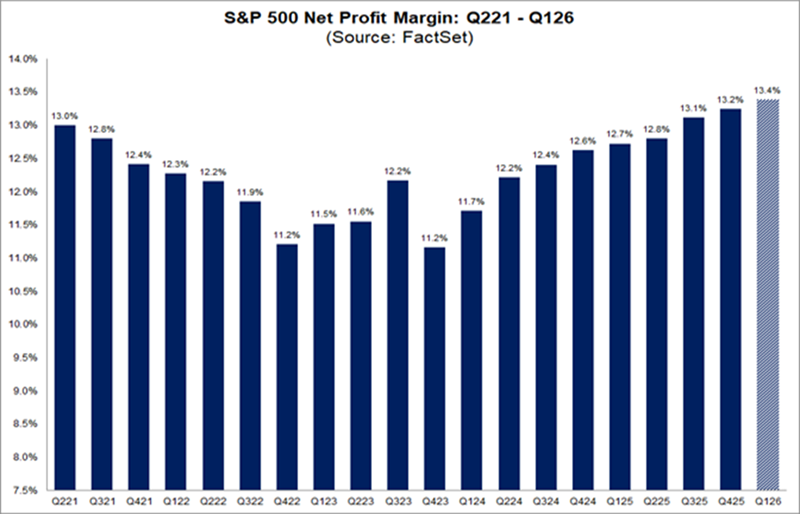
And thanks in large part to tech breakthroughs (AI, in other words) productivity is jumping, and those gains are showing up in strong corporate earnings growth. As of the end of 2025, profit margins had hit levels unseen in years, with more gains forecast:
Source: FactSet
And contrary to popular opinion, these productivity—and profit—gains are not coming at the expense of jobs. As I discussed last week, we’re starting to see data telling us that AI is, in fact, creating jobs. Over time, the resulting employment gains are likely to create opportunities for workers and companies to earn and spend, unlocking even more value from the stock market.
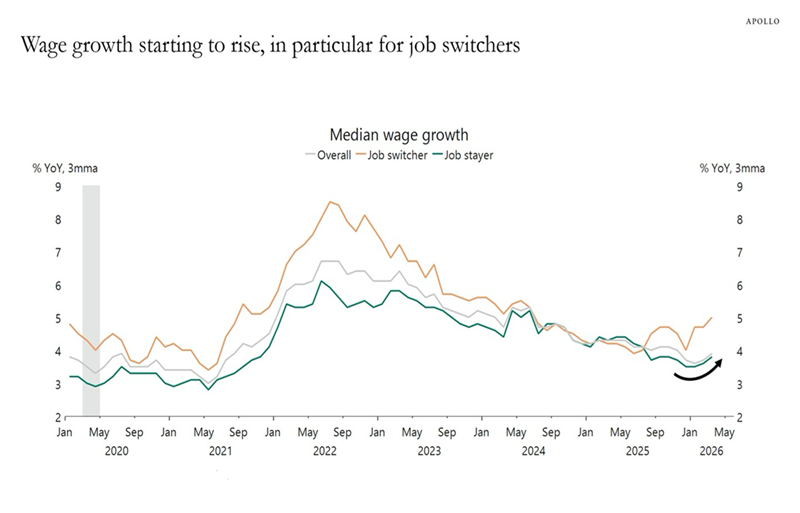
Here’s another report that backs this up (and pushes back on the whole “AI job apocalypse” narrative):
Source: Apollo Global Management
The chart above tells us a specific story: Workers moving from one job to another are likely to see their income rise—and significantly. This shows that companies are putting more emphasis on hiring, and are willing to pay for top talent. That’s another clear sign of a strong US economy.
Track 2: Our Bargain “Backdoor” On This Market Run
With all that said, it’s still easy to feel as if we’ve missed the bulk of the market’s upside. But with profits growing, and more money flowing through the economy, more gains are likely. And with a discounted CEF, as mentioned, we can do even better.
That’s because with CEFs we’re getting most of our return in cash, and we’re getting these funds for less than their portfolios are worth.
Consider a CEF called the Liberty All-Star Equity Fund (USA).
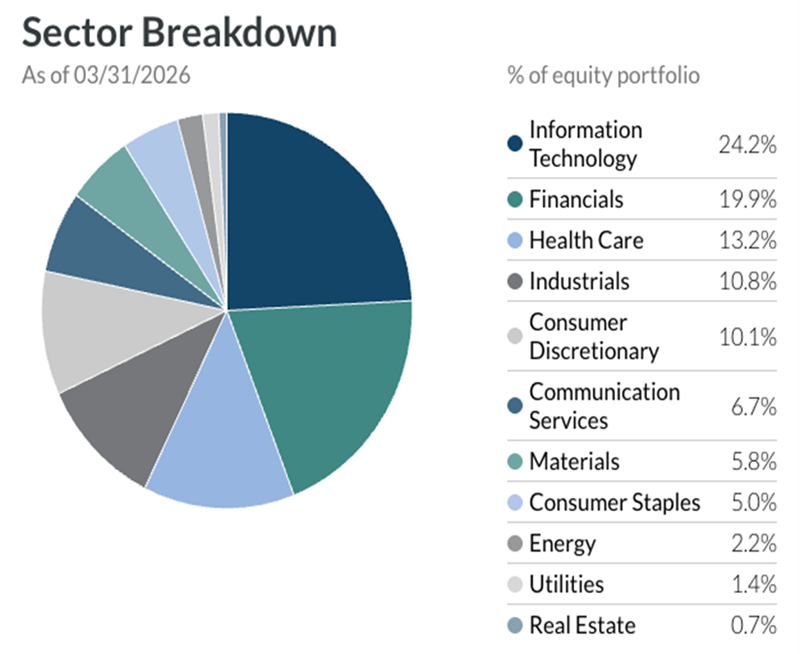
With a 10.3% yield, this fund pays nearly 10X what the average S&P 500 index fund does, while its large-cap focus means we get access to many of the same stocks: NVIDIA (NVDA), Microsoft (MSFT), Alphabet (GOOGL), Amazon.com (AMZN), Visa (V) and Charles Schwab (SCHW) are all main holdings, and USA is diversified in a way similar to the S&P 500 itself:
Source: Liberty All-Star Funds
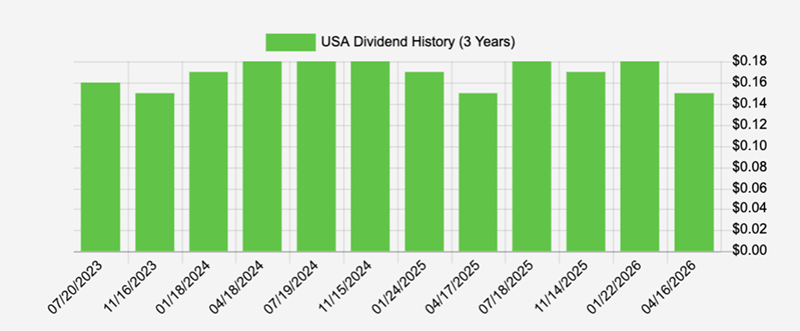
USA takes the returns on these holdings and “converts” them into an income stream for us. It manages that 10.3% payout by linking the dividend to net asset value (NAV, or the value of the fund’s underlying portfolio) and committing to paying out roughly 10% of NAV as dividends every year, in four quarterly installments of 2.5%.
That does mean the payout floats a bit, but we’re okay with that, since this “NAV peg” has resulted in a payout that’s been pretty consistent over the last three years:
USA Delivers Steady Dividends in Choppy Markets
Source: Income Calendar
Moreover, the fund’s strong returns over the last decade—216% on a market-price basis (in purple below) and 187% based on NAV (in orange)—have been more than enough to keep USA’s payout rolling out at a high rate. With the economy’s strong (and improving) prospects, I see that continuing:
USA’s Market Price (and Portfolio) Deliver
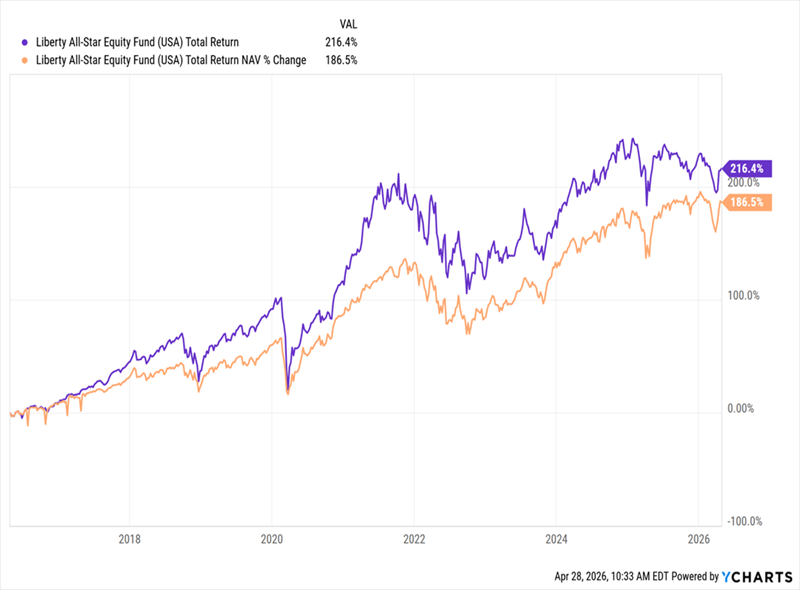
That gap between the fund’s own performance and that of its portfolio is unique to CEFs. As you can see at right in the chart above, it’s narrowed lately, setting up the discount opportunity you can see in the chart below:
USA’s Discount Hits COVID-Era Lows
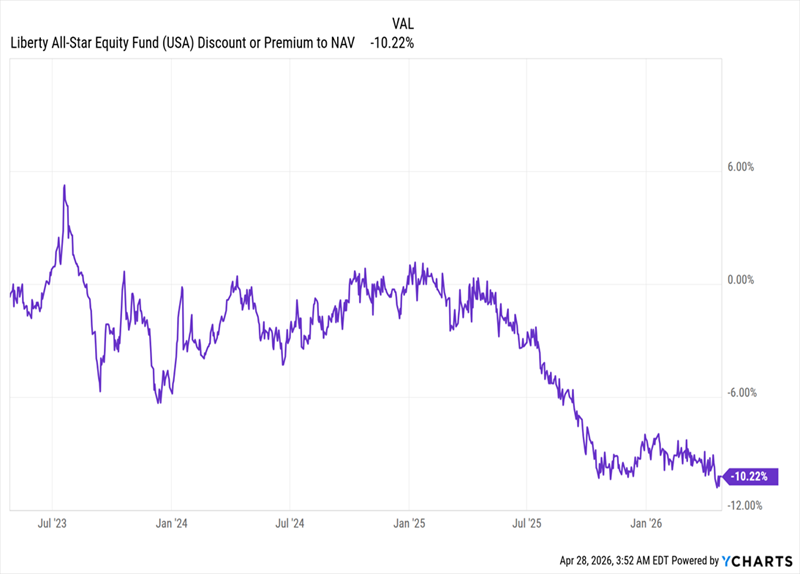
USA now trades at a 10% discount to net asset value (NAV, or the value of its underlying portfolio). That’s far below its 4.2% long-term average and the lowest it’s been since the dark days of COVID. It’s also far too large of a markdown for a large-cap fund that’s performing (and maintaining high dividends) as well as this one is.
Moreover, any gains in the stocks USA holds are likely to compound as the fund’s discount narrows over time.
This leaves us with a fund sporting a big yield, strong performance and a discount unseen since COVID. And that deal comes at a time when the economy is strong and growing. It’s a situation that clearly shows why CEFs are our first stop when we’re hunting for value, no matter what the rest of the market is doing.
These 5 Overlooked Funds Pay Dividends 60 Times a Year, Yield 9.7%
USA’s “floating” dividend is actually unusual among CEFs. Many pay monthly, in fixed, predictable amounts.
Investors in “regular” stocks and ETFs almost never get that luxury!
To make it easy for you to kickstart your own high monthly income stream, I’ve put my 5 top monthly paying CEFs in their own “mini-portfolio.” I call it, simply, the “60-Paycheck” Dividend Portfolio.
It boasts a 9.7% yield and kicks out 5 dividend payouts every month. That, as the name says, amounts to 60 dividend “paychecks” a year! Plus these funds are cheap now, putting solid upside on the table as rising productivity juices the economy, and stock market, further from here.
Now is the time to buy these 5 unique monthly payers. Click here and I’ll tell you more about them and give you a free report revealing their names and tickers, so you can collect your first monthly “paycheck” within weeks.