
There are plenty of reasons to buy closed-end funds (CEFs), but the one that most investors love most is pretty obvious.
The income!
The average CEF yields 8.7% as I write this. And while most investors have been conditioned to believe that this level of payout is unsustainable, this is not the case with CEFs. Many of these funds sport yields of 8% or more and haven’t cut payouts in years, even decades.
In fact, several have grown their dividends in that time.
The reason why is simple: The stock market gains around 10.6% per year on average. So a CEF that invests in stocks and pays 10.6% per year can maintain payouts, theoretically, since the fund is just handing that profit to shareholders as a dividend.
Of course, returns don’t arrive smoothly every year, which is why portfolio construction, discounts and care around dividend payouts all matter.
Moreover, there are a lot of variables—transaction costs, volatility and so on—but the idea of a fund that makes profits and translates those profits into an income stream for shareholders is not crazy at all. In fact, it’s a cornerstone of how wealthy Americans have managed their own portfolios for many decades.
So, if CEFs offer both high yields and sustainable payouts, how can we decide whether a fund is worth our investment dollars? There are a lot of things to look at, but today, I’m going to run through the three top factors, because they’re often overlooked.
We’ll take as our example the Liberty All-Star Growth Fund (ASG). Despite the “growth” in its name, this fund yields a healthy 8.2%, based on the latest quarterly payout. That and the fund’s 201% total return over the last decade suggest it’s more worth a closer look right now.
Step 1: Start With Portfolio Quality …
CEFs hand over profits from their investments, so those investments obviously need to be profitable. Which means the first thing we need to look at is the fund’s portfolio.
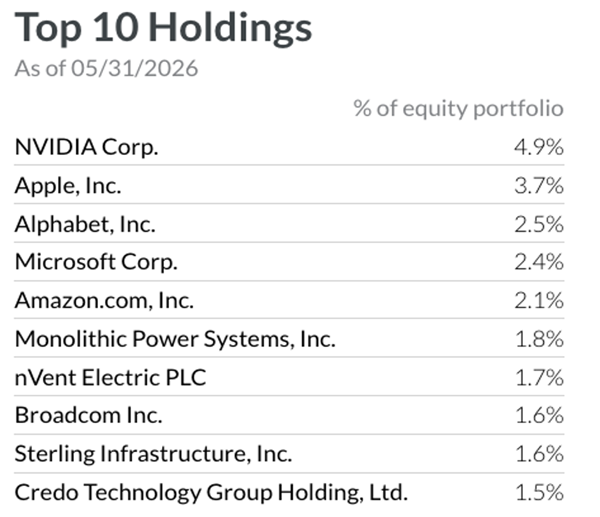
In the case of ASG, it’s straightforward: The fund starts with large-cap stalwards like NVIDIA (NVDA), Apple (AAPL), Alphabet (GOOGL), Microsoft (MSFT) and Amazon.com (AMZN), all of which are top positions.
The fund then mixes in lesser-known firms like Sterling Infrastructure (STRL), nVent Electric plc (NVT) and Credo Technology Group Holding (CRDO). All three companies benefit from the data-center buildout, providing systems and services for these massive facilities.
Source: Liberty All-Star Funds
Of course, if you’re bearish on these stocks, this would be enough to tell you to avoid ASG and look at the hundreds of bond, real estate, commodity or international CEFs on the market. But if you’re bullish, ASG passes the first hurdle.
Step 2: Insist on a Bargain
The next thing I like to look for is the fund’s discount to net asset value (NAV, or the value of its underlying holdings) and how that compares to its discount historically. Check out this chart.
ASG Goes On Sale
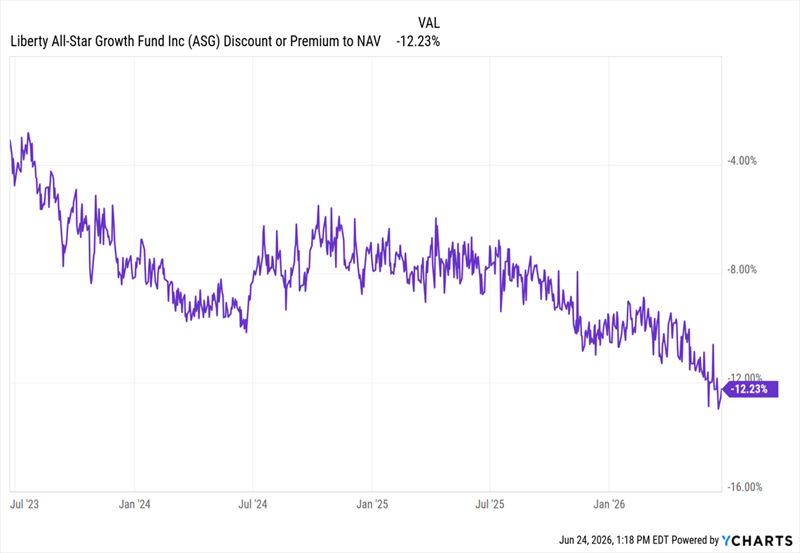
At 12.2%, ASG’s discount is near its widest level in years, but importantly, it looks to be forming a bottom around the 12% mark, as you can see at the right side of the chart above.
This shows that ASG is suddenly cheaper than it’s been in a long time. So, if our other checks look good, ASG would be a smart buy today, especially since the portfolio we’re getting is full of stocks set to benefit from AI’s continued spread into the wider economy (a process that’s only just beginning).
Step 3: Take a Magnifying Glass to the Dividend
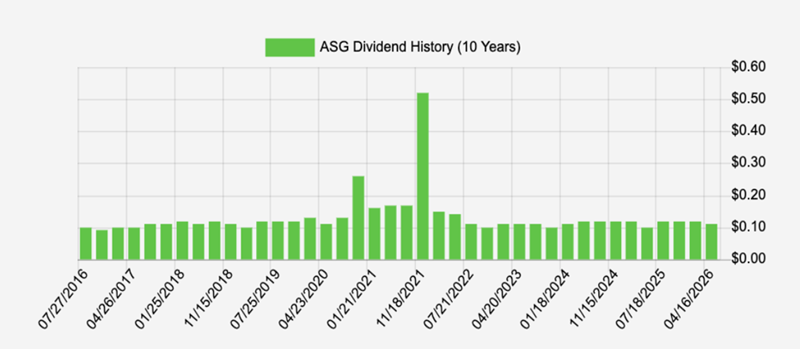
Income is obviously key here, so let’s look at dividends. Can we rely on the fund to maintain its current payouts?
A Long History of Solid Dividends
Source: Income Calendar
As you can see, the dividend has more or less held steady, and even grown modestly, over the last decade.
On this front, again, ASG looks enticing. One thing we do need to note here is that the payout does fluctuate some, as the fund commits to returning roughly 8% of its NAV per year as dividends, and that portfolio does change value daily.
This is a feature, not a bug, as it gives management certainty around the payout level versus the fund’s overall portfolio return. That, in turn, gives them more flexibility to buy stocks when they’re out of favor.
The Story Continues…
There is much more to consider, of course, such as management, leverage, fees and the fund’s mandate. These all come up when you do your due diligence on any CEF.
At the end of the day, though, what’s important is finding a CEF that invests in what you want to invest in, trades at a fair value and pays a dividend at the right yield, frequency and consistency that you need.
Viewed through that lens, ASG may make sense for you, especially if you’re bullish on US large- and mid-cap stocks, as well as AI’s long-term prospects. But of course, there are many other CEFs out there (nearly 400 in all) spanning stocks, bonds, REITs, preferred shares and many other assets.
Many of these funds are discounted today—ASG included. That gives us a chance to pick up these high-yielding plays at bargain prices.
My 5 Top Monthly Dividend CEFs Pay Out 60 Times a Year (and Yield 9.7%, Too)
Going by this three-step process, it’s clear that USA should be on the watch list of any income-focused stock investor. But I totally understand if you want a more frequent, steadier payout than this fund offers. Most people do.
With that in mind, I’ve assembled 5 other CEFs that pay nearly as much as USA—I’m talking about a rich 9.7% average dividend—and pay dividends monthly, to boot.
Think about that for a moment: With these 5 funds, you’re getting paid around 5 times a month. That’s a total of 60 dividend payouts a year!
I’ve put all 5 of these reliable monthly payers together in a “mini-portfolio” all their own. I’m urging all investors to take a close look at it now.
Oh, and there’s more for us here than “just” that 9.7% average payout. These funds also trade at unusual (and undeserved!) discounts, putting strong upside on the table, too.
Now is the time to buy them and start your 60 “paycheck” income stream! Click here and I’ll tell you more about these 5 stout monthly income plays. I’ll also give you a free report revealing their names, tickers and my full analysis of each one.