
I’ll cut right to the chase: I think the stock market—and our 8.8%+ yielding closed-end funds (CEFs)—could be on the brink of another spike.
If I’m right, we’ll have last week’s “disappointing” jobs report—which showed a loss of 23,000 positions in July—to thank. (And that 8.8% yield, by the way, isn’t made up: It’s the average payout on all CEFs.)
The stock market’s surprising reaction to that jobs report—it rose in response—also positions one of our CEF Insider tech funds very well indeed, with a deep discount to NAV (around 10.7% as I write this) that’s stair-stepping toward par.
That suggests even more gains are ahead for this powerhouse 7.3%-yielding fund, on top of the 37% total return it’s posted this year.
Let’s set the stage for that with this latest jobs report—and why I see it as the springboard we’ve been looking for over the last several months.
Employment Numbers Didn’t Say What Most People Thought They Did
The main reason why stocks rose following the jobs report is that investors feel a weaker labor market will give the Federal Reserve room to cut rates. And while that could turn out to be true, the crowd missed the more important story here.
That tale starts with the headline number: those 23,000 “lost” jobs. Funny thing is, it’s more than accounted for with job losses in just one sector: public schools.
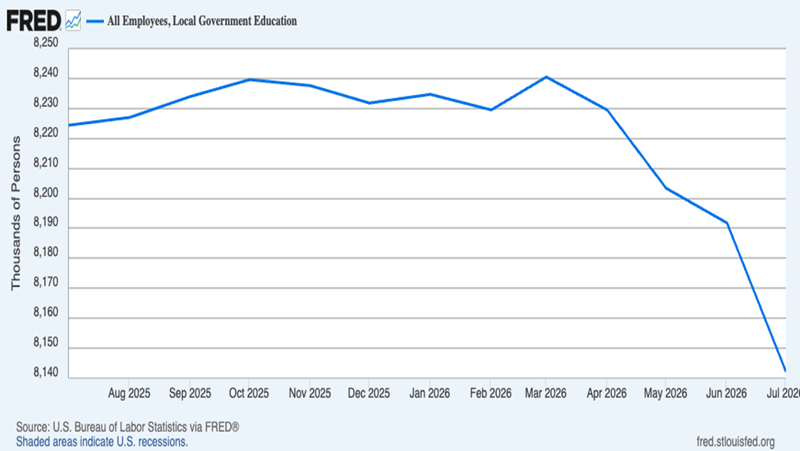
In total, 99,000 jobs were shed in public education from a year ago, in a worsening trend that began earlier this year. This is mainly about immigration: Fewer people are coming to America from abroad, which means fewer children and lower demand for teachers. Add in an aging population, and the big drop in public-education jobs makes sense.
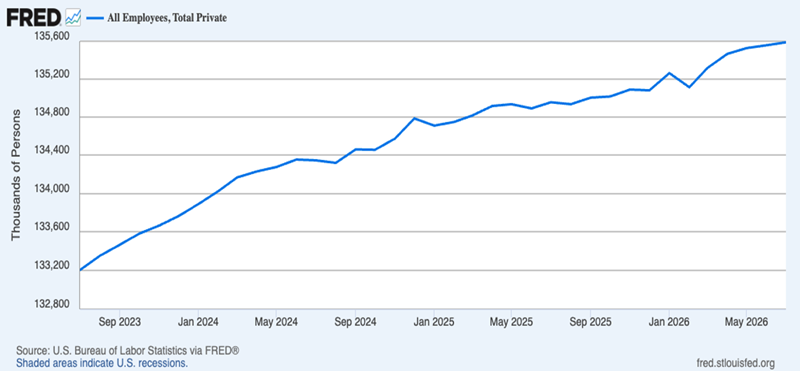
To be sure, fewer workers—wherever they’re employed—is never great news. But if we want to see where things are headed for US companies (and we very much do), we need to zero in on private-sector hiring, which grew in July, continuing a trend that’s now three years old.
As is always the case, not all sectors created more jobs. But there’s more to the story here, too. Let’s look at some of the worst performers: finance and leisure and hospitality, with the latter taking the sharpest dip of all sectors.
But here’s the thing to keep in mind: On a seasonally adjusted basis, tourism jobs are up. And since the World Cup is now behind us, it makes sense that these numbers would dip from May and June. But the long-term trend is clear: Demand for workers in tourism and entertainment is still rising.
As for finance, the decline is mostly in insurance, where companies are increasingly leaning on AI to boost efficiency and, yes, hire fewer people. But that’s not necessarily a negative for employment in the sector, as insurers will likely plow the savings into expansion, creating more jobs down the road.
The takeaway here is that the economy is doing better than the headlines indicate. That, along with the possibility of a looser rate environment, is why the stock market rose in the wake of the report.
This setup is also the perfect time to buy a discounted CEF, with stocks strong and investors still not fully appreciating the economy’s strength. When we do, we set ourselves up to win not one but three ways:
- Through these funds’ high dividends (remember: 8.8% on average), which are often monthly paid.
- Price gains as their underlying portfolios increase in value, and …
- Their closing discounts to net asset value (NAV, or the value of their underlying portfolios).
The best setup of all is when we can grab a fund that trades at a discount with momentum. That is, a markdown that’s still deep but marching toward par.
Case in point: the BlackRock Technology and Private Equity Fund (BTX), which holds high-quality tech stocks. Its portfolio includes public firms, like NVIDIA (NVDA), and private ones, like Anthropic, maker of Claude, one of the leading AI models.
BTX’s smartly built portfolio has helped the fund return 35% since we added it to our CEF Insider portfolio in the February issue. But shockingly, the fund is still heavily discounted!
We’re Still Buying BTX’s “Discount With Momentum”
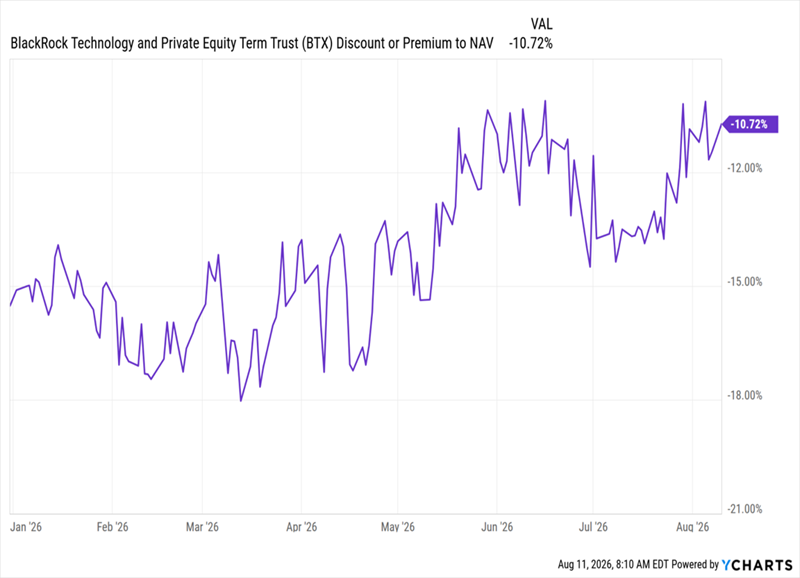
While the discount has shrunk since we bought, it’s still 10.7%, which is ridiculous for a CEF that gives us access to private tech firms. What’s more, a significant portion of BTX’s return has come in the form of dividends, thanks to a monthly payout that yields 7.3% as I write this.
And thanks to that still-deep discount, the yield on NAV (or what management needs to earn from the fund’s portfolio to cover the 7.3% payout to us) comes out to 6.6%. That’s very well covered when you consider that the fund’s total NAV return on the year has been 28.5%, or more than 4X the yield on NAV.
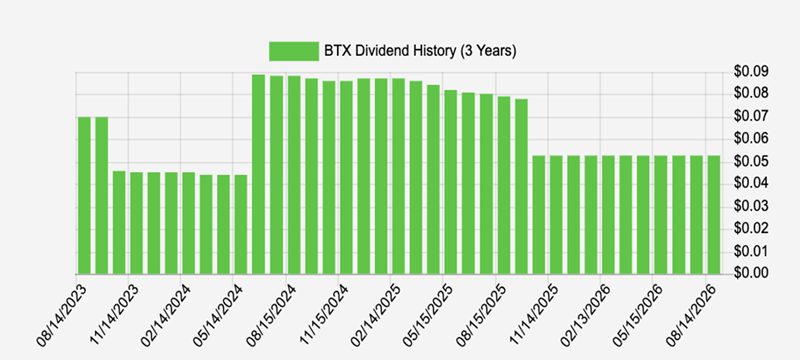
We also don’t mind that BTX’s 7.3% yield on market price comes in a bit below the CEF average of 8.8%. In fact, it gives us more confidence that this monthly payout will remain steady, especially since BTX’s management team, which took the reins in early 2025, reduced the dividend.
That move came after the payout got a bit too far over its skis under the previous team. You can see the move toward a more sustainable dividend in the chart below:
Source: Income Calendar
All of this leaves us with a fund sporting some of the top tech names (public and private), trading at a 10.7% discount that’s narrowing and sporting a 7.3% dividend that looks solid. That’s a nice setup for future gains and steady income. Let’s buy (or add more) while our window remains open.
These 10% Dividends Get Us in on AI’s Next Big Surge (Before the Crowd)
BTX is Part 1 of our “dividend-driven” strategy for profiting from AI’s stunning growth.
Part 2? Buy CEFs holding companies that use AI to supercharge their businesses.
I know. Sounds kind of obvious, right? But it actually takes a lot of digging. (Like with insurance companies showing up as top AI users—that’s a fact you have to hunt for.)
My team and I have zeroed in on 4 such funds. I call them “pivot point” funds because they’re squarely in the tracks of the profit shift from AI developers to AI users.
The crowd hasn’t yet keyed in on these funds’ potential—yet—so they’re still cheap. That sets us up for gains while we collect their rich 10% average dividends now.
It’s the perfect “1-2” punch on AI’s next wave, and I want to share everything—our full strategy and the names and tickers of these 4 CEFs—with you. Click here to get the details and a free Special Report revealing the names and tickers of these 4 bargain-priced 10%-paying funds.