
The world’s biggest asset manager says now is the time for us to grab “generational high yields.”
I believe them. And today we’re going to follow their advice.
The setup is clear: Even though high bond yields have caused a lot of worry, especially around heavily indebted AI firms, these worries (as they often do) bring opportunity.
That opportunity is this: Yes, yields on corporate bonds have soared, especially in the more speculative corner of the market, where heavily indebted AI players like CoreWeave (CRWV) operate.
But in other corners of the bond market, something interesting is happening: Yields are hitting highs not seen in 18 years, while default risk remains low.
This is where that word “generational” comes in. BlackRock, the world’s biggest investment firm, with $15 trillion in assets under management, recently flagged today’s corporate-bond yields as “generational high yields.”
BlackRock is referring to a setup we’ve talked about before on Contrarian Outlook: the fact that bond yields are rising, but they’re doing so against the backdrop of booming corporate profits.
That leaves us with a chart of yields on investment-grade AAA-rated bonds that looks like this …
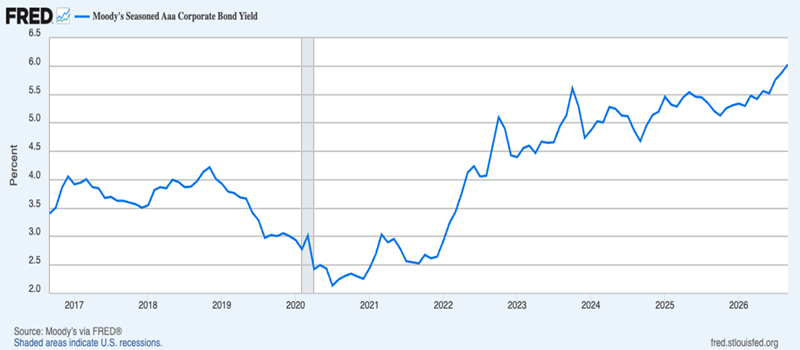
At 6%, this is the highest yield we’ve seen since 2008. And it’s bumping up against a corporate-bond default rate that’s low. Even for higher-yield (and higher-risk) corporates, defaults sit at just 2.8% as of August, according to Fitch Ratings.
So, if even the safest corporates are paying 18-year highs, then high-yield (or so-called “junk”) bonds are yielding even more.
That’s where the 13.4% payout we’re targeting today comes in. And because high-yield bonds are hated right now, we can get in at a rare discount.
And when you add in well-connected, professional management (essential in the small world of corporate bonds) and a well-diversified portfolio, you spread that already-low default risk even thinner.
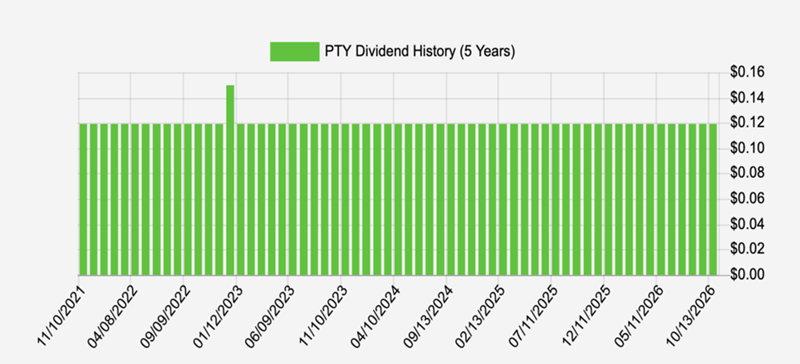
That’s what we get in the PIMCO Corporate & Income Opportunity Fund (PTY), the closed-end fund (CEF) behind that 13.4% yield. PTY’s payout is rock steady:
Source: Income Calendar
High, consistent dividend? Check.
Savvy management? Check. PIMCO is one of the best in the business, which is why its funds usually trade at premiums to net asset value, or NAV (more on this in a moment).
Diversification? Plenty. PTY holds 931 assets spread across high-yield corporate bonds, securitized debt and floating-rate bank loans. That last group pays more as rates rise, a nice hedge if yields keep climbing.
Now let’s talk value, because this is where the other part of this “generational” opportunity comes in:
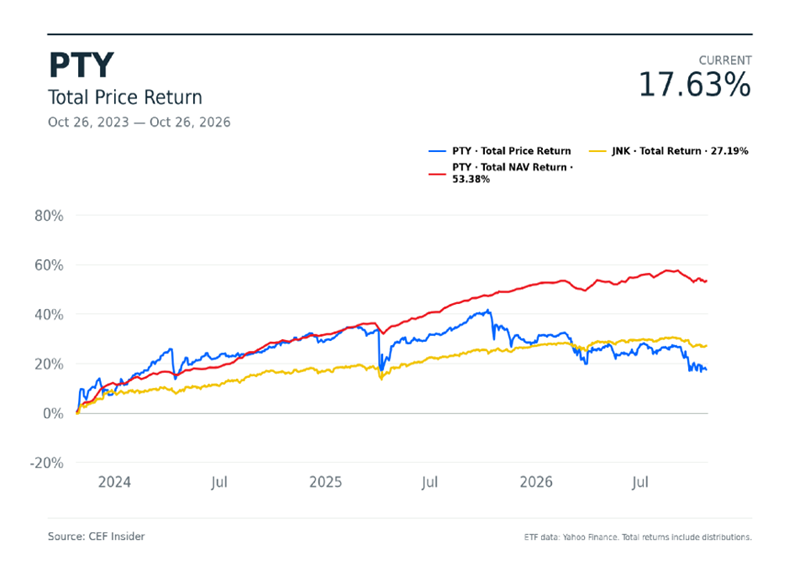
The three lines in the chart above tell us a lot. In blue is PTY’s return based on its market price. You can see that it faltered in 2025 and still hasn’t recovered. Before that, this metric was outrunning the return of the high-yield-bond benchmark SPDR Bloomberg High Yield Bond ETF (JNK), in yellow.
Then, earlier this year, PTY’s market-price return started to underperform the index. That’s rare for the fund over any sustained stretch, so it deserves our attention.
Now look at the red line: That’s PTY’s total NAV return, or the return of its portfolio. This is a key metric because, since it’s less influenced by investor sentiment, it’s the cleanest measure of management’s performance.
And as you can see, it’s been marching higher. So investors are selling at a time when PTY’s fundamentals are very good: Its NAV has posted a 53.4% total return over the last three years, while its total return based on market price has faltered. That’s knocked PTY’s premium from around 16% to a discount:
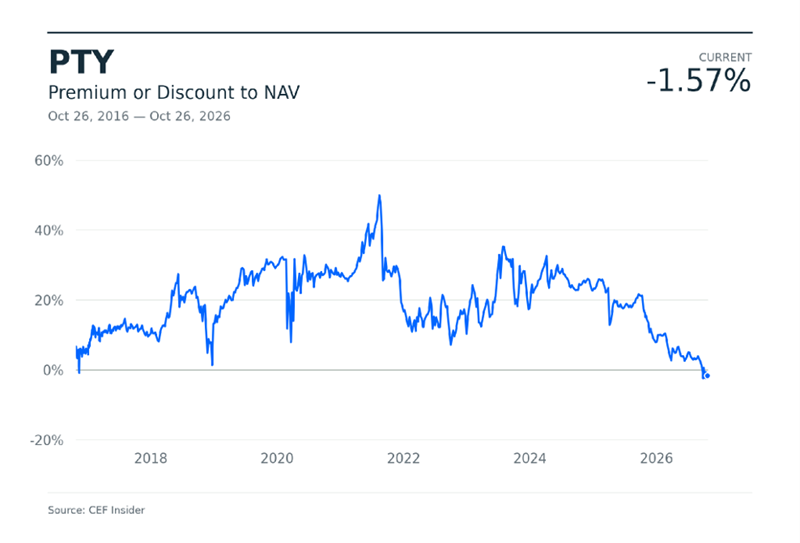
Above, we can see how rare a discount on PTY is: This is the first time the fund has had one in more than a decade. Even the pandemic failed to knock this premium off its perch.
PTY’s selloff makes even less sense when you consider that the fund is a proven performer: In the last 10 years, its total NAV return (in blue below) has blown past the return of JNK (in red):
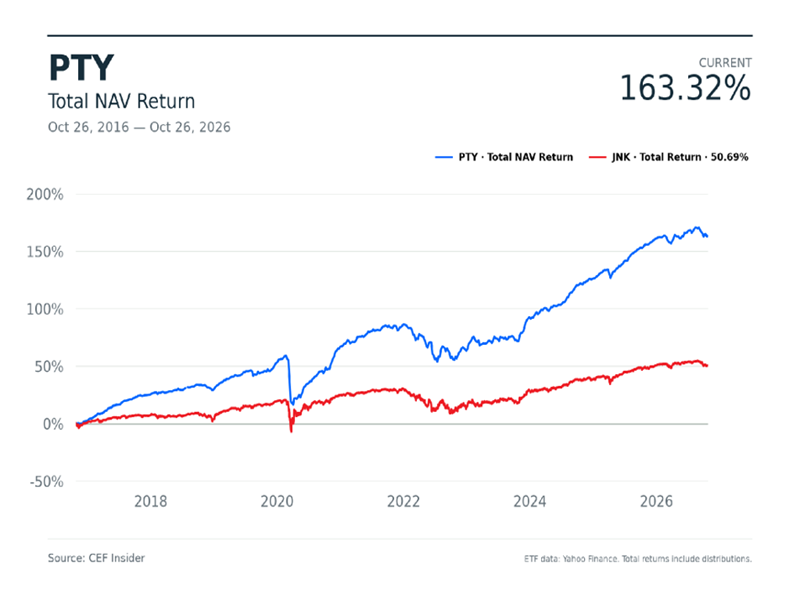
At the end of it all, we’re left with a 13.4% yield, a decade-best entry point and a savvy manager in the form of PIMCO. That’s a setup we’ve rarely seen in the past, and one we may not see for another generation—or more.
PTY’s “Discount Swing” Isn’t Unique: 4 More Bargains (Average Yield: 9.8%)
When a discount swings as hard as PTY’s has, the fund lands squarely on our radar.
That’s because, when a CEF’s market price plunges in relation to its NAV, it gives us a chance to buy cheap—and ride along as investors come around and the discount narrows.
And we collect a high yield while we wait.
That’s the kind of setup we look for in CEFs. And right now, I’m seeing it in 4 other funds. They yield 9.8% on average, and I see 20% upside potential in them over the next 12 months.
I don’t expect these deals to last—especially if Treasury yields keep easing back from their October highs, as they have been over the last few weeks. That could spark a “rush into income,” and I expect these bargain payers to be at the front of the line for many investors.
I’ve put my research on all 4 in a free Special Report called “4 Great CEFs to Buy Now: 9.8% Yields and 20% Potential Upside Ahead.” Click here and I’ll tell you more about these bargain high-yielders and give you your copy of this Special Report now.