
Corporate-bond funds are cheap now, and their yields have soared.
We can “thank” high interest rates for that. When rates rise, bond prices fall. That, as always with bonds, is a key part of our buying opportunity today.
What’s more, this opportunity is (finally!) starting to get on the mainstream crowd’s radar.
How do I know? Because even the financial press (which seems like it’s been able to talk about tech stocks and little else for years now) is catching on: CNBC recently published a story with a title that literally said, “This could be one of the best times in recent market history to buy corporate bonds.”
Let’s look at a 3-point “hit list” breaking down exactly why this is an incredibly good time for bonds. Then we’ll zero in on one discounted closed-end fund (CEF) yielding 11.9% that’s particularly well positioned. It’s a long-time holding of my CEF Insider service.
- The economy is strong (despite inflation) and gaining speed
This is the most important part of the story here, and the data is clear: The economy is regaining momentum, despite the fact that consumer sentiment is in the dumps.
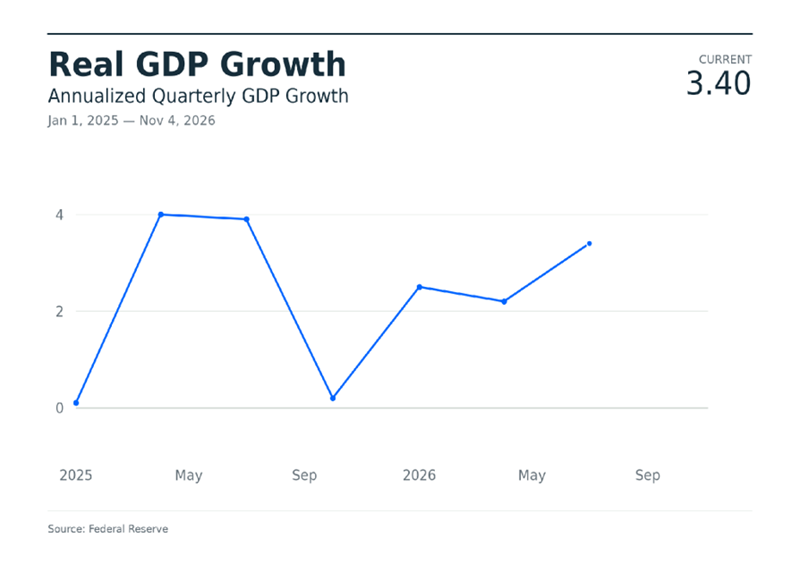
We did see economic growth weaken at the end of last year, but things have been steadily improving. In the third quarter of 2026, growth was above the historical average for the US. Moreover, at an annualized clip of 3.4%, it’s near the heights we saw in mid-2025. Plus, this is real GDP growth, meaning that it’s after inflation is considered.
The bottom line? At a high level, the US economy is performing well.
- Defaults remain low
A strong economy means companies are earning enough to pay their debts, so it’s no surprise that default rates remain unusually low. According to the latest data from Fitch, they were at 2.6% in September, down from 2.8% and at the low end of Fitch’s 2.5% to 3% forecast range for 2026.
- Rates have risen (and taken bond yields with them)
The fact that defaults are low because of fundamentals is key, and it’s proven by another fact: Companies are not defaulting on their debts, despite today’s high interest rates. In fact, they’re not only keeping the bills paid—they’re thriving.
According to FactSet, of the S&P 500 companies that have reported Q3 results so far, the blended earnings growth rate has been 30.2%.
So it shouldn’t be too surprising that companies are seeing higher borrowing costs and are still able to afford to pay their debts. The result is that corporate bonds are yielding a lot, they’re relatively safe, and the economy is growing enough to support this strength for a long time.
Moreover, at some point, the conflict with Iran will end, and a solution will be found to today’s high oil prices. And, of course, we’ve got AI continuing to roll out across the economy, boosting productivity and cutting businesses’ costs. That’s another disinflationary force that’s not getting much attention these days.
Taken together, those two points suggest lower interest rates in the longer-term future, putting upside on the table for today’s bond buyers, in addition to high yields.
This 11.9% Payer Trades at 3X Its Usual Discount
I think it’s clear that corporate bonds are a good buy now, but we can make them an even better one when we pick them up through a closed-end fund (CEF) called the BlackRock Corporate High Yield Fund (HYT).
In addition to its 11.9% dividend, HYT gives us a portfolio built for this “high-rate, high-growth” economy, and we can buy it at a 9.5% discount to net asset value (NAV, or the value of that portfolio—more on this shortly).
About 83% of the fund’s holdings are in high-yield bonds, and the credit rating on 94% of its portfolio is BB or lower (including 2.6% that aren’t rated at all). That makes HYT a pure play on corporate bonds, and specifically the more speculative side of the bond market, where yields are high, and discounts are easier to find.
On the discount front, HYT trades at that 9.5% markdown as I write this, more than triple its five-year average markdown of 3.1%. That’s vastly overdone, and if you look at the last few weeks, you can see that the discount is offering us another clue that investors could be finally coming around to corporate bonds: It’s narrowing.
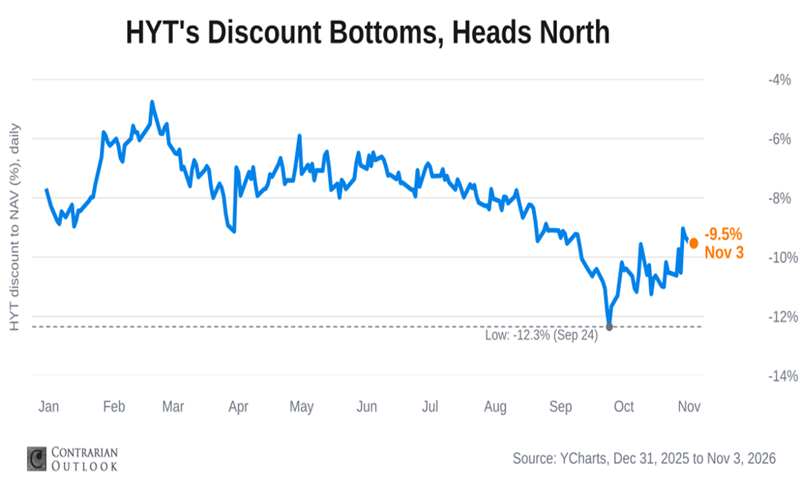
So we’re getting in with a wide discount that’s got momentum as it heads toward par (a scenario we love with a CEF). And we’re also getting a fund with a long history of beating the high-yield-bond benchmark, the State Street SPDR Bloomberg High Yield Bond ETF (JNK).
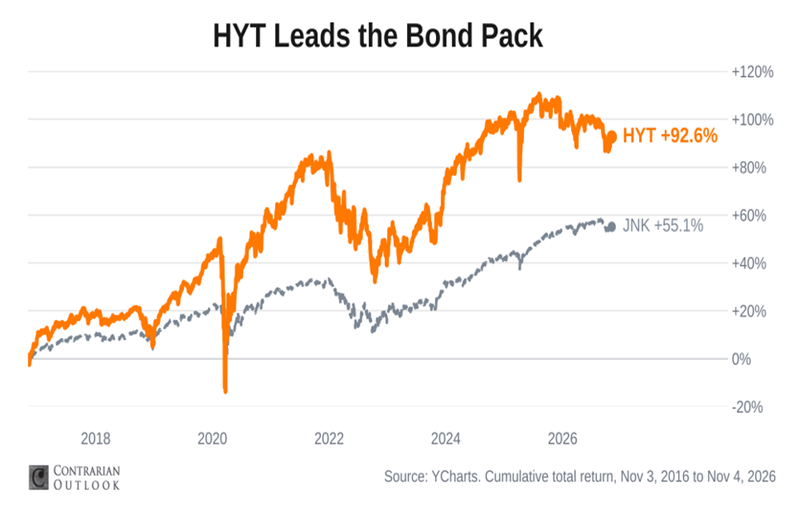
HYT’s strong returns are, in part, the result of its use of leverage, with management borrowing against around 21% of assets. That’s enough to juice its results (and noticeably lower its borrowing costs) when rates fall, but shouldn’t burden the portfolio too heavily if rates surprise to the upside.
Let’s wrap with that 11.9% dividend, which is paid monthly, has edged higher in the last decade, and even held strong through the bond massacre that was 2022.
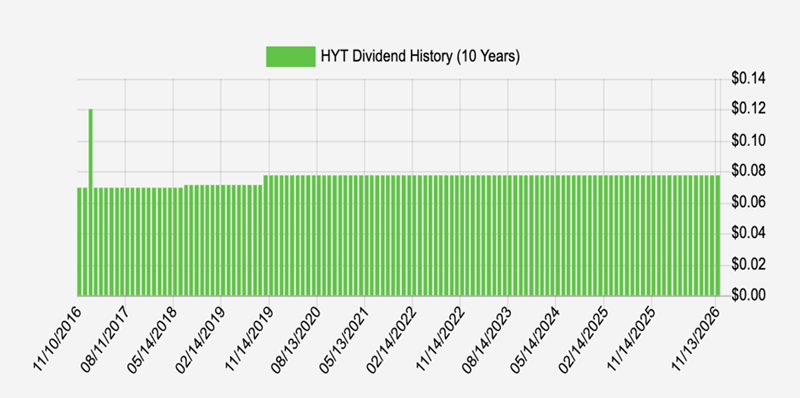
Source: Income Calendar
The current backdrop (with plenty of high-yield bonds available at markdown prices, backstopped by continued US economic strength) suggests further support for HYT’s payout. It could lead to a narrower discount, too, as more investors discover this well-run fund.
5 More Monthly Payers (Yielding 9.2%) to Get Ahead of the Coming “Bond Fever”
HYT isn’t the only fund “translating” today’s strong economy and high rates into steady monthly income.
I’ve got 5 more for you that pay every month and yield 9.2% on average. Like HYT, they let us collect big dividends while the mainstream crowd is hunting for investments beyond tech stocks—and still warming up to high-yield bonds.
On a $500,000 portfolio, a 9.2% yield works out to about $3,833 a month in dividends. Better still, that’s money you can get without selling a single share.
I’ve put all 5, with names, tickers and my full analysis, in a free Special Report: “5 ‘Must-Own’ Monthly Dividend Funds Yielding 9.2%.”
Your copy is waiting for you. Click here and I’ll tell you more about these 5 monthly payers and give you this exclusive report right away.