
One thing we love to find as income investors? A situation where a double-digit dividend is coming our way—at an undeserved double-digit discount.
Every now and then, a situation like that can get truly extreme. These are the times when we really want to take a closer look.
This is the kind of setup we have with a closed-end fund (CEF) called FS Credit Opportunities Corp. (FSCO) right now.
I’ll cut right to the vitals. As I write this, FSCO yields 13.7%.
The discount? It sits at 27%.
In other words, this fund is now on the table for just 73 cents on the dollar. As recently as last year, it traded above par. It also stands out next to the 6.3% average discount among CEFs tracked by my CEF Insider service.
However, I see that discount narrowing again in the months ahead, for a reason that may surprise you: the elevated odds of another stock-market drop.
Why do I say that? The reasons likely won’t surprise you. They start with the Iran conflict, which has sent crude back above $100 a barrel while the Strait of Hormuz remains effectively closed. And now we’re hearing calls to slow AI research, which could, in turn, drag on investment.
To be clear, I see stocks recovering from any pullback and going on to produce long-term gains, as they always have. But these concerns are weighing the market down, even if the long-term story remains bullish.
That brings me to bonds, which I see becoming more attractive to investors as stocks wobble—especially corporate bonds. That’s because corporate bonds are facing a much different situation than stocks.
That story begins on the government-bond side, where, as I know I don’t have to say, we’ve seen yields rise. Last week, for example, the yield on the 10-year Treasury note hit 5%, a high not seen since 2007.
Corporate-bond yields have been pulled up with yields on government bonds, raising the prospect of higher income. Meantime, corporate America’s fundamentals are a lot different than those of Uncle Sam’s debt-burdened books.
Earnings growth, for one, remains solid, and indeed in plenty of cases record-breaking. As a result, the risk of defaults among corporate bonds is low—in my view, lower than the market thinks. That’s a plus for FSCO, in particular, because of the kind of debt the fund holds.

Source: Future Standard
Unlike many corporate bonds, which fall in price as yields rise, first-lien loans (which make up the bulk of FSCO’s portfolio) carry floating rates, something that makes them more valuable in an environment like this one, as their income streams rise.
As a result, FSCO’s market price has been rising slightly (see purple line below) in the last few months, even as the stock market has stumbled. At the same time, FSCO’s NAV (see orange line below) has more or less moved sideways.
Investors Bid Up FSCO, Narrowing Its (Still-Wide) Discount
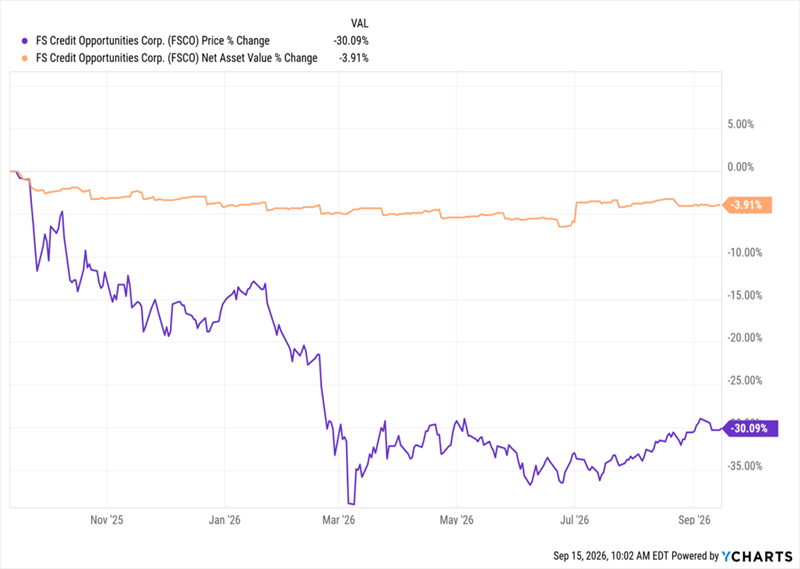
This suggests stronger sentiment around the fund, and it’s narrowed the discount slightly. But even so, FSCO’s markdown remains around that 27% mark.
Why does this situation exist? One issue is the dividend, which was reduced a few months ago but has since seen a slight increase.
The cut was because FSCO has been suffering a hangover from last year’s private-credit worries. But private-credit valuations have now mostly recovered.
In other words, FSCO’s discount reflects 2025 sentiments, even though we’re deep into 2026—and are starting to look at what the story of next year’s market will be.
Already, we’re getting a hint of that narrative, and it’s starting to look like it will include higher bond yields, along with Fed rate hikes. But at the same time, we’re also likely to see stronger debt coverage from highly profitable firms that still have a lot of room to incorporate AI into their businesses.
And while higher interest rates do impact leverage, which FSCO uses, the fund’s ability to see its investment yields rise with interest rates also means that these higher leverage costs aren’t likely to affect net income.
That’s because the fund’s incoming investment income has been rising, even as borrowing costs go up. This is one of the perks of running a senior-loan fund in a rising-rate environment.
This is all bullish for FSCO, but the fund has another advantage, as well.
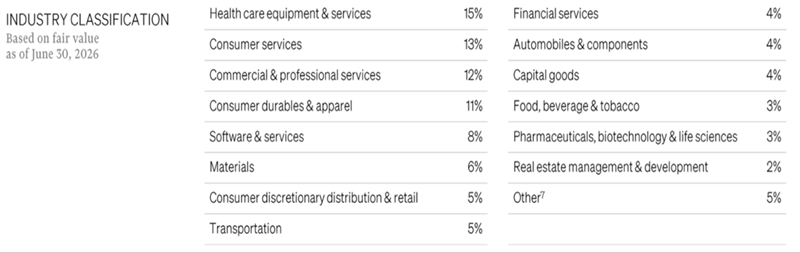
In addition to a high yield and strong historical fundamentals, FSCO is well-diversified across a variety of industries and, crucially, is not overexposed to the crowded tech sector.
As a result, we’re left with a fund whose recent history has left it looking oversold. And a 13.7% income stream (especially one that looks like it’s recovering) isn’t something that stays oversold for long.
Soaring Interest Rates? With 5 Monthly Payers (Yielding 9.2%), You Can Ignore Them Entirely
If you’re like most investors, you’ve been watching like a hawk as bond yields have marched higher.
The fact that you’ve read my article on a bond fund like FSCO tells me that.
When it comes to the stock market, though, we’re all wondering the same thing: When will these worries finally break through?
When will the dam break?
We’ve already seen stocks wobble these past few weeks. And even that move lower has been fraying nerves.
But not everyone’s nerves.
Some investors are quietly collecting fat dividend checks every single month from 5 of my favorite monthly dividend plays.
These 5 funds—which are among my very top picks among CEFs—yield an outsized 9.2% on average. The straight-up math here is, of course, that every $100K invested gets you $9,200 in yearly dividends.
The folks who own these 5 tickers aren’t sweating the interest-rate see-saw, or any other headline that’s been buffeting the market lately.
Because they’re safe in the knowledge that their monthly payouts have staying power: They’ve rolled in through rate scares, a pandemic, wars, political drama in the US—you name it.
And by collecting dividends that high, these investors don’t really have to sweat stocks’ daily moves. They just wait for their next check.
I want you to join them—and start collecting this rich 9.2% payout yourself. Click here to get my full briefing on these 5 bargain-priced monthly payers, plus a Special Report revealing their names and tickers.