
Consumer staples are boring and reliable. And they typically pay generous dividends.
But generous has nothing on these fantastic yields from 5.2% to 11.3%!
Historically, staples have held up better than the broader market during downturns. Lately, however, that hasn’t happened:
Consumer Staples: A Rare Failure to Protect
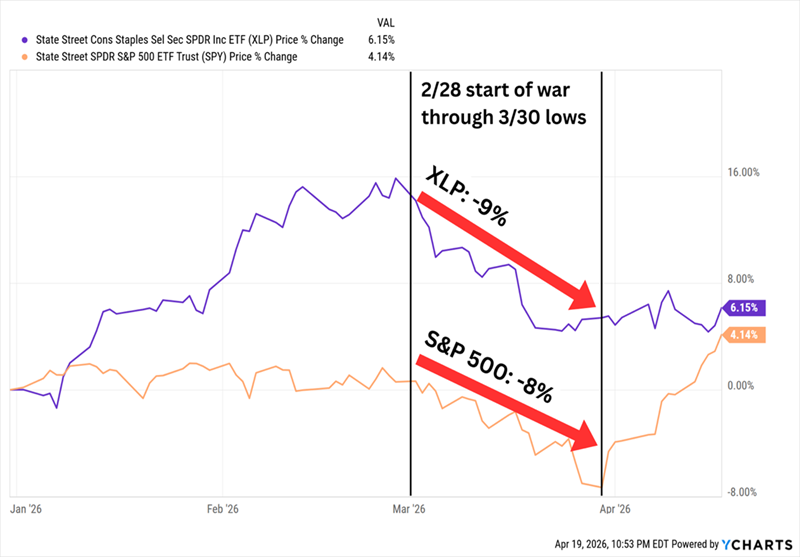
Uncertainty fueled a staples rally across the first couple months of the year. But when the war in Iran triggered a near-correction in the S&P 500, the sector didn’t just take the same elevator down—they found a faster one.
The rub? The war sent inflation expectations through the roof. Defensive though staples might be, when consumers really start pinching pennies, they shift away from the pricey brand names that anchor this sector and into private-label products from smaller public and even private companies.
The sector as a whole still isn’t cheap. But if we dig a little deeper, we’ll find names that are inexpensive, or getting close—and many of them punch way above their dividend weight class.
In fact, the five staples stocks I want to examine more closely today yield, on average, several times more than the sector as a group—and as high as 11.3%.
Let’s take a look.
Kimberly-Clark (KMB)
Dividend Yield: 5.2%
Kimberly-Clark (KMB) is one of the biggest names in consumer staples, selling personal-care and household products in more than 170 countries. Its brand portfolio includes plenty of familiar names, including Kleenex tissues, Cottonelle and Scott toilet paper, Viva paper towels, Kotex feminine care products and Depend adult-care products.
KMB shares have offered above-average dividends for years—and that’s really about it. The stock has not only been unproductive since the COVID pandemic, but it has also delivered a lot of up-and-down action. Not exactly the defense and stability we want out of the sector.
But it’s difficult to ignore a once-in-a-generation yield thanks to its recent stock dive.
KMB Has Only Yielded Above 5% Once Before—In 2009
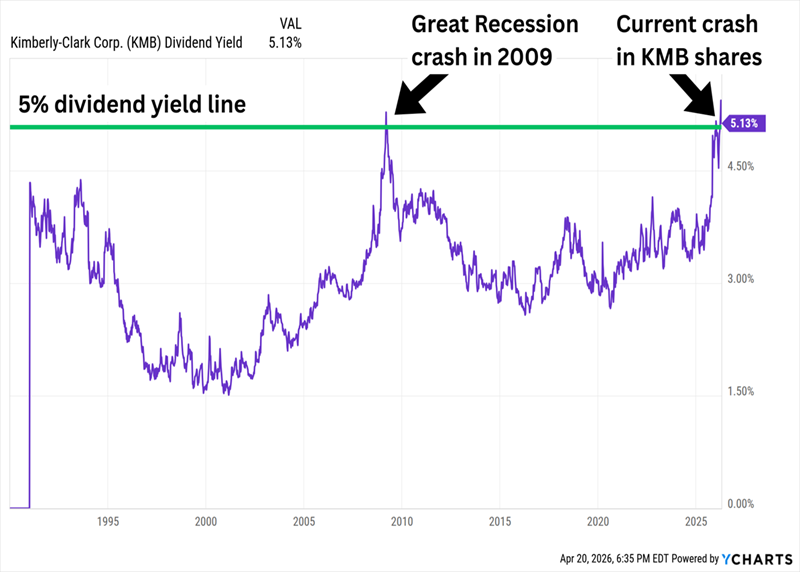
Kimberly-Clark’s stock faded across 2025, but it fully crashed out in November 2025, when the company announced a $48.7 billion cash-and-stock deal to buy out Kenvue (KVUE), the consumer health division that Johnson & Johnson (JNJ) spun off less than three years ago. The deal, which is expected to close in the second half of this year, would create the second-largest health and wellness company on the planet (and be accretive to earnings in two years). So why the drop? The deal involves paying 0.15 KMB shares per Kenvue share held, which projects out to about 290 million new shares, diluting existing Kimberly-Clark shareholders.
But the dive presents an interesting opportunity: We can buy a Dividend King (54 years of distribution growth and counting) that’s currently yielding 5% at a forward P/E of just 13 when the staples sector broadly is trading at 22 times earnings. It’s a seemingly safe payout, too, at a little less than 70% of future earnings.
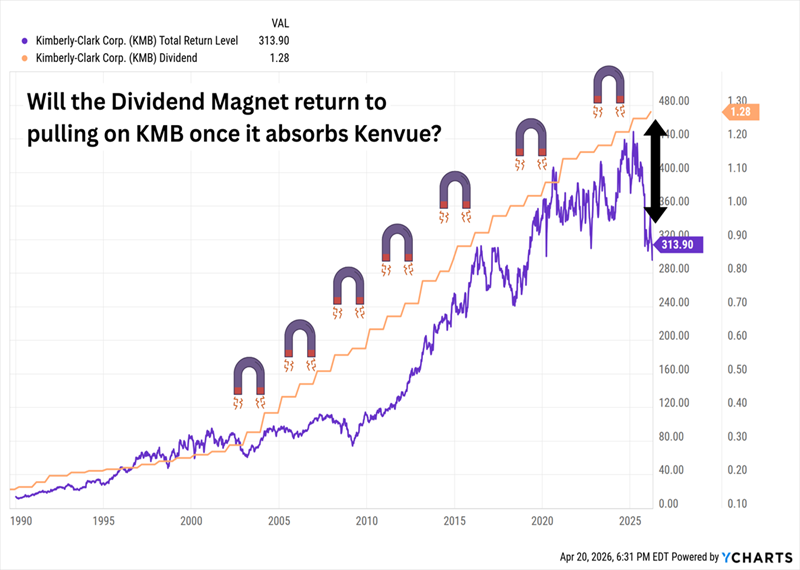
And historically, the Dividend Magnet has helped support Kimberly-Clark shares over the decades.
KMB Is Rarely This Disconnected From the Dividend
Nomad Foods (NOMD)
Dividend Yield: 7.0%
British Virgin Islands-headquartered Nomad Foods (NOMD) is Europe’s leading frozen food company, offering up frozen fish products (like fish fingers and natural fish), frozen poultry, frozen meat, ready-made meals, ice creams, and a load of other products. And it does so under about a dozen brands, including frozen-food pioneer Aunt Bessie’s, Birds Eye, Iglo, La Cocinera, Goodfella’s, Belviva and more.
Nomad’s brands are of various ages (Birds Eye has been around for more than a century), but the company itself is only a decade old. It started in 2014 as an investment vehicle, then after buying Iglo Group and Findus Group, it switched listings from the London Stock Exchange to New York, and it has continued its acquisitive streak ever since.
NOMD is a relatively young payer—in fact, I highlighted the company’s fresh dividend a couple years ago. At the time, I mentioned that in the prior couple of years, “Nomad has been hobbled by volume declines, as well as higher commodity costs digging into margins. That in turn has sent investors packing from NOMD shares.” A year later, Nomad raised that new dividend—but ran into similar input-cost inflation and other headwinds that sent shares into the ground.
Nomad’s Stock Is Lost in the Wilderness
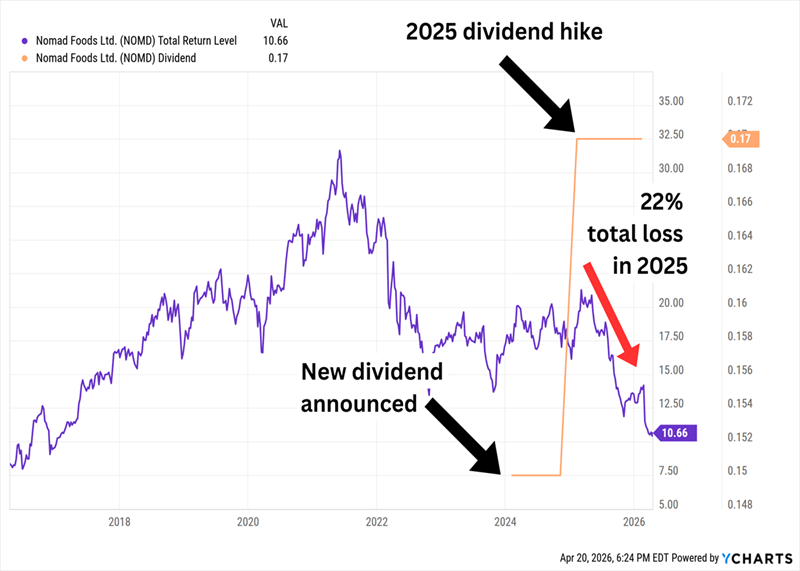
2026 very much looks like a reset year. The company has a new CEO, Dominic Brisby, and it has started an operational-efficiency program that should run through 2028. Earnings are expected to retreat by about 10% this year before snapping back to slightly above 2025 levels.
But the dividend—which accounts for just 45% of 2026’s lower profit estimates—is plenty secure and yields a thick 7% at current levels. Meanwhile, shares trade at less than 6 times analysts’ expectations for 2027 earnings.
Conagra Brands (CAG)
Dividend Yield: 9.4%
Conagra Brands (CAG) houses a variety of popular food brands, including Marie Callender’s, Banquet and Healthy Choice frozen meals; Vlasic pickles; Duncan Hines baking mixes, Slim Jim meat sticks and Reddi-wip whipped cream, among others. But it also has a foodservice business that provides a bit more diversification than most grocery-anchored staples names.
Conagra has been facing a host of issues. Like with NOMD, input costs have been an issue. But it’s also being challenged by increasing GLP-1 adoption—a factor that has me bearish on another staples play—cuts to SNAP, and as I mentioned earlier, private-label brands, which continue to take share away from packaged-food producers and put it in the hands of grocers.
Also like Nomad, Conagra is betting a new CEO can do what the last one couldn’t. The company is just a week or so removed from announcing its own C-suite shakeup, announcing that John Brase will replace outgoing Sean Connolly as CEO.
CAG is cheap, with a forward P/E just below 9. It’s also yielding an insane 9%-plus.
That’s Uncharted Territory for Conagra
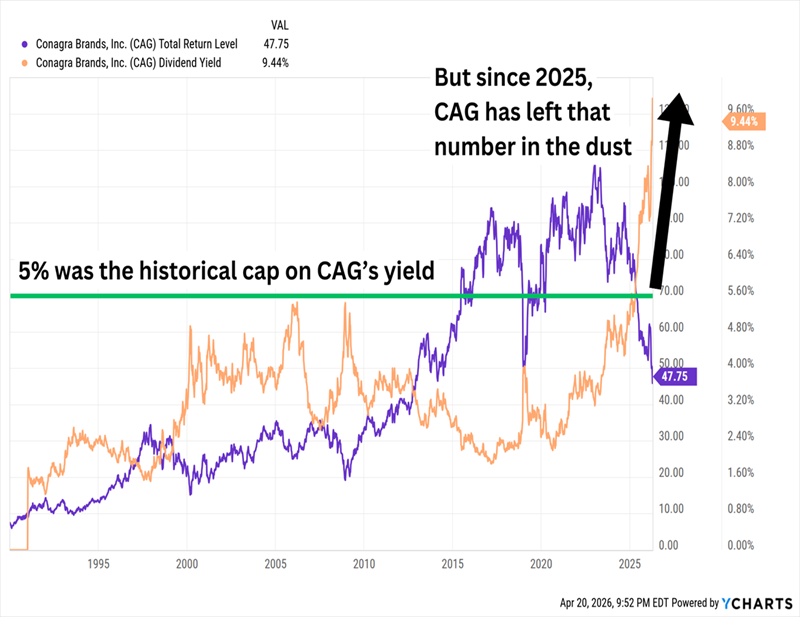
But unlike Nomad, there’s no expectation that earnings will bounce back after a downward reset this year.
The dividend is expected to account for more than 80% of those profits. That’s technically safe for now, though it affords Conagra little room to maneuver its way out of its current problems. Also, a dividend cut wouldn’t be unprecedented. CAG slashed its dividend by 34% amid several transformational moves by the company in 2006—about half a year after the company hired a new CEO.
Cal-Maine Foods (CALM)
Dividend Yield: 10.6%
Cal-Maine Foods (CALM) is the country’s largest producer and distributor of fresh shell eggs in the U.S. It’s also a prime example of how a low beta doesn’t always mean we’re dealing with a low-volatility stock.
CALM’s stock price is strongly tethered to the price of eggs. That was great news in 2024 and 2025 as the avian flu ripped through the hen population and cramped egg supply—but not so great now that those flocks are being replenished and we’ve entered a seasonally weak period for egg prices.
Cheap Eggs Have Cracked CALM Wide Open
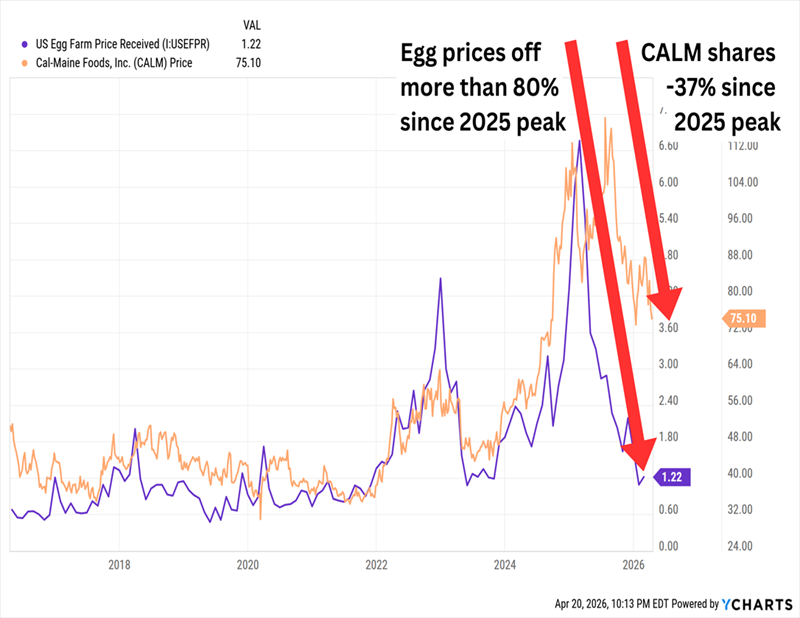
CALM is trying to diversify at least somewhat by expanding further into higher-margin specialty eggs, as well as prepared foods. The latter category’s sales quadrupled year-over-year in the latest quarter.
Still, the pros expect Cal-Maine’s earnings for fiscal 2026 (which ends in May) to have cratered by 70% this year, and they’re forecasting another 45% drop for fiscal 2027. So while it’s trading at just 9 times this year’s earnings, that balloons to a forward P/E of 21 on next year’s lousier numbers.
The good news? Dividend coverage on CALM’s nearly 11%-yielding payout isn’t in danger.
The bad news? That’s because CALM, out of sheer necessity, has a variable dividend that very closely reflects its financial success.
As Cal-Maine’s Stock Goes, So Goes the Dividend
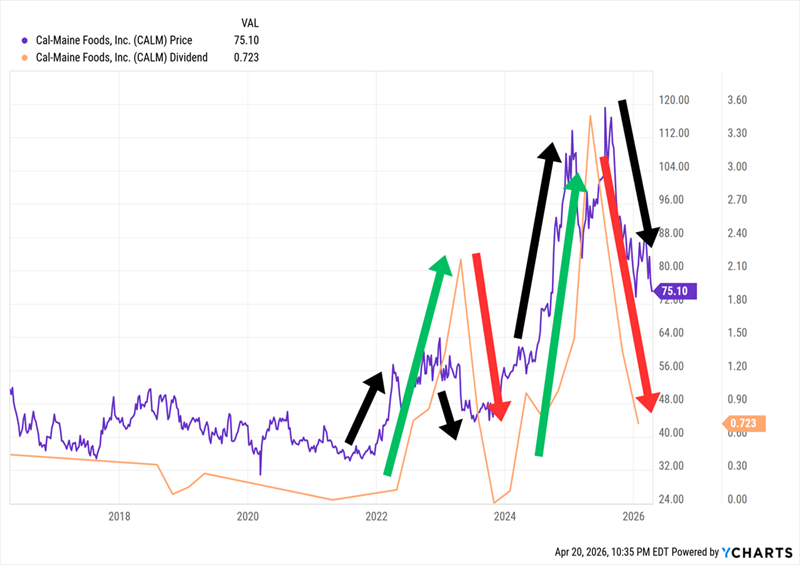
The 10.6% yield, for instance, is based on its last four payouts. But if we annualized the most recent dividend, the yield is closer to 4%.
Cal-Maine will never be a dividend solution for anyone who needs income security, but it’s a potent kicker on a stock that already treats traders to wild swings. And while egg prices have collapsed for the time being, supply issues can reignite the stock overnight.
But buyer beware: The Wall Street Journal reported just a few days ago that the Department of Justice is preparing to file an antitrust lawsuit that “would implicate major egg producers such as Cal-Maine (CALM) and Versova” in alleged coordinating to set egg prices through information sharing. The decision to file suit hasn’t been made as I write this—but if it does, it could be a significant overhang on shares.
Flowers Foods (FLO)
Dividend Yield: 11.3%
Flowers Foods (FLO) is a bakery giant whose misfortune has sent shares into the cellar, and its yield into the sky.
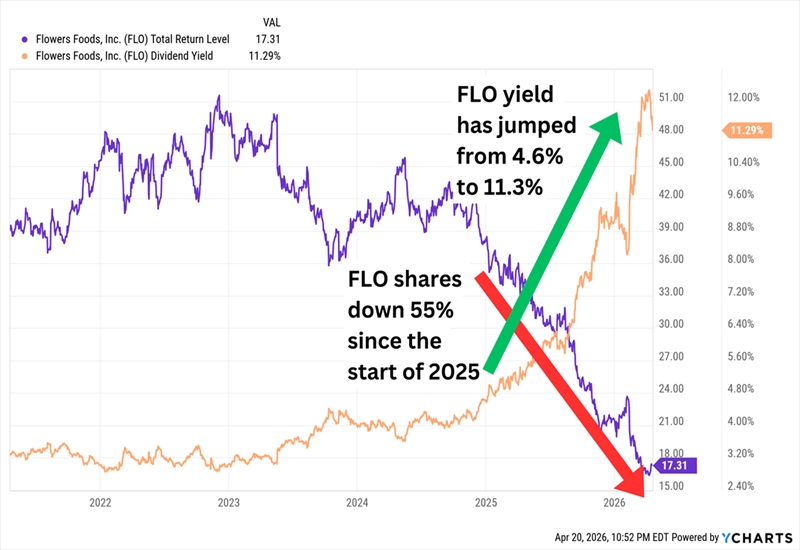
Flowers’ business is split into bread (Wonder, Sunbeam, Nature’s Own, Dave’s Killer Bread, among others) and snacks (Tastykake, Mrs. Freshley’s and more). But all of that is the “Branded” segment, which makes up about two-thirds of revenues; the remaining third is generated by an “Other” segment that includes private-label brands and other business.
Flowers is suffering from the same ailments as the other food stocks above, as well as dwindling cash and high debt of $1.3 billion. (FLO is a $1.9 billion company by market cap.) To complicate things further, Flowers is also the subject of a pending Supreme Court case, Flowers Foods v. Brock, which will determine whether last-mile drivers are exempt from the Federal Arbitration Act.
I continue to keep an eye on FLO because it has been one of the highest-yielding consumer staples stocks of the past couple years, and it remains inexpensive, at a forward P/E of around 10.
But that’s a low valuation on a company whose profits are expected to plunge by another 20%-plus this year—into territory that puts its very high dividend, and its nearly two-decade dividend-growth streak, in real danger. Flowers’ dividend annualizes out to 99 cents per share. The company covered it last year at $1.09 per share, but FLO expected to earn just 84 cents this year and next.
I think we’ll get at least a signal in late May, which is typically when Flowers announces its annual increase for the year. If it’s business as usual, that could be a strong indication from management that it can weather the storm. If not? Watch out.
2026 Is a Mess. My Favorite 11% Dividend Can Help You Clean Up.
If I’m going to take a swing on a double-digit yield, I’d prefer an investment that isn’t at risk of collapse from a weight-loss shot or healthy chickens.
My favorite home-run dividend doesn’t face any of the problems these other stocks do. In fact, it’s not even a stock—it’s a widely diversified, brilliantly built, 11%-yielding portfolio of bonds … but one that’s still set up for stock-like gains.
This fund checks off just about every income box I can think of:
- It pays a whopping 11% in annual income!
- It has increased its dividend over time!
- It doles out special dividends on the regular!
- And it pays its dividends each and every month!
On top of that, Morningstar previously named this fund’s manager a Fixed Income Manager of the Year. He’s been inducted into the Fixed Income Analysts Society Hall of Fame, too.
That’s about as good a resume as we’ll find, and his fund will pay us $1,100 for every $10K we invest.
Funds like this don’t stay quietly priced for long. Their premiums tend to rise as volatility ticks higher and as investors rotate out of growth stocks and into reliable sources of income like this. I don’t want you to miss your chance. Click here and I’ll introduce you to this incredible 11% payer and give you a free Special Report revealing its name and ticker.