
Let me take you back a little over six months, to December 2025.
Back then, things looked rough for our favorite high-yield real estate investment trusts (REITs)—and the 8%+ paying closed-end funds (CEFs) that held them.
Nonetheless, I forged ahead with the December issue of CEF Insider, which was bullish on these unloved income investments.
It was very much a contrarian take.
After all, REITs had lagged the S&P 500 in 2025, and there were reasons to think that would continue. This, in fact, had been the story since the dawn of the 2020s. In that time, REITs had faced waves of setbacks: pandemic restrictions, work-from-home, soaring interest rates, and finally the attention-sucking AI trade.
But we saw things differently: A new Fed chair was coming in. The US economy was still strong, new businesses were forming at historically high rates. Existing businesses were expanding. And then, of course, there’s the data-center buildout.
All of these things are driving higher demand for REITs’ properties. We felt this would usher in a period of growth that would exceed mainstream investors’ worries.
The crowd is finally starting to come around. Below you can see that the REIT benchmark ETF, the State Street SPDR Dow Jones REIT ETF (RWR), in purple, has soared past the S&P 500 index fund (in orange) this year:
REITs Climb a “Wall of Worry” in 2026
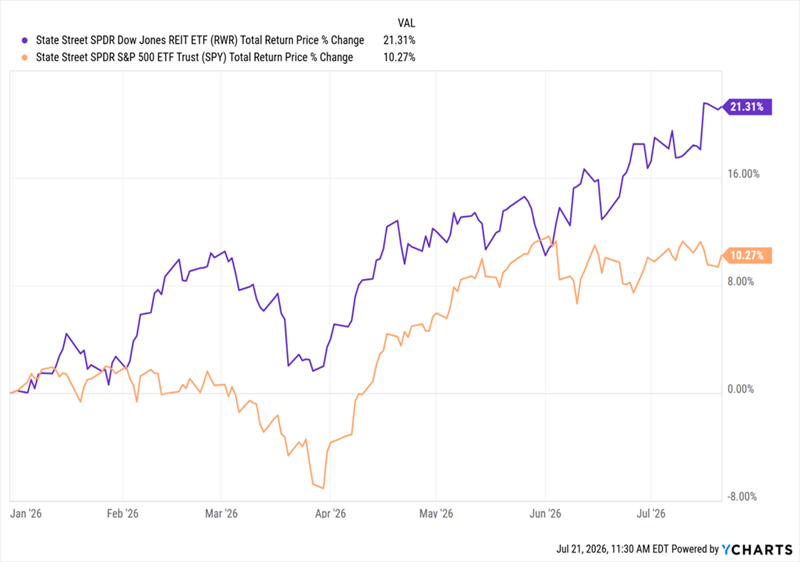
Apparently, 2026 is the right year for REITs. But why the sudden change?
When It Comes to REITs, Most Investors Are Stuck in the Past
REITs, at their core, are a fairly simple asset class to understand. They’re managed by real estate pros who pool money entrusted to them and use it to buy property.
REITs are often large in size and have teams of experts scouring for attractive opportunities across the country. As a result, REITs tend to perform well over the long term. As you can see below, RWR (again in orange) crushed stocks for years—until the pandemic and the period of high inflation and interest rates that followed.
REITs Dominated—Until COVID Crashed the Party
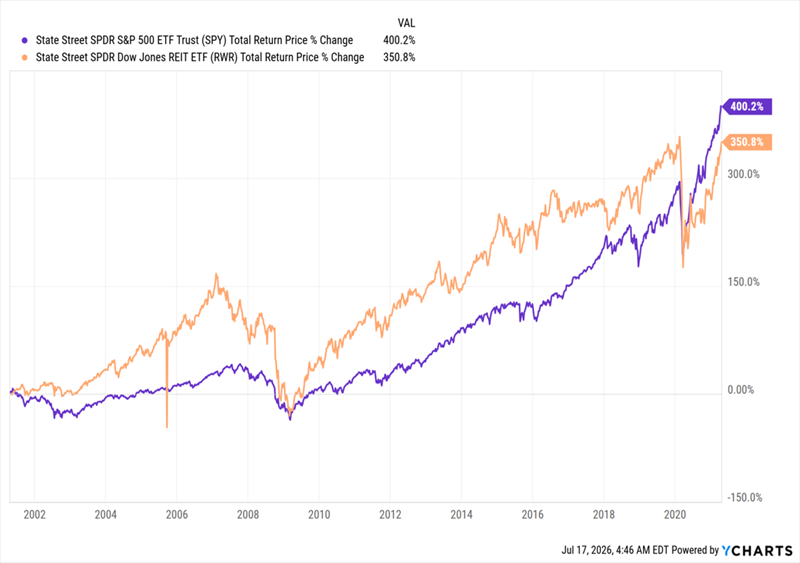
It’s important to note that this outperformance held even through the subprime-mortgage crisis. It just goes to show how durable these investments can be. And some REIT funds did even better, like the Cohen & Steers Total Return Realty Fund (RFI), a current CEF Insider holding:
RFI Outruns Stocks and REITs
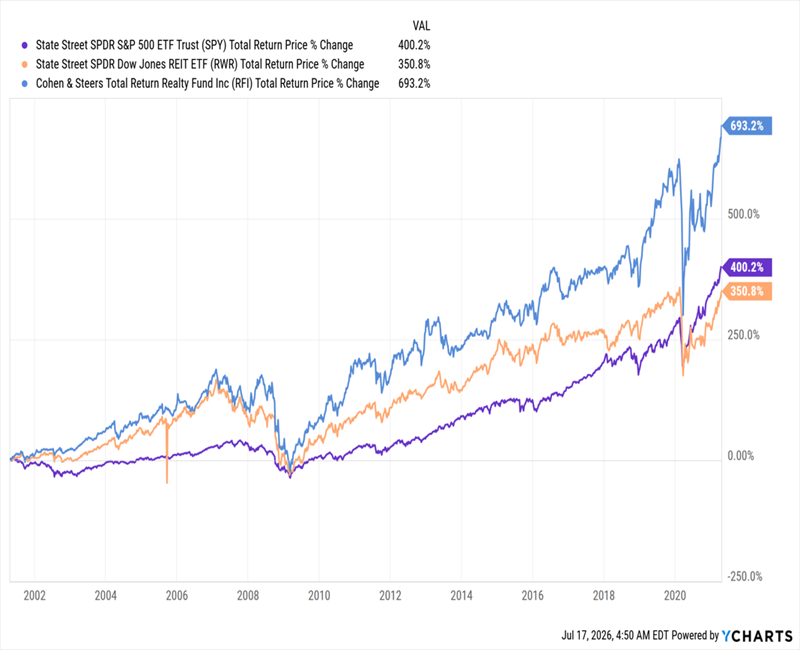
For 20 years, RFI (in blue above) far outpaced the S&P 500 (in purple) and RWR (in orange), with a 693% return that dwarfs their 375% average return. What’s more, RFI did this with a high yield it still offers today: Its current yield is 8.4%, while RWR yields 3.2% and the typical S&P 500 stock is around 1%.
And that high payout has been the picture of reliability:
A Rock-Steady Dividend
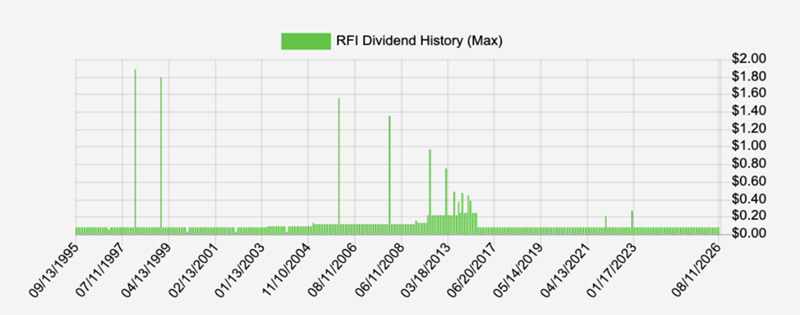
Source: Income Calendar
RFI has been around since the 1990s. In that time, its regular payouts have remained remarkably steady. And while that may seem a long time to go without payout growth (even for an 8.4% payer), RFI does things differently: It pays regular special dividends that build on that 8.4% “headline” yield (the spikes and dips above).
That’s a “win-win” for us and the fund: It gives us extra payouts every now and then, and it gives management flexibility. When REITs are unloved, RFI can hold off on the special payouts and buy bargains—setting us up for more upside and further solidifying RFI’s already reliable income stream.
RFI can afford these distributions thanks to something unique to the nature of CEFs: Because of their “closed” structure (i.e., CEFs can’t generally issue new shares to new investors), their share counts are mostly fixed. As a result, the performance of their shares on the open market can differ from the value of their underlying portfolios (their net asset values, or NAVs).
The result is a discount or a premium to NAV—a CEF’s main value indicator.
A fund’s NAV return also affects the stability of its payout, which is funded from NAV. In the case of RFI, its total NAV return (in orange below) exceeds its dividend yield in the past year, leaving the payout well-funded.
RFI’s NAV Keeps Climbing
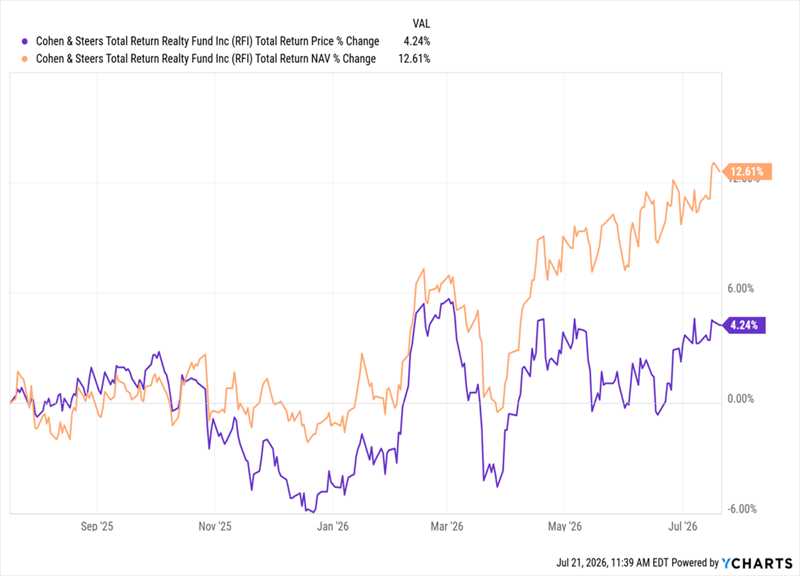
Note how RFI’s total NAV return, in orange, keeps inching higher, at 12.6% over the last 12 months. Since RFI pays an 8.4% yield, that 12.6% covers its payouts with a lot of breathing room. At the same time, RFI’s total price return has been just 4.2%.
As a result, RFI’s discount has widened and is now 4.9%. As CEFs go, that’s not huge (the average discount is 5.2%). But we need to look at the relationship of the current discount to its history: In the last decade, RFI has averaged a 0.4% premium to NAV.
RFI’s “Stealth” Sale
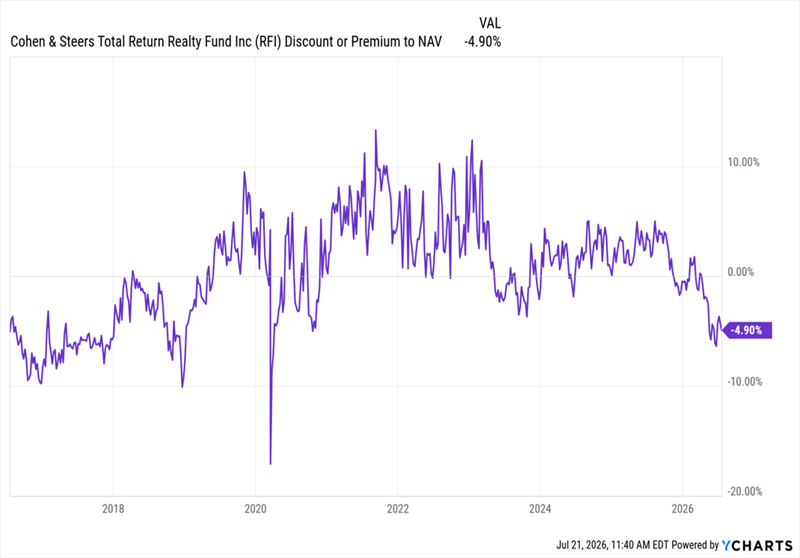
Here’s something else that stands out about that premium: It held for much of the late 2010s and into the 2020s, until rate hikes and the 2022 stock-market rout caused it to slip to a discount. That discount widened this year because RFI’s price returns couldn’t keep pace with its NAV returns.
This is the good kind of expanding discount, and it’s typically a sign that a fund is undervalued and positioned to recover as investors catch on to the fact that its portfolio is doing just fine—and bid up the shares in response.
That leaves us with a CEF we see as a great pickup for gains and diversification. The kicker is that we’re collecting an 8.4% dividend that’s proven itself over time.
4 Other Huge Dividends (9.9% on Average) The Crowd Has Left Behind
RFI is the kind of fund we love to find, with a portfolio running hot but investors still illogically shunning it.
The result? A rare discount setting us up for price gains while we collect a high, stable payout.
I’ve got 4 more CEFs for you that are in the exact same spot: They come from across the economy, holding blue-chip stocks, bonds, REITs, tech stocks and more. My latest analysis suggests 20%+ price gains are on the table in the next 12 months. That’s in addition to these funds’ 9.9% average dividends.
These are the kind of funds we can “set and forget”—happily collecting their steady double-digit income streams while we wait for their overdone discounts to close.