
I’m sure you’ve heard about the worries around private credit. They really hit the wall when Blue Owl Capital, a major private lender, put redemption limits on one of its funds earlier this year.
As investors, we must take note when such things happen. But we also need to remember that breathless media coverage of such events creates opportunities. That’s especially true in situations like this, involving a corner of the financial world many people simply don’t understand.
These are just the kind of setups we love to exploit at my CEF Insider service. And this one is handing us an opportunity in regional banks—and in particular, a closed-end fund (CEF) holding such banks, and turning their profits into a growing 6.4% dividend.
I’m talking about the John Hancock Financial Opportunities Fund (BTO), a CEF Insider holding that’s returned 14.7% since we bought it in our January 2026 issue.
We bought BTO for many reasons, including the fact that its underlying portfolio (referred to as its net asset value, or NAV) has outrun the go-to S&P 500 index fund—the State Street SPDR S&P 500 ETF Trust (SPY)—over the last three years.
BTO’s Portfolio Beats the Market …
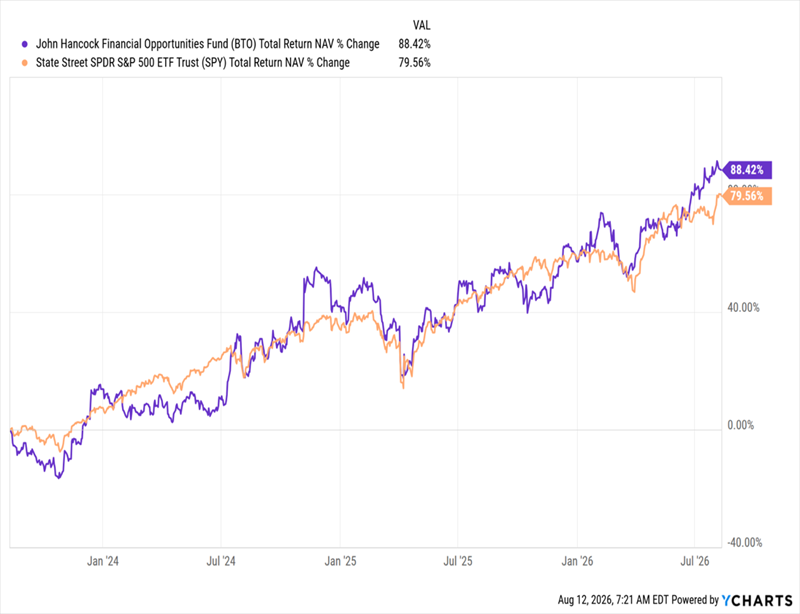
Notably, this period included the private-credit panic earlier this year, during which BTO still mostly led the S&P 500.
But here’s the thing: On a market-price basis (yes, CEFs’ portfolios can, and often do, trade independently of their price on the open market), the fund is not reflecting this fact.
… But Its Return on the Market Lags Behind …
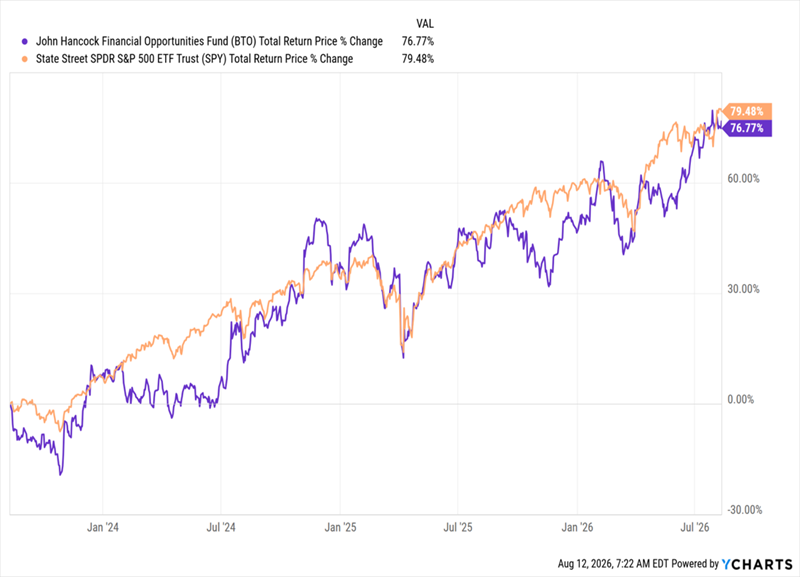
Even though its market price–based underperformance is slight, it has affected the fund’s valuation, which has slipped to a discount that’s getting wider. A discount is rare for this fund, which has carried a premium for much of the last decade.
… Dropping BTO to a Rare Discount
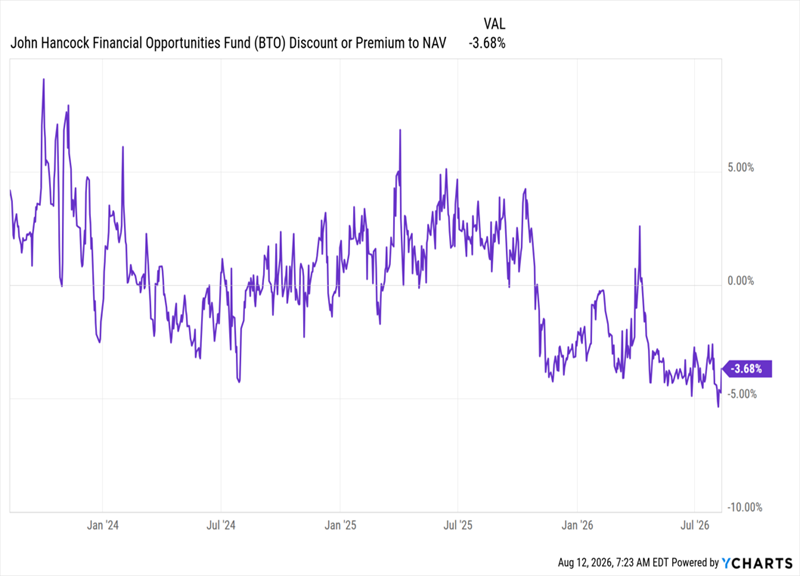
BTO (and CEFs in general) are often attractive when they trade at unusual discounts like this. But when one appears, we do need to make sure we understand why it exists, and whether it indicates a bargain or a fund that’s “cheap for a reason.”
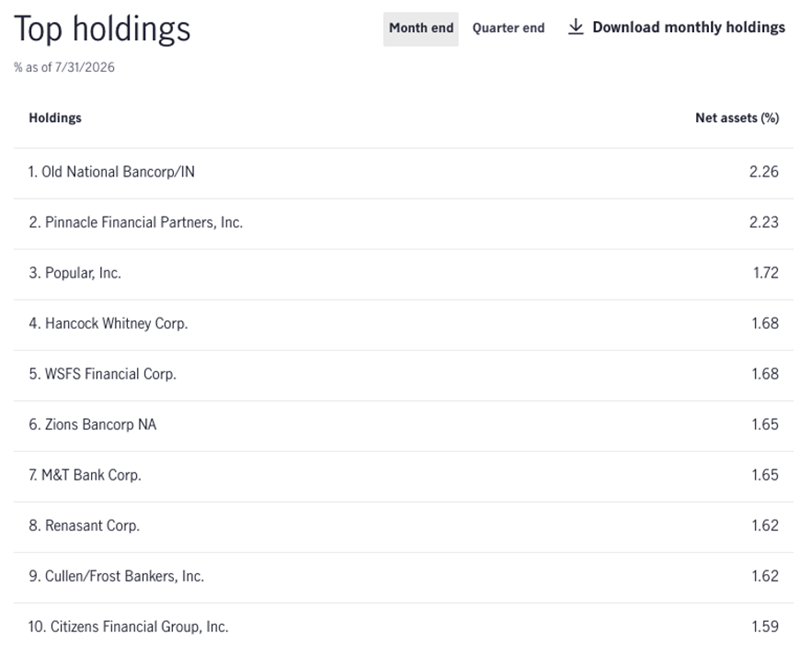
Source: John Hancock Investment Management
As you can see above, BTO’s portfolio is focused on regional banks. Top positions Old National Bancorp (ONB), Citizens Financial Group (CFG), M&T Bank (MTB) and WSFS Financial (WSFS) are smaller players with deep ties to their communities.
ONB, CFG, MTB and WSFS have also been good at capitalizing on a trend that lets them outsource their risk. BTO’s management has noticed this, and has focused on the regional banks playing this trend well.
This trend has been underway since the 1970s and has picked up over the last 30 years. It circles around the fact that, over that time, lending by banks has played a smaller part in the overall economy:
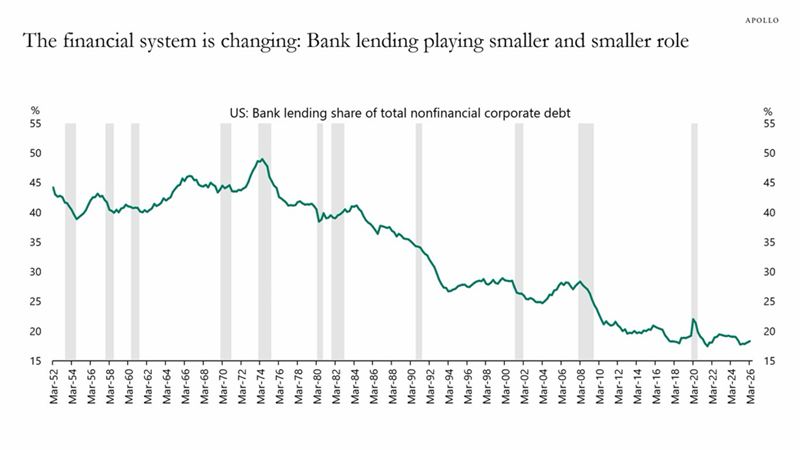
In the old days, a business owner or manager would go to their local bank and ask for a loan. While it still works this way for smaller businesses, larger firms often go a different route.
This is where two classes of other lenders come in—business development companies (BDCs) and, yes, private-credit funds. Over the years, these firms have set themselves up as “middlemen” between banks and borrowers. I want to focus on the latter sector that, yes, has been the focus of recent concerns.
Here’s the problem with a blanket concern like that, though: As is the case with all companies, some private-credit firms are indeed risky, but some are not. And the banks that lend to the ones that are less risky are likelier to outperform. And this is what many local banks have been doing.
Now, instead of spending money and time investigating every business looking for, say, a $10-million loan, these banks can lend to private creditors who will do all of that for them. Better still, these firms pay fees and interest to the banks for the privilege!
As a result, the best-run regional banks have less risk, and can lend selectively to private-credit funds that are the best at sifting out borrowers that can repay those loans.
This trend is not going away. And it’s good for regional banks, as it separates this lending risk from their other operations. This, in turn, is benefitting BTO’s investors (including us!).
Now let’s talk about BTO’s 6.4% dividend, which, yes, is lower than the 8.8% average yield across the CEF space. But we’ll happily take that when we’ve got a fund growing payouts like this:
BTO’s Dividend Soars
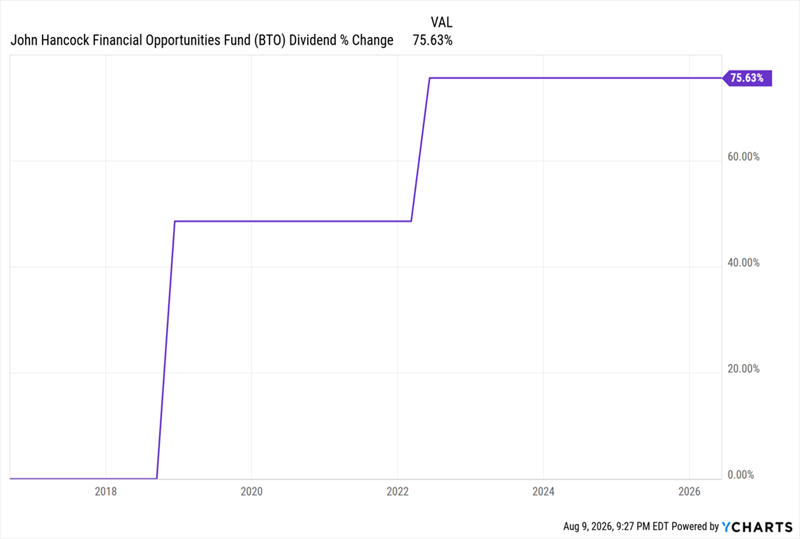
A 76% hike in payouts over a decade is rare for CEFs. And I expect more as regional banks continue to gain and BTO’s strong NAV returns easily cover its payout.
All of this has helped drive that 14.7% return CEF Insider members have seen since we bought BTO. The fund is currently over our buy-up-to price of $39, but we’re watching it closely. If it dips, we’re happy to back up the truck. And if we see its discount keep widening (especially due to a continued rise in NAV), I may raise that buy-up-to-price so we can take advantage. Stay tuned!
Get My Latest Update on BTO—Plus 5 Monthly Paying Funds Yielding 9.7%
CEF Insider members will immediately get the word if (and when) I change my buy-up-to price on BTO.
To make sure you don’t miss any updates on this terrific fund, click right here. When you do, I’ll tell you more about the service and let you in on 5 other CEFs I’ve got urgent buy calls on now. These 5 CEFs pay monthly and boast a healthy average yield of 9.7%.
All 5 are still cheap (perfect for today’s pricey market) and, because they pay monthly, you won’t have to wait long to collect your first payout.
All the details are waiting for you now. Click here and I’ll tell you more about these stout monthly payers, give you a free Special Report revealing their names and tickers and invite you to test drive CEF Insider, which gets you my latest updates on BTO and the rest of our high-yielding portfolio.