
Getting antsy about the midterms? Wondering whether oil will ever come back down? Afraid the AI bubble is going to pop, blowing a dotcom-sized hole into your retirement portfolio?
I’m not. Because I’ve found the best cure for headline risk is a fat income check—preferably one that arrives every month.
The headline risks I mentioned are really starting to eat away at investors big and small. The VIX volatility index just spiked to multimonth highs. Hedge funds have been unloading their tech holdings at the fastest rate in a decade. Even though the major indices are just a percent or two off their highs, breadth has been terrible and small caps are actually in a correction.
Not to mention, one of our favorite indicators of stock market sentiment has swung to “shaking in their boots.”
Investors Are Panicked. That’s Usually Our Cue to Buy!
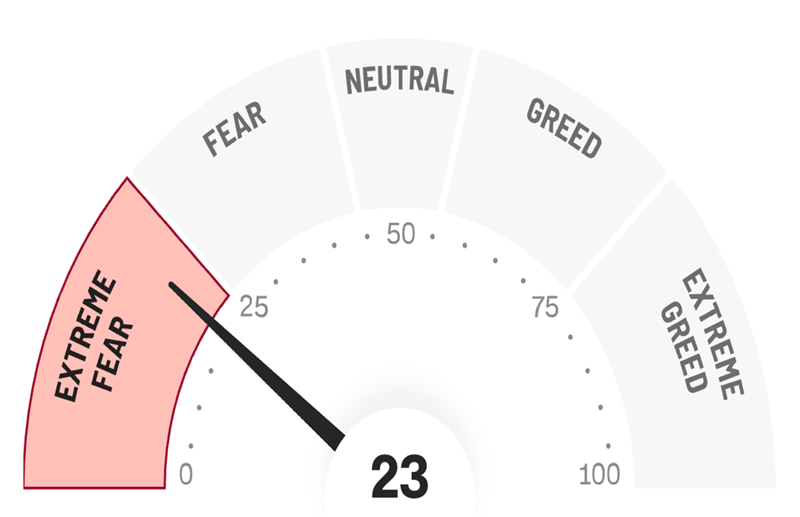
Source: CNN Fear & Greed Index
It’s easy to think “defense” in this market—uncertainty tends to put a premium on protection. However, enough stocks have sustained enough damage that we contrarians can cast a wide net for more aggressive opportunities.
And my favorite waters to trawl are in monthly dividend stocks, whose yields are often enough to provide us with a big offset against market downturns.
Have you found yourself trying to convert a portfolio of quarterly dividend payers into a smooth monthly income stream? It is doable, but there’s a pattern to the quarterly payers that we need to smooth out. They tend to dish their dividends in one of three phases.
The early birds are our January, April, July and October payers. They pay in the first month of the quarter. Then we’ve got our “middle children,” delivering in February, May, August and November. Then we have our latecomers. They pay right before the end of the quarter: March, June, September and December.
Now if we stack too many of these January payers together, for example, we might run low on cash by the time it comes to March. I know, I know. There’s a way that we can account for it by taking a certain amount of money from our brokerage account into our checking account. We could leave a buffer there. But why deal with all of this when we can just find companies that pay monthly?
Boards are finally starting to catch on to this. We have not one, not two, but three companies below that have converted from previous quarterly dividends to monthly payers. They are beginning to see things our way. All we want is that monthly check.
But we can’t buy just any monthly payer, because we want to make sure that that check’s going to be cut on time, on target, for all 12 months. I hate to say it, but there are many monthly payers with a sketchy history of dividend cuts over the last decade. Let’s look at a five-pack today, including those three newly converted monthly payers.
UDR (UDR, 5.1% dividend yield) is a multifamily real estate investment trust (REIT) that has been doing business for more than half a century and boasts an ownership position in more than 60,000 apartment homes. It’s geographically diverse, too, with net operating income split 40/35/25 across the Northeast/Mid-Atlantic, West Coast and Sunbelt, respectively.
This has been a roller-coaster of an industry, especially since COVID, but UDR has managed to deliver at least some level of dividend-growth through it … up until the only kind of dividend “cut” I like to see:
When a Quarterly Payout Turns Into a Monthly Payout
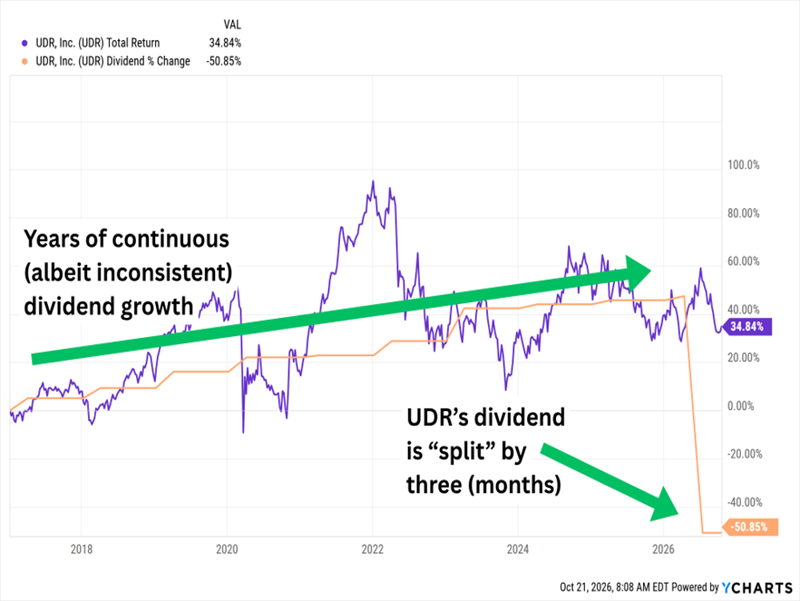
That’s right: This summer, UDR converted its vanilla quarterly distribution schedule into a monthly rate, which—thanks to the power of faster compounding—is also a minor raise in its own right.
As for the business itself? UDR has done well in navigating what has been a difficult environment for multifamily operators. In fact, that environment is the biggest near-term ceiling for this stock.
The yield, which is now back above 5%, is near historical highs. At 13 times 2027 estimates for funds from operations (FFO, an important REIT profitability metric), the discount could be a little deeper. And while higher interest rates don’t exactly help UDR’s ability to borrow, they do make apartment living look more affordable than a costly mortgage.
But the multifamily space has still been sluggish compared to its historical norms, so new money might not collect much more than UDR’s frequent dividend in the short run.
I’m also keeping my eye on another recent monthly convert—Four Corners Property Trust (FCPT, 7.0% dividend yield), a restaurant-focused retail REIT with 9.0 million square feet across 1,336 properties in 48 states. The full details are in my latest REIT missive, but it’s a solid portfolio that would look better if its so-so valuation contracted a bit more.
Yet another recent convert is a leader in its space. I’m talking about Capital Southwest Corp. (CSWC, 11.4% dividend yield), a member of another high-yield industry: business development companies (BDCs).
CSWC provides capital to smaller businesses that Wall Street banks either don’t want to do business with, or would charge them through the nose to do so. It targets firms that generate EBITDA (earnings before interest, taxes, depreciation and amortization) of between $3 million and $25 million.
BDCs mostly work in credit, and Capital Southwest is no different, with the vast majority of its deals made with floating-rate first-lien debt. Its diversified portfolio of 141 companies represents about a dozen industries, most notably healthcare, media/marketing and consumer services. And this portfolio is able to generate a current 10.4% “base” yield that it tops off with supplementals.
Those Supplementals Add Roughly 1% More to CSWC’s Yield
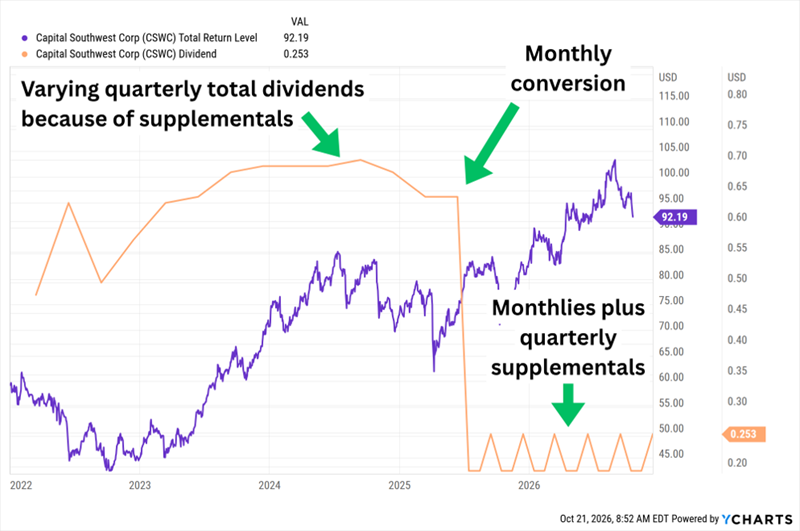
BDCs commonly offer high-single- and even double-digit yields. The problem is that it’s a brutal industry where many stocks’ yield is the only source of positive return we’ll get. Not so with CSWC, which is one of the better operators: it only uses moderate leverage and its dividend is well-covered.
The catch is that CSWC commands a high premium. It’s getting cheaper—a 40% premium has been reduced to 35% in only a week’s time—but it’s still among the pricier BDCs.
We can also get high and diversified monthly yields from the closed-end fund (CEF) space.
Nuveen Floating Rate Income Fund (JFR, 12.9% distribution rate), for instance, pays us nearly 13%, which it generates from floating-rate senior loans and (to a lesser extent) junky corporate debt.
Managers Scott Caraher and Coale Mechlin have assembled a portfolio of roughly 490 issues, split roughly 80/20 between the U.S. and the rest of the world. About 90% of its assets are rated non-investment-grade, and more than half of that is rated B or lower. Caraher and Mechlin aren’t afraid to take big swings with debt leverage, either. Total leverage is nearly 40% right now.
“Floating-rate” refers to their variable interest rates, which are tied to a benchmark but adjusted as that benchmark changes. This reduces what they distribute in falling-rate environments, but raises their income payments when rates are climbing, like they are now.
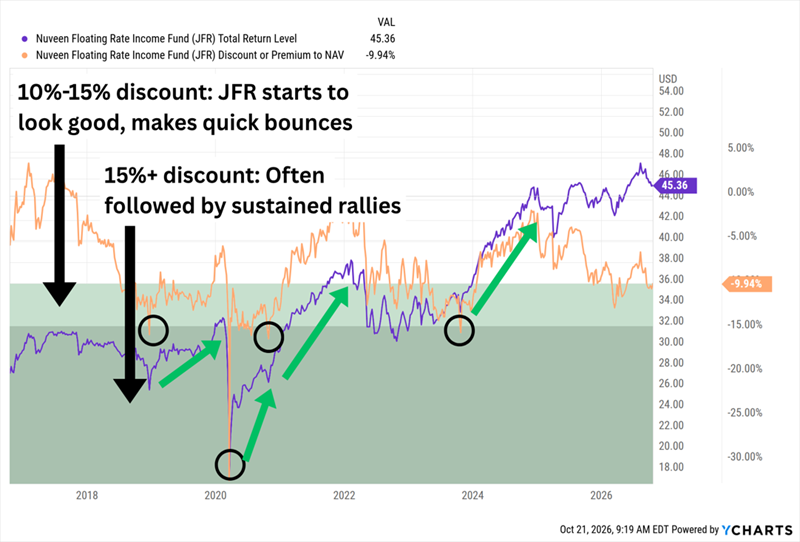
But I’m keeping a closer eye on JFR’s discount to net asset value (NAV). It currently trades at about 10% less than what its assets are, which is already deeper than its 8% five-year average. Nuveen’s fund tends to behave well under this level.
However, JFR Really Gets Going When That Discount Widens Past 15%
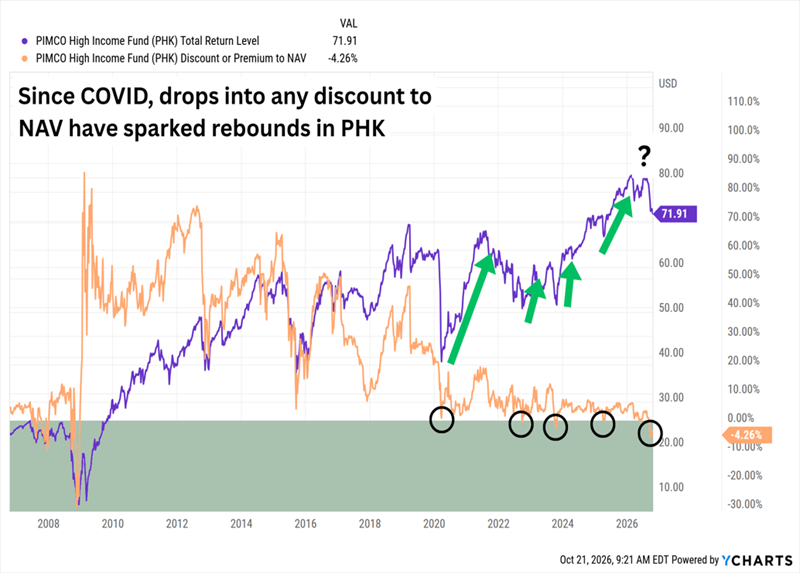
PIMCO High Income Fund (PHK, 14.2% distribution rate) pays even more on an even broader basket of debt.
Managers Alfred Murata, Mohit Mittal and Giang Bui can effectively go anywhere, and they do. They currently have double-digit allocations to high-yield credit, non-agency mortgage securities, non-USD developed-market bonds, and emerging-market bonds. They also own a little investment-grade credit, U.S. government debt and other short-duration debt.
This CEF shifts between using moderate and high levels of leverage; it’s currently near 30%, but I’ve seen as little as 15%. Still, it’s enough that PIMCO’s fund has sharp peaks and valleys.
Its pricing to NAV doesn’t jump around like it used to. But it still trades at a long-term 5% average premium to NAV, it’s still pretty sensitive to trading at a discount …
… And Right Now, PHK Trades at a 4% Discount
My 2027 Income Plan: 3 Monthly Dividends Paying Out 11% or More!
The Federal Reserve probably isn’t coming to rescue these bond funds anytime soon. So while they look good as eventual high-yield swing plays, I’m looking elsewhere for long-term wealth-building solutions.
Right now, as I look ahead to 2027, I’m laser-focused on a trio of incredible income plays that most people don’t even know about.
I call them my “Monthly Dividend Superstars.”
They’re three 11%-plus investments that fully subscribe to the idea that “boring is beautiful.”
We’re not reaching for the Pepto every time the economy hiccups.
We’re not recoiling every time Fed Chair Kevin Warsh sneezes.
We’re just sitting pretty and collecting a high and secure level of income that lets us live our lives instead of doomscrolling our days away.
How high? Consider this: A mere $600,000 nest egg—less than half of what most financial gurus insist you need to retire—put to work in these Monthly Dividend Superstars could generate a $66,000 annual income stream.
That’s $5,500 every month in regular income checks!
I’m loading up on these monthly dividend stocks ahead of 2027 as long as they remain in our “buy zone” … which they might not be for much longer! So click here to learn everything you need about these generous monthly dividend payers right now!